A to Z 2025 – Novel-writing…

I confess I am not a great fan of autobiographies that begin at the beginning and follow a temporal path up to the present day – not that the person might not have some interesting stories, facts and opinions strung on their necklace, but it just doesn’t appeal as a structure. On the other hand, in my last, extra year at school in Oxford, retaking an A-level and adding a couple more, I was allowed out of school on my recognisance and saw a fascinating Exhibition at the Modern Art Gallery. The Artist had laid out and photographed every single possession of a single person – for example, all the cutlery was laid out in one shot, all the shoes in another. This more thematic approach appeals more and although I am not arranging the objects which I have chosen to tell my story in chronological order, I hope that my writing will be sufficiently interesting to keep your interest Dear Reader, and that on the journey from A to Z, you will assemble an impression of my life and who I am…
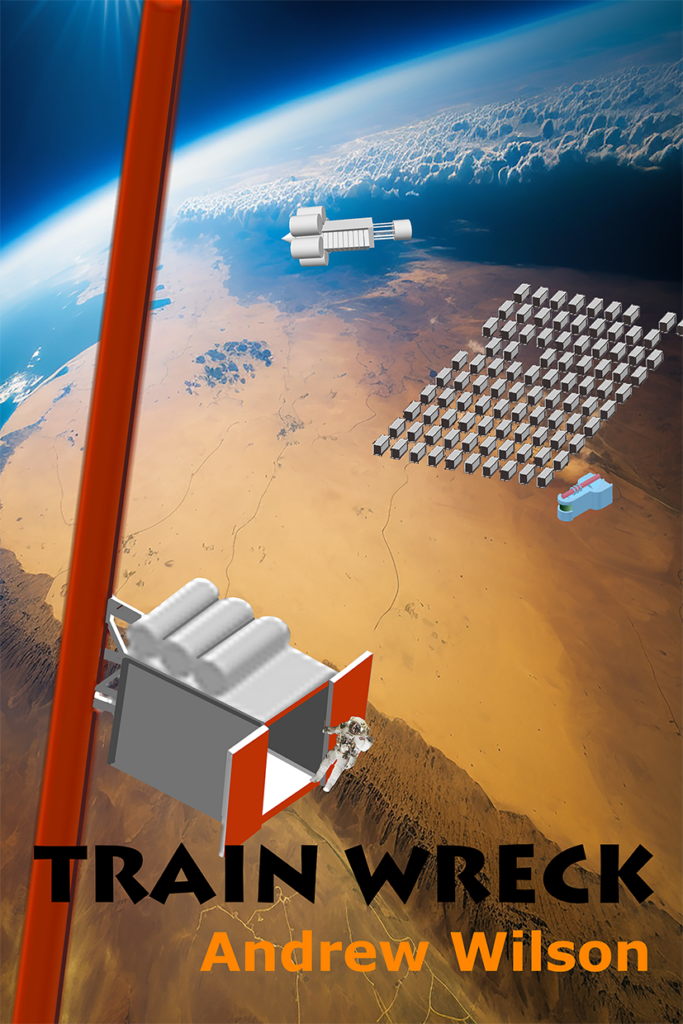
This cover used all my graphic skills- firstly I tried to get Midjourney AI to generate the whole thing but didn’t get anywhere near my visualisation but I really liked the background view of the planet and so I prompted the AI just to generate that and the astronaut. The space-elevator, spacecraft and field of containers floating in space were done in AutoCAD 3D, and everything put together in PhotoShop including the lettering.

When I was living in Ireland, my late sister Carol, invited me to go along to a writing group (yes! face-to-face!) and I realised that I had once enjoyed writing creatively but that as you rise in age, free-writing is one of the first things to go in order to make room for more academic subjects. I remembered one of the few unprompted stories I wrote outside school – it was a ghost tale in which a sorrowing father whose little daughter had accidentally walked into the big saw blade in her father’s saw mill and now, on the one year anniversary, the father, eyes blurred with tears and beside himself with grief and guilt, does the same… This short and sorry tale, though of a genre I don’t enjoy, is evidence that all my mother’s storytelling had left its mark and after the short writing challenges in the writing group, I started a novel which I still haven’t finished (although I have picked it up again recently). The novel deals with themes of post-colonialism and looks at the abuses that happen between countries as if they were intra-familial abuse and weaves several threads around it’s central characters taking in Rwanda, India and Ireland. With such weighty themes, the novel has taken a lot of research and gestation as you can imagine. On the other hand, my second novel – the opening anyway – came to me in a dream when I was recuperating from a hip replacement – I awoke and reached for my phone to record as much as possible before, as dreams are wont to do, it vanished. I started writing and it proceeded in a very linear manner – I even tired to use the A to Z 2021 (see the tab at the top of this page), to push myself to finish it. I didn’t quite make it, but it did get done in the following six months. I felt that finishing a novel (since as I have remarked before, I am not good at finishing things) would, however different a book it was from the first effort (a utopian science fiction novel), be an effort worth making and so it has proved to be. I now have a Critique Partner and he is also writing a science fiction novel though now that I have moved back to the first book, he has taken the change in good faith. Although there is a twenty-year difference in age between us, we never lack things to talk about on our two-weekly chats.

An extract from “The Book” (it has no title yet)
There is a sub-plot in the book involving a young Indian Rhodes scholar at Oxford who has finally plucked up the courage to ask a young Irish barmaid out on a date and being Oxford – it has to be punting…

As she lay back against the cushions of the punt, like Cleopatra propelled down the Nile, Margaret’s only regret was that she was compelled to face backwards. Watching Satajayit’s somewhat erratic and obviously unpracticed use of the punt pole to propel them downstream made Margaret nervous. Besides, although this branch of the Cherwell could not really bear comparison with Africa’s greatest river, nevertheless, Margaret would have preferred to watch it’s charms unfold facing forward. She did not feel she knew Satajayit well enough to face forward in silence or to lie bottom up in the sloping bow of the punt and offering possible distraction to Satajayit. So, resigned to watching the river recede from her, Margaret decided to risk a lesser distraction from his efforts by resuming conversation with Satajayit.
“You never finished telling me who Cecil Rhodes was”, she said.
“No indeed”, said Satajayit as he ducked to avoid the branch of a tree he had managed to steer beneath. Out in the open, he managed a long, powerful glide in the right direction along an open stretch of water with no other boats or obstacles to negotiate and took advantage of the respite to reply more fully. “You must have heard of De Beers Diamond Mines?” she nodded ”Well, Cecil Rhodes founded the company and made millions when he was still a young man. He went out to South Africa to join his brother in farming because he had poor health and the warm climate helped. After they were rich, he came back to England, to Oxford in fact, to complete his education.”
“They must have been delighted to have such a rich young man come here. From what I hear these colleges are always on the lookout for benefactors.”
“I am sure you are right. So too were the Freemasons because they invited him to join.”
“Really!” said Margaret, sitting up a little. “My father was a Freemason too. It’s big with the Protestants in Ireland. Bloody men’s clubs! All sticking together to scratch each other’s backs is what it’s all about!” This sudden vehemence surprised Satajayit and caused his next thrust of the pole to wobble the boat precariously.
“Ach, I’m sorry but I’ve no time for all that carry on!” she said, flopping back onto the cushions.
“No, no, you are right!” said Satajayit animatedly, “and Rhodes thought so too. Even the night he joined, with the usual secret initiation, he wrote they were an organisation ‘with ridiculous and absurd rites without an object and without an end.’ The next night, he had a brainwave – to create a secret society to further the interests of the British Empire and indeed all the Anglo-Saxon people. He wrote down his plan and called it ‘Confession of Faith’.”
“So that’s what you meant about his relationship to the mother country. Well, if you ask me, England was never any ‘mother’ to her empire – more like a thoroughly bad father. Look what they’re still doing in Northern Ireland!”
“Oh yes, I have been reading about that – most unfair on the Catholics. So, although you are Protestant, you are not in agreement with the British policy in Northern Ireland?”
“No! I am not! And the funny thing is, it wasn’t till I came to England that I started to see what was really going on. At home people don’t talk that much about Northern Ireland and ‘the troubles’. You know, when partition took place, we had a civil war that was almost worse than the war to get Britain out of Ireland. Both wars were bloody, but this was worse not because it was us against them. No, this was father against son, brother against brother. So that’s why I think we don’t want to hear about it all starting up again in the north. But then when I came here people were so ignorant about Ireland, like those eejits in the pub today but when I did get talking to the odd one, I realised there was a lot I didn’t know either and I started to take home the papers people left in the bar and to read them. It’s all a terrible mess, Ireland, it’s all ignorance and stupidity on the part of the British. Half the politicians don’t know any more than those students and they don’t care as long as the Unionists continue to vote with them!”
“It is strange to hear you use the word ‘partition’ as my country too has had partition when the British left and likewise it was divided along religious grounds. India is mainly Hindu and Pakistan is mainly Muslim, although there are a few people in each country who didn’t move at the time of partition, so there are still some troubles from time to time. Personally I don’t have any time for all that religious nonsense. India is stuffed full of religions for all the good it does. If there is a God or Gods, I am sure he wouldn’t want people squabbling the way they do!”
“Well isn’t that what the British always did with their bloody Empire? They conquer a country and exploit it as long as they can, and when they leave, they leave it all upside down like a house after a burglary with everybody fighting amongst themselves?” This was more a statement than a question – Margaret sitting bolt upright with indignation again.
“Oh, but in India they left behind great civilisation, railways, a legal system, schools and of course a parliamentary system!” Satajayit said, adding proudly “To which I for one hope to belong someday!” He beamed and completely forgot to pole, nearly running into another punt coming the other way. Only hasty action by the other punt avoided a mishap, but Margaret scarcely noticed with, as her Grandmother would have said, ‘her dander up’. “Do you so?” she said “Well I bet when you are in the know, you’ll find the British robbed the place blind before they left, I mean if they were so great for India, how come there are so many starving people there?”
“Oh my golly! You do ask some difficult questions. I have never met a woman so fierce in her opinions before. Why, you ask better questions than some of the students in the seminars I go to!”
Margaret fell back laughing but sat up again suddenly and with a serious look said, “Well, do you know, I’ve never said anything like that to anyone before! They may not talk much about the north where I come from, but I can tell you, they wouldn’t like to hear me say what I’ve been saying. Oh, Jeany Mac no!” and she burst out laughing again.
“Jeany Mac? Who is this Jeany Mac?” asked Satajayit once more poling the punt downstream and beginning to look more comfortable with the process.
“Ach, it’s only a saying we have, I don’t know where it comes from or who she was.”
“Are you perhaps one of these feminists?” Satajayit asked cautiously.
“Well I haven’t burnt my bra if that’s what you mean!” Margaret replied with mock indignation and burst out laughing at the look of embarrassed horror that overtook her companion’s features and nearly caused him to fall off the punt. ”I’m sorry,” she said, “I was only joking. I never thought of myself that way, but I suppose I do agree with a lot of what they are saying, even though I’ve only read about it in the papers, I mean I don’t actually know any. Come to that I don’t know many people at all. This is the first time I’ve been out with anyone.” She said, suddenly shy, her eyes dropping to her lap as she wondered at her candidness with this comparative stranger.
“You don’t have any family here in England?” he asked quietly.
“No. I left home under a bit of a cloud, and when I came here, I had to do something I didn’t feel very good about and I just kept myself to myself for a long time.”
Satajayit had little experience of women, and although he could not guess what she might be referring to, instinct told him it was better not to probe, so he punted on steadily, the two of them silent for a few minutes. Margaret realised she felt better for having spoken to someone about the loneliness of the last while and it occurred to her that maybe it was because Satajayit was also alone in a strange country that had liberated her.
“Tell me about your family.” She said and noticed a cloud pass momentarily across Satajayit’s normally sunny features.
“There is not much to tell.” He said diffidently. “My parents are not very well off. They are farmers, and I have an older brother who will take over the farm.”
“Really! Me too!”
“What a coincidence! It is truly a strange world. I myself won scholarships, first to school and then to the University of Bombay and finally to here, to Oxford University.” He beamed.
“Your family must be very proud of you so!”
“You would think so, wouldn’t you?” Deflating visibly Satajayit suddenly headed the punt alongside a stretch of open bank and pushed the pole firmly into the mud to hold them fast and sat down facing Margaret. The sudden seriousness made Margaret sit up and draw her legs in to face Satajayit eye to eye.
“You must understand, my father is a very old-fashioned man. He believes everyone has their place and they should stick to it. He thinks I have no business getting ideas above my station and that no good will come of it!”
That sounds only too familiar, thought Margaret but said nothing – just looked sympathetic.
“It is most fortunate that I do have an older brother who wants to farm, otherwise I would have had no choice about going to school. I would have had to stay on the farm to look after my parents when they got old.”
“And do you have any other brothers and sisters?”
“No. That is quite unusual you know, for an Indian family. It makes my mother sad and maybe a bit ashamed. I think perhaps she is proud of me, but she would not contradict my father. It is only because the other people in the village were so pleased for me that my father allowed me to go away to the school in town, and that is where I met Mr Horatio Singh!” Satajayit said, his serious face breaking into a smile of happy reminiscence.
The serious moment seemingly passed, Margaret burst out laughing at the strange combination of names.
“What is so funny, please?” said Satajayit with a frown.
“Horatio! It just seems a strange name for an Indian man!”
“Ah well, you see Mr Singh’s parents were very keen on history and wanting to give their son a truly auspicious start in life, they named him for the great Englishman Horatio Nelson!”
“I see. And what did he do, this Horatio Singh?”
“He was my school teacher, and because it was not a boarding school, but I lived too far away, I used to live in Mr Singh’s house. He was like a second father to me and I can say with the utmost certainty that without Mr Singh, I would not be here today”, and he looked around as if to take in the full reality of the exact spot in which they had come to rest.
The effect of this look was so comical that it was all Margaret could do to keep a straight face, but not wishing to offer any further offense she managed.
“Yes indeed, he it was who set me on the path to learning and gave me encouragement, he is truly my mentor.”
By now, it was late in the afternoon and the light was starting to fade. Satajayit punted them slowly back to the boat station. For the first time since they had met that day, they fell silent, but companionably so.
Margaret felt relaxed and lay back contemplating this gauche but passionate thinker who was propelling her along like the Queen of Sheba whilst Satajayit glowed inwardly at having negotiated the novel experience of dating a member of the opposite sex without any mishaps. They made their way up the High Street again both knowing that sooner or later they would have to go their separate ways, though neither voicing the question of where that might be or what might follow on from this first encounter. Satajayit lived in Rhodes House whilst Margaret lived out along the Cowley Road and so was walking in the opposite direction to home. Half way up the High Street, Satajayit wordlessly took Margaret’s hand. They turned together to look in some of the shop windows, both noticing the novel reflection of their conjoined forms more than the contents of the shop display and yet without comment, savouring their silent companionship. Finally, they reached Carfax, the crossroads at the top of High Street, and Margaret turned to face Satajayit, reached up to plant a firm kiss on his cheek. “I’ll be seeing you at the Turf then”, she said, and with a squeeze of his hand, she turned and walked back the way they had come.

© Andrew Wilson, 2025
A Parka For Your Soul

“Make of it a parka

For your soul.”

Alice Walker, from Before you knew you owned it

I kept seeing the kid in the parka at random times and in random places about the city but it was only when I went on a trip out of town and there was the kid standing on the train station platform opposite where I was awaiting my train home. I say a kid, but in truth I never really saw his face – lost in the halo of the fur around the hood. Was it even a he or a kid and not an old man – I just had an impression from the general build and demeanour. It was that time at the station that I knew the manifestation was mine alone – a spirit guide, if you will.
There was a comfort then, in the vision, it salved my soul which let’s face it, in these end times needed salving…

© Andrew Wilson, 2024

Over at dVerse Poets Pub, msjadeli in Prosery invites us to respond to the line from Alice Walker (at top) in 144 words…

Signature Dishes – a Lyric Essay

A signature dish usually has a story
Rooting its cook in the time and place
Where it was acquired and from whom…

Palaver Sauce was my first glorious excursion into cooking in a different way, and I brought it out at dinner parties for many years and told its story. The American professor of West African studies who taught my fellow student and I to stew the things which convention would say ought not to go together, red meat and white, and salt fish…

Goat—funkier than lamb, nearer to mutton
Chicken – chopped in chunks still on the bone
Salt Dried Cod – ancient African currency that once bought slaves
Spinach sauce rich with garlic and chilli
Turmeric, my own addition.

Palaver is the Portuguese word for quarrel but there is no argument once cooking’s worked its magic.

My old boss Tony, took me for a meal in Manchester, in a church converted to a hotel and restaurant with a swimming pool in the Lady Chapel and Venison Marinated in Strawberry and Stilton on the menu.
Tony gave me my first job as a cook—I will not honour it with the title chef.
Ratatouille
Chilli con Carne
Six Quiches, various
and six buckets of salad each morning
developed my skills and gave me staples so that years later when I opened my own restaurant, Frewin’s, The Carroll Hotel long gone, I sentimentally made that Venison dish my own signature, menu centrepiece…

Small things can make a signature dish
I nestle walnuts into Apple Crumble topping
For who thinks of roasting walnuts
Yet how delicious is this tiny touch
Browned at the crown but protected from burning
A rival to its cousin Pecan Pie.

But crumble never overtook Bread and Butter Pudding at Frewin’s – I made a rod for my own back with that one, so often was it ordered, but at least it could be made at a moment’s notice – the ingredients always to hand…

Buttered Brioche bread
Cream
Milk
Eggs
Veins of sugar and raisins interleaved

Ramekins into the microwave until the mix began to rise and then into the oven to swell and brown – the look on diners faces when the souffle impersonating dessert arrived hot foot…

Christmas Dinner for the whole family, though a favourite feast, is my least favourite meal to cook – all logistics and creativity giving way to tradition. Yet special meals are not always for the many, once, I spent a quiet Christmas with just my sister, Carol, in a town in Roscommon where a halal meat packing plant had populated the place with Pakistanis and the supermarket shelves with foodstuffs I could have found back home in “Bradistan*”.
I decided to treat Carol to a “desi**” breakfast such as we had both enjoyed in Bradford. Such fun making wholemeal, spinach pooris, flicking the wrist to spin the disks discs like frisbees, into the deep fat fryer – watching them inflate like little green footballs then eating the curry and lime pickle with pooris and fingers, not forks and spoons.

Also at Carol’s command
I recreated a Victorian favourite
Sussex Pond
Suet Raisin pastry
Crudely thrown together
Roughly rolled out
To line a plastic bowl
A chopped-up lemon
And equal weights of
Butter and muscovado
The filling in and
Pastry top crimped down –
Four minutes in the microwave
Is all it took and
When the pudding –
Turned out on a plate
Was cut into – out poured the
Pond water, rich and brown
Its sweetness offset by
The chunks of lemon.
This too graced my restaurant
Tables for special guests
With suitable appetites for
Suet pudding – I promised
To deliver in just twelve minutes
Start to finish and
I never lost my race…

Food is life, and love, and comfort
and is it any wonder that
it generates stories
rooted in people, places
traditions and relationships
flavours and feasts remembered…

© Andrew Wilson, 2024

* So many Pakistanis came to work in the mills of Bradford, that it was sometimes referred to as Bradistan.

** from the Sanskrit word “Desh” meaning “country”. The word “Desi” refers to something “from the country” and so for Pakistanis in Bradford, it means things from the old country – desi food, desi calendars, and desi dress.

Over at dVerse Poets Pub, in Poetics: Satiating the Soul, Punam invites us to celebrate any or all of the things that go to make up the Hindu festival of Diwali – cleaning the house, preparing food, and celebrating the festival of Light with friends, family and everyone else…

I have been intrigued for some time, by the idea of the lyric essay and have bought books by Claudia Rankine and Kathleen Graber as examples, but the form is as slippery as a fish and impossible to pin down. Writers.com begin a very good attempt at definition by saying “Lyrical essays explore the elements of poetry and creative nonfiction in complex and experimental ways, combining the subject matter of autobiography with poetry’s figurative devices and musicality of language.” This is my first serious attempt at the form…

The Witches of Washington…

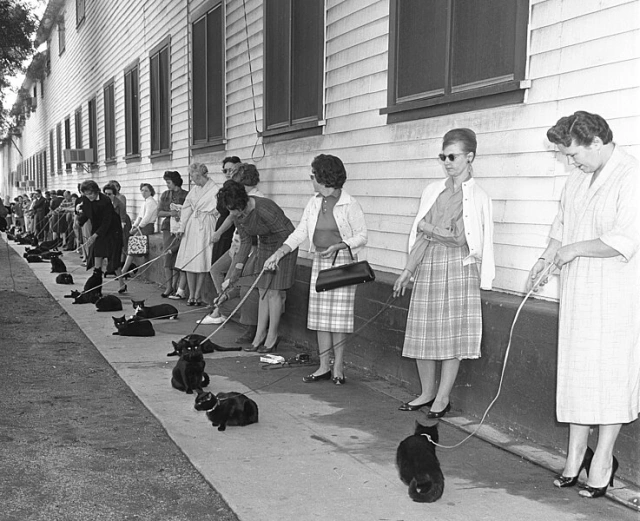
The image above is from the Los Angeles Times Photographic Collection.

The greatest feat of the Washington Witches Coven was to remain in plain sight as this rare photograph from the 1960’s reveals. Gathered together outside the premises of their leader, a veterinarian by trade, the members of the coven are each accompanied by their witches’ familiars – black cats each and every one of them. In any other age, such an unprecedented number of black cats in one place would undoubtedly have rung alarm bells and resulted in a witch-hunt, but this group of fashionably dressed (for middle-aged women) were merely perceived as slaves to the growing trend of pets as fashionable accessories and their predilection for felines of a noir colouring, merely a fashionable affectation.

Under the election and presidentship of renowned misogynist Donald Trump, the words “witch-hunt” found renewed currency, though not, ironically, in connection with actual witches! By now a little more discreet in their public gatherings, the Washington Coven played their part in fighting the menace of arse-trumpeting but just as all right minded people had been staggered by the election of the great, orange baby, so too, the matrons and even the younger members of the coven had found themselves wrong-footed and at a loss as to how best to combat the orange menace. The audacity of Trump madness fuelling false news such as baby-eating, paedophile rings operating behind Pizza restaurant fronts, beggared belief! By the time the coven were getting their ducks in a row, lining up the most potent spells to use on His Orangeness, he failed to be re-elected and a huge celebration ensued under full moon in the Washington Woods and much debate was had about the extent to which the power of the coven’s spells had contributed to the orange downfall.

But Trump is back, once again riling up his base with the same tired tropes about “draining the Washington swamp” – if only he knew the real powers ranged against him… Go! Black Cats!

This was written for Melissa’s Fandango Flash Fiction #FFFC

Six Degrees of Separation – Wifedom…

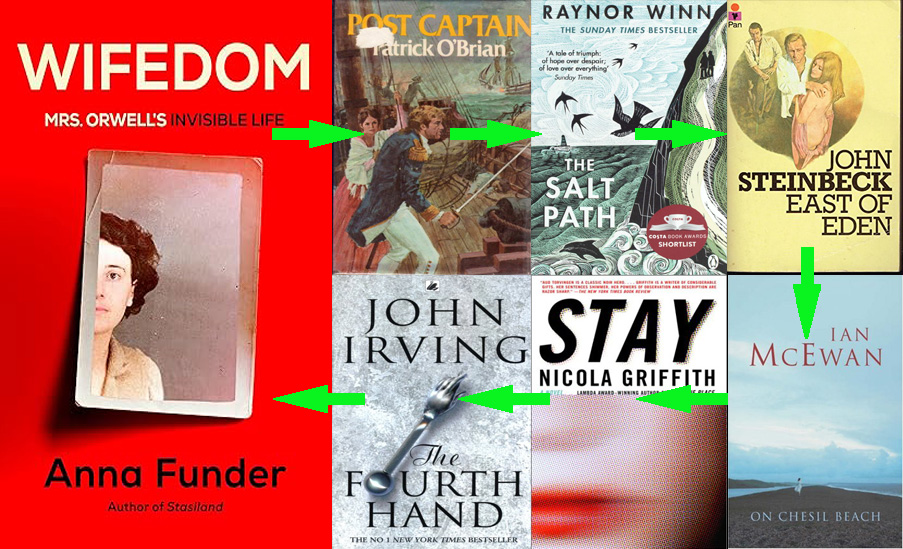
Six Degrees of Separation is an excuse to peruse six favourite books linked to an initial offering by our host KateW and eventually link them back to the beginning. Kate W offers us big themes in her choices and since I have been participating, these have included – being adrift in Time, Friendship, Memory, and Romance. This month we have the biographical Wifedom and the theme for me will be that of wives albeit mainly fictional examples – also, three of the books have been adapted for screen…

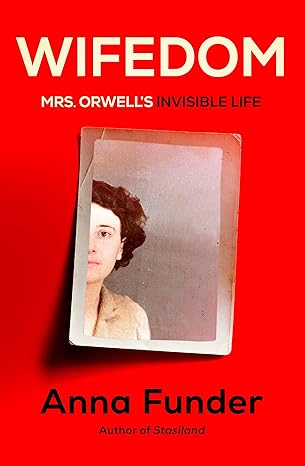
I have not read Wifedom (as is usually the case with Kate W’s suggestions) but I would like to after reading what Amazon has to say about the book. – At the end of summer 2017, Anna Funder found herself at a moment of peak overload. Family obligations and household responsibilities were crushing her soul and taking her away from her writing deadlines. She needed help, and George Orwell came to her rescue.

“I’ve always loved Orwell,” Funder writes, “his self-deprecating humour, his laser vision about how power works, and who it works on.” So after rereading and savoring books Orwell had written, she devoured six major biographies tracing his life and work. But then she read about his forgotten wife, and it was a revelation.

Eileen O’Shaughnessy married Orwell in 1936. O’Shaughnessy was a writer herself, and her literary brilliance not only shaped Orwell’s work, but her practical common sense saved his life. But why and how, Funder wondered, was she written out of their story? Using newly discovered letters from Eileen to her best friend, Funder re-creates the Orwells’ marriage, through the Spanish Civil War and the Second World War in London. As she peeks behind the curtain of Orwell’s private life she is led to question what it takes to be a writer—and what it is to be a wife.

A breathtakingly intimate view of one of the most important literary marriages of the twentieth century, Wifedom speaks to our present moment as much as it illuminates the past. Genre-bending and utterly original, it is an ode to the unsung work of women everywhere.

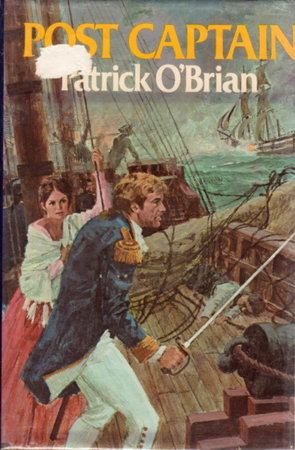
The Aubrey–Maturin series of novels by Patrick O’Brian have been compared to the works of Jane Austen – exhaustively researched plots drawn from the annals of the British Royal Navy and transplanted into Patrick O’Brian’s fictional Master and Commander series, these books are as equally character-driven as they are portrayals of the events of life in the navy during the years of the Napoleonic wars and I urge anyone who fears such books to be too technical or militaristic, to try them. No better example – beyond the two main protagonists Aubrey and Maturin, than the portrait of the eventual wife of Captain Aubrey – Sophie. The life of any sailor’s wife would be hard and full of fear of her husband never returning, long periods of absence, varying financial fortune and many other forms of uncertainty, but in Sophie we have a wife of heroic qualities to match the vicissitudes heaped upon her – a wife who takes charge of Aubrey’s home life every bit as much as he is captain of his ship at sea! The rather battered cover below depicts Sophie’s first appearance in the series of books alongside her future husband…

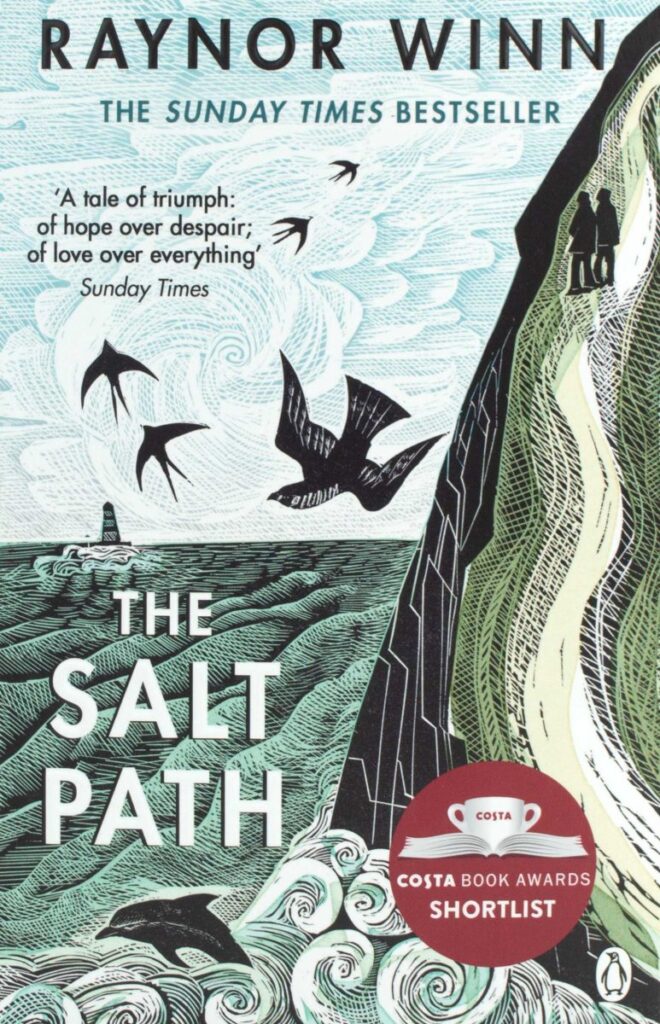
Another wife heaped with vicissitudes along with her husband, is Raynor Winn in her autobiographical account of how she and her husband, having lost their house and business due to a treacherous friend and having simultaneous with their homelessness, receive a diagnosis of her husband’s terminal illness. They decide that with nowhere else to go and nothing to be done, they will spend the summer walking the coastal path from Somerset to Dorset around Devon and Cornwall. No spoilers but their endurance trial brings unexpected rewards and Raynors’s support of her husband is exemplary… Below is the very beautiful cover designed by Angela Harding.

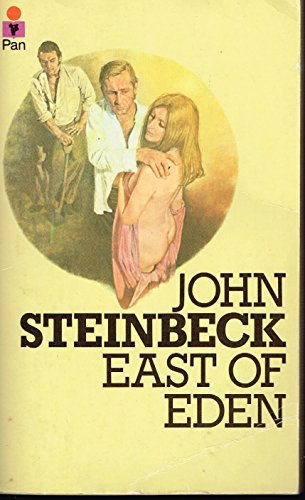
If the three wives portrayed so far have been long-suffering, among other things, Cathy in East of Eden, by John Steinbeck, is the one dishing out the suffering, beginning by running away after burning her parents to death – she is a character of pure evil – described as having a “malformed soul”. Steinbeck regarded East of Eden as his magnum opus even though other books are more famous, Cannery Row (previously covered by me), The Grapes of Wrath and that much studied in school – Of Mice and Men. Despite being made into an iconic film featuring James Dean, I venture to suggest that not so many people have read the epic family saga East of Eden. Indeed the film only deals with part of the story and I wonder if Steinbeck would be disappointed that his magnum opus is not the one that time has accorded that accolade to.

The title East of Eden comes from the fourth chapter of Genesis, verses one through sixteen, which recounts the story of Cain and Abel and the whole book – accused by some of being “moralistic” certainly deals with big themes – good and evil, brotherly rivalry, love and depravity and as always with Steinbeck we are treated to a portrait of the life and times in the Salinas Valley, California. There is a saying about writing that “big themes are dead weights” and whilst this is undoubtedly a weighty novel, it is still a great read from a master, even if not his master work…
The cover below makes as sensational a view as it can of the central drama of two brothers torn apart by the inexplicably evil Cathy.

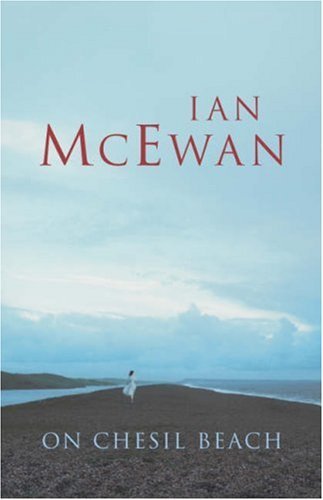
Another painful marriage is depicted in On Chesil Beach by Ian McEwan – an author not renowned for being the most cheerful in his writings, the unfolding of this depiction of a virginal couple on honeymoon in an as yet sexually unliberated 1962, is excruciating in the extreme and yet, such is the quality of the writing – you cannot look away… on Chesil Beach has been turned into a film.

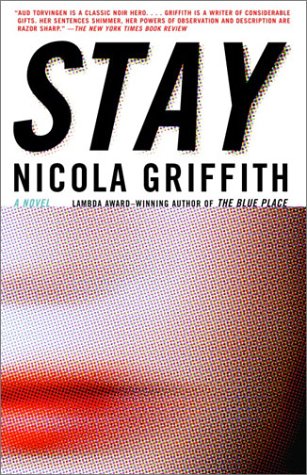
Many of the writers I have covered in my 6 Degrees are writers I read long ago but Nicola Griffiths is a new favourite whose canon I am working through in order, from Ammonite (Lesbian science fiction) to her current amazing historical novels featuring Hild, a powerful woman from Britain’s pre-medieval history. Between these wildly divergent books linked only by their themes of strong women and excellent writing, comes the Aud Torvingen series of which Stay is the second book. Aud is not exactly your typical P.I. as she is a woman of independent wealth but in each of the three books she conducts investigations, willingly or unwillingly and (spoiler alert) – she also falls in love in book one and in book two has to deal with the loss and the grief over her lover. Although Aud does not find the happiness of marriage until book three, Stay is a portrait of a wife thwarted and her response by throwing herself into “a series of physical, moral, and emotional challenges that she has been dodging for weeks, months, and yearsnone of her choices are easy.” What more can we ask from a book…

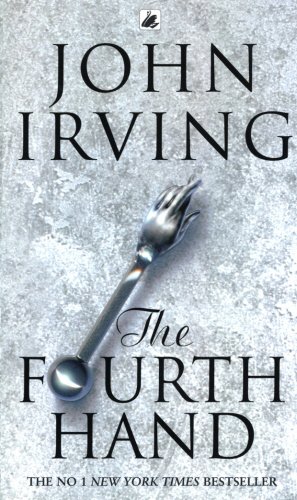
My last link, slightly tenuously back to Wifedom, is The Fourth Hand by John Irving. It is a tale of a wife who is so dedicated to her husband that – well here is what the Penguin blurb says:- While reporting a story from India, a New York television journalist has his left hand eaten by a lion; millions of TV viewers witness the accident. In Boston, a renowned hand surgeon awaits the opportunity to perform the nation’s first hand transplant. A married woman in Wisconsin wants to give the one-handed reporter her husband’s left hand, that is, after her husband dies. But the husband is alive, relatively young, and healthy…
The widow supplies permission for the transplant but then demands visitation rights with the hand – a typical thought experiment of a plot from the masterful John Irving. This is the first of John Irving’s books that I have included in 6 Degeees but once discovered, I devoured his early books such as The World According to Garp and several of his books have been turned into films. I recommend some of his later books too, such as Till I Find You about tattoos and tattoo artists. Irving has repeated elements that crop up in many of his books – bears, hotels, wrestling but however far-fetched some of the things Irving writes about may seem to be, they make you think about life in a clever and enjoyable way – no wonder he occupies half a bookshelf of mine!
The link back to Wifedom – the extraordinary connection between and support/dedication of a wife…

Time Shelter

I try to ration myself for prompts, perturbed by the idea that I will be swallowed in an endless cycle of call and response, but one that I will not miss each month, is 6 Degrees of Separation. Starting from a given title, each reader of books – no matter when they read them, summons six links to form a chain that finally links from and back to the beginning book.

I confess I do not make enough time for reading books, words bound between covers on paper as opposed to screens, though I always have one novel and at least one non-fiction on the go – however slow. I confess that the Poets Pub is often the guilty party in keeping me from the books though I do not blame or object because beautiful, moving or informative as books are, the pleasure of company and connection are better still.

I’m afraid my To Be Read list rarely coincides with the 6 Degrees prompt and only sometimes am I moved to purchase the recommendation, but recently I fell hook line and sinker for Time Shelter. The book is a metaphorical creation of memory clinics where sufferers from certain kinds of memory loss may steep themselves – full-immersion – in a room recreating an era from their past and get the backroads to their lost memories cleared of debris. A few weeks or months in which a loved one comes to life again is worth so much to relatives grieving the loss of someone who is still alive…

Dear Readers – I bought the book! I have no regrets and I recommend it even to poets – no! especially to poets so they may dive into a novel length metaphorical fiction that explores memory and loss, health and sickness and if that sounds depressing, I assure you that Time Shelter, by Georgi Gospodinov is most entertainingly told – and now your turn to confess – when is the last time you read a fiction by a Bulgarian?

This Prose Poem was written for Laura Bloomsbury‘s prompt for  National Buy a Book day over at dVerse Poets Pub

© Andrew Wilson, 2023

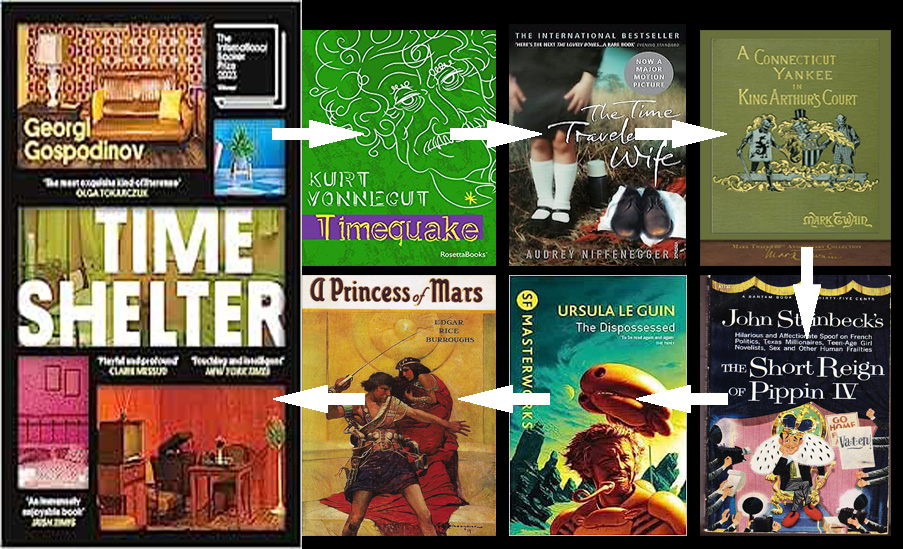
6 degrees of Separation – Time Shelter

This is a post in the 6 Degrees of Separation run by Kate W. over at books are my favourite and best in which she gives the starting point of a particular book and invites you to take a journey through 6 other books of your choice, all connecting in some way and perhaps ending up back at the beginning – why not have a go yourself? Challenges are to writing, what scales and arpeggios are to those learning musical instruments, they exercise the faculties, but unlike scales, this challenge is most enjoyable, teasing out as it does, the connections, at a thinking level, between books…

In Time Shelter a 2020 novel by Bulgarian author Georgi Gospodinov, Gaustine, a psychiatrist, creates a clinic for people with Alzheimer’s disease in Zürich which works by immersing patients into rooms containing articles from past decades and stimulating their memories of that period. The narrator is tasked with collecting the artefacts with which the rooms are stocked and travels throughout Europe to complete his mission. But soon the clinic is attracting healthy people who also want to escape a mundane present reality and return, nostalgically to other decades.

This rang a massive bell with me because some thirty-five years ago, I came into contact with a charity called Age Exchange in London, propelled by Pam Schweitzer MBE who pursued funds with the indomitable spirit that is ideal for such a role. They did exactly what the fictional clinic did – trained reminiscence workers to assist suitable dementia patients in recovering memories from the past using a library of artefacts gathered by the charity in Blackheath. The Exchange part of the charity’s name arose because they gathered reminiscences on various themes such as “Can we afford the Doctor?” and turned them into plays (that one was about Britain before the National Health Service) and performed them in schools thus recycling memories through the generations!

Time Shelter is a satire on nostalgia, populism, irony and melancholy and though I had not read it, I have ordered a copy…

Timequake is a 1997 novel by Kurt Vonnegut Junior (yes – him again!) in which he makes the world relive a decade of their lives with no possibility of change – a study of determinism in which he asserts that people have no free will. As so often with Vonnegut, he weaves personal and family history into the tale with the wry humour which is his hallmark. I think I read this book so long ago that it was back when I still used libraries to source my reading material…

The Time Traveller’s Wife by Audrey Niffenegger (such a Wagnerian-sounding name!) is a book that I had read before watching the film adaptation and although it was a faithful adaptation of it, I still prefer to imagine a story as told in its original form. This book takes further the idea of not being able to be in control of one’s destiny. The eponymous wife is powerless to know when or for how long her husband will disappear into the past or future including her own any more than her husband who is at the mercy of a genetic mutation that plucks him in and out of his timeline at random, each know things about the other’s past and future at different times, often uncomfortably so. This book is a thought experiment, a “what if” but like much speculative fiction, it ultimately reveals more about how we as human beings are than how we might be in the unlikely event that time travel is possible…

A Connecticut Yankeee at the Court of King Arthur by Mark Twain is a satire about monarchy and feudalism. We meet another hapless time-traveller – a Yankee engineer called Hank Morgan who awakes after a bump on the head, to discover that he is in the past at the court of King Arthur. He decides to use his skill to improve the world with his modern knowledge so the book also celebrates Hank’s homespun ingenuity and his sense of the rightness of democracy. Although he ultimately fails (darn that determinism), the book marked a move by Twain from portraying the America of the Gilded Age, to more progressive values.

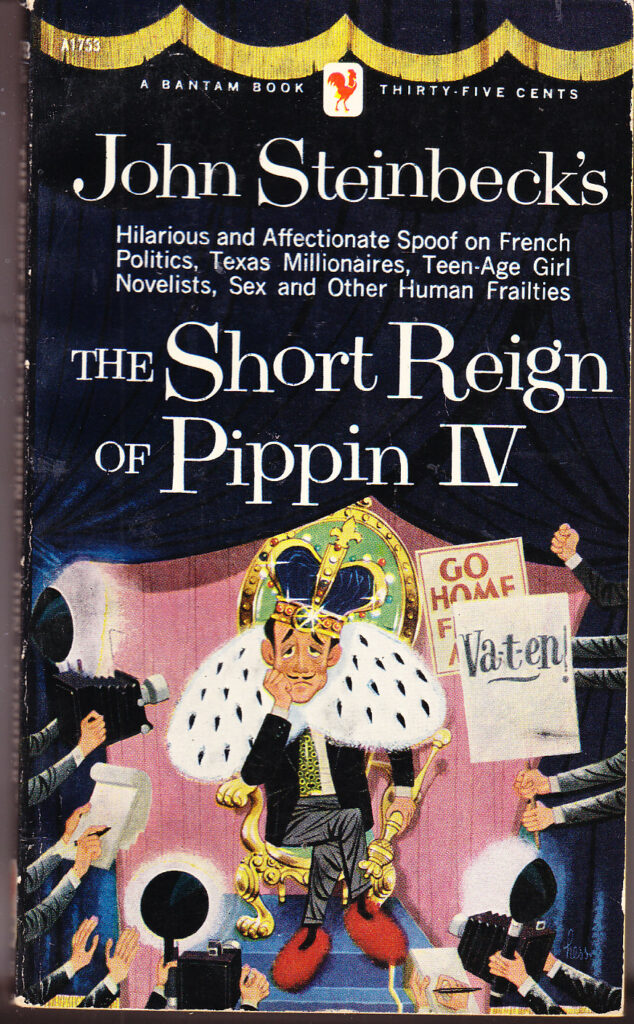
If Hank’s time travel left him in the service of King Arthur, then our next hapless hero is forced to become a king having descended, albeit distantly, from Charlemagne. The Short Reign of Pippin IV by John Steinbeck sits on my bookshelf in a very battered state having belonged first to my father as a young man – it was published when I was just two years old. In a kind of false flag operation by the French communist party, Pippin Héristal, an amateur astronomer is proclaimed King of France (in order that the French people may have something to rebel against – which they eventually do!). Like Hank Morgan, Pippin Héristal tries to make the best of what has been thrust upon him by doing what he thinks might make a difference but fate is already against both of them…

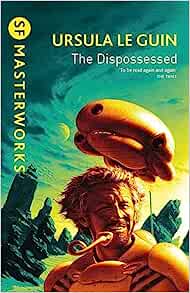
In the next link, another man is tested, this time by two different and opposing societies – in The Dispossessed by Ursula Le Guin, the world of Urras is a capitalist society divided into two competing superpowers  – so much like our own world. The habitable, but resource-poor moon of Urras, is Annares and 200 years before, the rebellious factions of Urras have been sent or volunteered to go there where they have formed a society based on anarcho-syndicalism. Given the lack of resources and the inefficiency of the societal model, Annares is not exactly a thriving place to live. The leading character is Shevek, who Le Gin identified as being based on  J. Robert Oppenheimer – often referred to as “the father of the atomic bomb” and who regarded his involvement in the Manhattan Project as that of a physicist and on seeing the first test of the Trinity bomb, said he thought to himself “Now I am become Death, the destroyer of worlds.”. Of the subsequent use of nuclear bombs on Hiroshima and Nagasaki, he told President Truman he felt he had “blood on my hands”, which did not go down well. In The Dispossessed. Shevek has a similar quandary when he tries to develop a General Temporal Theory and is blocked by a jealous superior and frustrated by his obligation to contribute manual work to society. He decides to go to Annares where he is welcomed because the capitalists see in his work, the opportunity to develop a spacecraft that will make crossing to the stars possible. But while capitalism thrives on his work, Shevek becomes involved with a new revolutionary underclass… Once again, Ursula Le Guin gives the lie to the writing maxim that “big issues are dead weights” – you just need to be a brilliant writer to incorporate them into the right story!

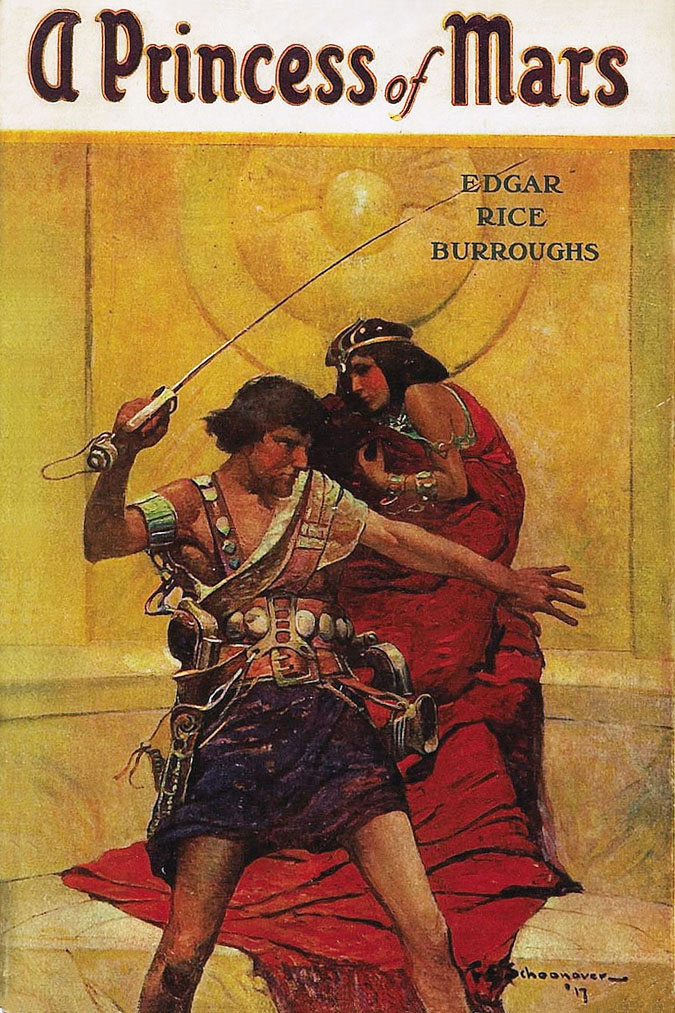
After such erudite stuff, the last book of my six may seem a little frivolous in style, but it contains all the elements we have seen on this journey, a man thrust out of his own time and/or place, into a different world in which he must try to do his best to survive, thrive and even contribute what he knows to the betterment of the society he finds himself in. A Princess of Mars (Barsoom) – is a genre-busting novel by Edgar Rice Burroughs, he of Tarzan fame, and in his Barsoom series, he gives us – planetary-romance, fantasy, sword and planet, and post-apocalyptic speculative fiction from before those terms were even minted! This is not a science fiction book that depends on technology such as spacecraft since the hero – John Carter – transitions to Mars without explanation when in a tight spot on Earth and later returns, again without any control on his part. Edgar Rice Burroughs’ works are full of violent action and derring-do, but the breadth and depth of his imagination made him a huge influence on many later writers – Robert A. Heinlein, Arthur C. Clarke, and Ray Bradbury, H. P. Lovecraft, James Cameron, and George Lucas to name a few.

Finally, what links A Princess of Mars back to Time Shelter, is nostalgia – just as the “healthy” people in Time Shelter, are drawn to use the retro rooms of the clinic because they are fed up with their contemporary lives, so A Princess of Mars harks back to a rose-tinted view of American past – the frontier life when the good were good, you knew who was bad, and men were men and women swooned –” “the good old days”…?

Spies

What is a spy if not a cursed liar
Who for love puts hand in fiercest fire
But not the love given to a sweet woman
The love of country is inhuman.

We watched a French, great tragedy conclude
Where agents of The Bureau were deluded
Believing they could steer their star-crossed fate
Clinging to the happy ending till too late.

For once your life is built on falsehood complex
The web you weave the fates will always vex
And you must pay for secrets stolen, finally
No matter how handlers and bosses rally

The cause of saving hapless agents’ lives
Is hard on lovers, colleagues, friends and wives
All pawns in what is known as the Great Game
The spy is destined for a life without fame

And if their life of infamy be revealed
Be sure the fates no happiness will deal.

© Andrew Wilson, 2023

This poem was written in response to a challenge from Posted by Björn Rudberg (brudberg) in Poetry Forms on dVerse – The Poet’s Pub, to write a Heroic Sonnet in iambic pentameter – you can read about it here.

My partner and I have been binge-watching a five-series drama made by the French company Canal called The Bureau. Since the French are famed for their interest in love, this drama, whilst being a cracking, edge-of-your-seat tale of the life of spies, also examines the philosophical implications for the loves of those who make their living by living a lie – can they find happiness? Since the poem might be spoiler enough, I will say no more…

This is the first time I have attempted a Sonnet in Iambic Pentameter – something I vaguely remember being taught in school but had to resort to Wikpedia for the finer points, including all the exceptions to the rules which make lines memorable – I hope I have done it justice. I guess that we many of us have this poetry form flowing through our veins with so many great poets and playwrights having embraced the form.

U is for Utopias…

  If you have been following this blog’s A2Z Challenge then you will know that I have been trying to finish a novel, “Train Wreck”, and publishing a chapter below each post – at least until day 15 when I ran out of completed chapters – there is another one in progress – but if you have been following the novel and would like to receive the balance of the chapters – let me know in a comment. Meanwhile, Utopia is a central theme in the book…


I looked at how the desire for someone to be living a Utopian existence, led us to project the idea onto Scandinavian countries under my entry for S, and how we have eventually discovered that they have feet of clay like the rest of us. But what exactly is a Utopia and must we always be doomed to disappointment?

The word Utopia was coined by Sir Thomas More for his 1516 book of that name  describing a fictional island society in the south Atlantic Ocean off the coast of South America. The term has come to be used as a synonym for “deluded”, “impossible” or “far-fetched” and it has a counter term Dystopia. The very SciFi picture at the top, comes from a blog piece that argues for the additional idea of a False Utopia – one which initially appears Utopian but hides a dark secret. An example of this would be HG Wells’ “The Time Machine” where the happy, beautiful people living their utopian life above ground, are in fact fodder for the Morlocks who live underground.

The Wikipedia article on Utopias suggests that whilst mainly a literary endeavour, thought experiments if you will, Utopias can be the subject of real-world experiments too but quotes Lyman Tower Sargent who argues that “the nature of a utopia is inherently contradictory because societies are not homogeneous and have desires which conflict and therefore cannot simultaneously be satisfied”. In other words, to offer equality to all people – a fundamental aim of the Utopian dream – you cannot offer the same thing to all people because they are different.  Lyman Tower Sargent further states “There are socialist, capitalist, monarchical, democratic, anarchist, ecological, feminist, patriarchal, egalitarian, hierarchical, racist, left-wing, right-wing, reformist, free love, nuclear family, extended family, gay, lesbian and many more utopias…”

We tell stories, I believe, as a fundamental aspect of our human nature – a consequence of our big brains. For if we can deduce “Those are lion tracks, they were made three days ago and there was a cub too, so a lone female, with a limp – so wounded…) then we can also put together a story which is completely made up, because both the deduction and the fiction require the use of our big-brain imagination. So in telling Utopian stories, we are trying to imagine a better way to live, one which will reconcile the flaws in human nature and the contradictions those flaws create in the real world.

Are we wrong to keep trying to visualise Utopias? Of course not, our human nature might remain essentially the same but our superficial circumstances change all the time and we must constantly re-envision utopian possibilities…

“Train Wreck” is just another Utopian experiment imagined and described and then traversed to uncover its inevitable flaws and contradictions – but I hope, that in the tradition of HG Wells, my SciFi tale is a good enough story to be worth the reading…

“And now I was to see the most weird and horrible scene
of all that I had beheld in that future age.”

crop from File:The Time Machine by H. G. Wells (Famous Fantastic Mysteries, August 1950).pdf


VE Day – Reflections on my Mother’s War…


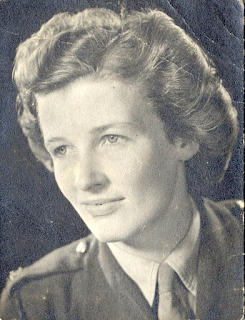
Born in 1920, my mother was 19 when she joined the army for World War 2. Yet she had already had two phases in her life, growing up as one of six with a gamekeeper father who was bitter about lost opportunities following the First World War. His brother had emigrated to America before the war but couldn’t take my grandfather with him because he was under 16 and the family was put out at losing one potential bread-winner, let alone two. The brother said my Grandfather should enlist and that he would send money so that my Grandfather could join him after the war – which he did send the money, but the family spent it and my Grandfather had to become a gamekeeper instead of a teacher – his first choice, since with so many men killed and women having to support their parents, teaching became reserved for young women. This made my Grandfather bitter and he wouldn’t allow his children to do homework and advance themselves – instead, saying that they would go into domestic service at 14 – and that is what happened. It is sad that whatever social mobility and reduction in entitlement was brought about by WW 1, passed my Grandfather by in his disillusionment. Meanwhile, his brother in America put his upbringing on a farm to a different use, becoming a teacher at an agricultural college and marrying a Southern belle and setting his family on an upwardly mobile trajectory.

So before the Second World War, my mother had had five years of domestic service, first as a maid and then after being taken at 16, to Morocco (or maybe Tunisia, she wasn’t sure) to assist in looking after a baby during a family holiday, she became a children’s nanny. My Mother had many stories about her time in domestic service but they are not for “the day that’s in it” VE Day – suffice to say that domestic service was hard to leave and the war offered the one way which could not be frowned upon and so she joined up.

My mother quite quickly rose to be a Sergeant in the signaling corps, which for women, meant manning telephone switchboards and after working at a number of bases, she went to live and work on the island of Portland near Weymouth, where, in vast underground bunkers, the invasion was being planned. Living on Portland was as near to the front line as most women got, the island was a target for bombers and even fighters, given its strategic role and its nearness to German-occupied France. My mother told tales of having to grab her landladies children and dive for cover when a German fighter strafed the back gardens of their street and how a German bomber crashed in the High Street. The last time I took my mother to Weymouth before she died, on a beautiful sunny day with the beach thronged with holidaymakers, she pointed out a hotel where a German bomber, fleeing home after unsuccessfully reaching its mission target, loosed its bombs killing an entire wedding party that had just arrived at the station for the wedding feast. I grew up seeing my mother in tears on Remembrance Sunday, thinking of the six men, any one of whom she might have married, as well as all the others who never returned from other front lines, yet the poignancy of all that loss, and the realization of just how recent the war was, only a few years before I was born, was never stronger for me than on that sunny day in Weymouth.

There were other stories from my mother’s war, the bullying Sergeants that she took on, the girls she had to protect from untoward attention, and the spy that she prevented from stealing secrets and who was caught and shot a few weeks later. Latterly, my mother decided not to repeat these stories about the war anymore. In the run-up to VE Day, I have heard other veterans say the opposite, they had never talked about it until recently but now felt that “it doesn’t matter anymore” and so have told their tales. Everybody had their own way of dealing with their memories in the aftermath of this traumatic but highly stimulating time. I often thought that our generation, the baby-boomers, had nothing remotely to compare with the traumas of that war – until now, when once again, literally the whole world has been turned upside down. Yet still, it is nothing like WW 2, unless you are on the front-line in a hospital, for most of us, this momentous time is about “staying at home”. 

It would be immoral to envy my parent’s generation for their experience of the war and yet the choices were clear for them, to literally fight a great evil – the warlike references to fighting the Covid 19 virus are a mere shadow of such events – yet the choices we face are far more complex – too complex for many people, including many of the politicians who are supposed to steer our ships. Many people just want it all to be over and things to get back to the “old” normal. I hope, in a positive way, that there is no return to rampant consumerism, unchecked, unconsidered planet-destroying growth. I hope it is the death of capitalism as we have known it – and I am very afraid that there is the possibility of the opposite happening – of those on the right using the crisis to entrench their power and mismanagement ever more firmly. So let us today, remember the sacrifices made in that other war, and the joy of it’s ending but let us not forget the long road to recovery that followed, not always fairly, and not shy away from the difficult choices that face us in our testing times.