“Choose any subject you would like to write about…” that is the object of the A to Z Challenge, and thinking of things that interest me is not a problem for me, but choosing a subject not only to write about, but to write in a way that other people will catch my interest – that is the real challenge! This year I turn to a subject, close to our skin if not our hearts, and yet, again, I wonder if this subject will get some people past the title on the list – dismissed as niche? For this year, my theme is What We Wear – Fabrics and Fibres
Okay, I know this is a bit of a cheat because Weaving should be at the end of the A to Z, but it will be impossible to discuss many of the forthcoming fabrics without a basic understanding of weaving – so the trickery and too, the length, but you can always refer back to it as you encounter references to weaving later in this A to Z…
We are used to the idea of the “Fossil Record” as a means of understanding the history of the Earth’s geological past and the evolution of life through and in response to that past, but in truth, there are many gaps in the fossil record because it is very difficult to become a fossil and very easy to rot away without a trace. And so it is with fabrics, fibres and even the tools that were used to make them. For example, the stones that were used tension the warp of the earliest looms may have survived whilst the wood and cord of the looms on which they were used, have long since vanished. Impressions of fibres and cords can be found “fossilised” in pottery yet the circumstances which might preserve a piece of fabric are as rare as those needed to record the form of a jellyfish and other animals lacking hard parts, and so the early history of our relationship with, and use of, fabrics and fibres, is patchy to say the least.
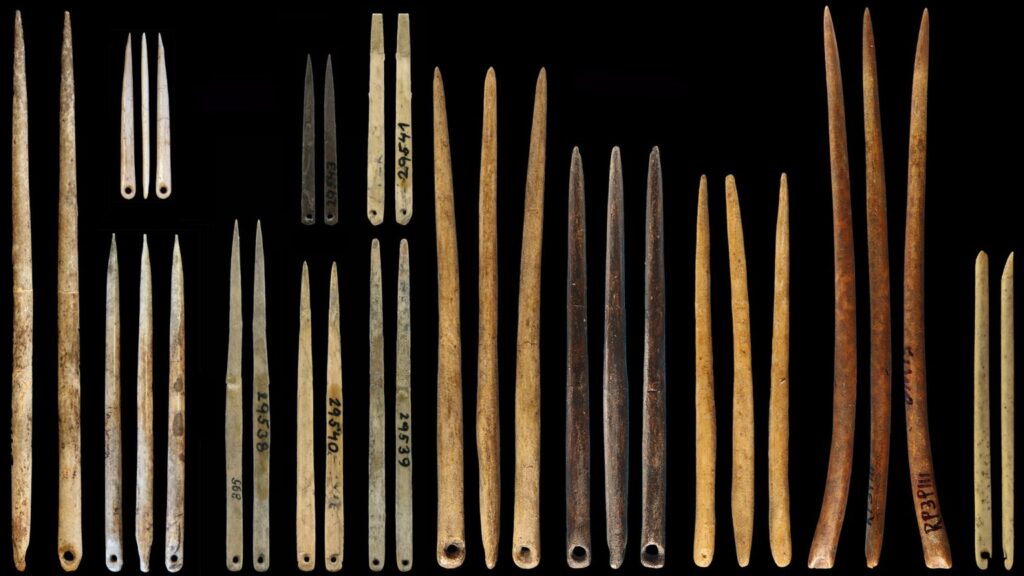
The earliest fossils that tell us about our use of fibres, are also hard, like the shells or skeletons of fossil animals, but we can infer things from the size of the needles and the size of their eyes, and the very fact of the needles existence tells us that we were sewing – sewing things together. Maybe not fabrics as we think of them today, but skins – leather, perhaps soft bark and if there are needles, then there must be threads of sorts – sinews, bast(the inner bark of trees) and cords made from plant fibres – flax, hemp and nettle. The first needles date back to 26,00 to 20,000BC, the Stone Age, and it is known too, “that Stone Age tooolmakers grasped the significance of twisting, which increases strength by diverting part of any tensile strength into lateral pressure”.1 Such a simple sentence, and one which those stone age craftsmen or women, could not have articulated in such a scientific way, but knowledge they arrived at by experiment , trial and error – yet right there is the basis of spinning – the process by which most fibres are turned into yarn – from which we make fabric.
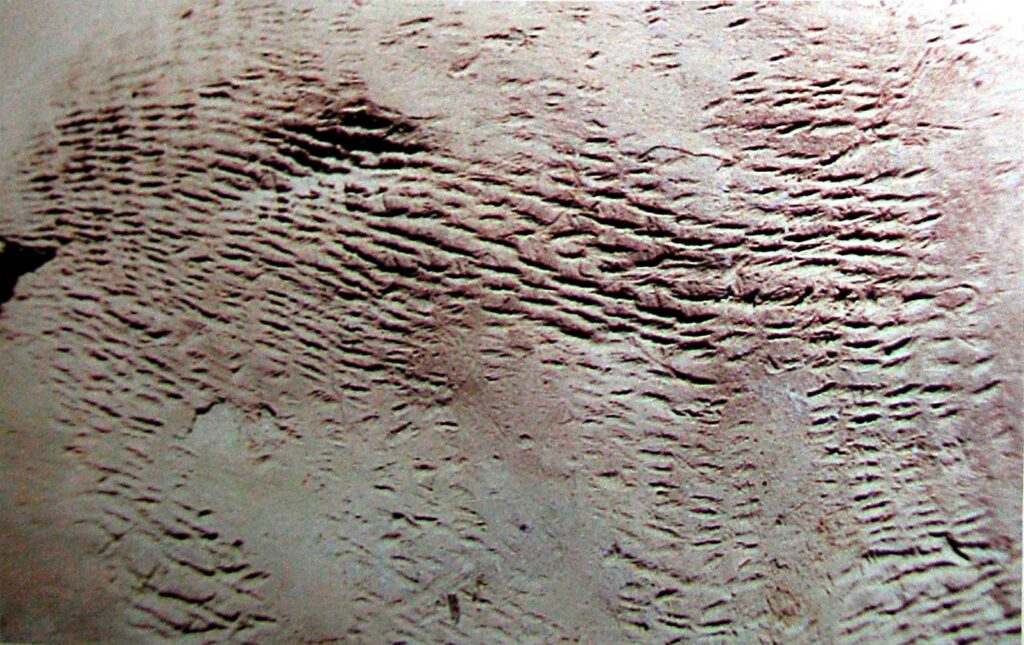
Before looms emerged, there were three main techniques that made the earliest kind of fabrics, Spiralling, Looping and finally Interlacing – this latter is the basic concept of Weaving2 and to the device which assists these processes by keeping one set of threads stiff (the warp), so that the other set of threads (the weft) can be passed over and under (woven through) the warp threads to produce a fabric.
So I am going to jump to looms because for much of history, weaving accounts for most of the fabrics I am going to explore. It is true that today, machine knitting has assumed great importance – not the knitting your Granny or Tom Daley do, but warp-wrapped machine knitting that produces say cotton jersey – the fabric that T-shirts are made from but I will cover that later.
August 28, 2022 by Mazharul Islam Kiron
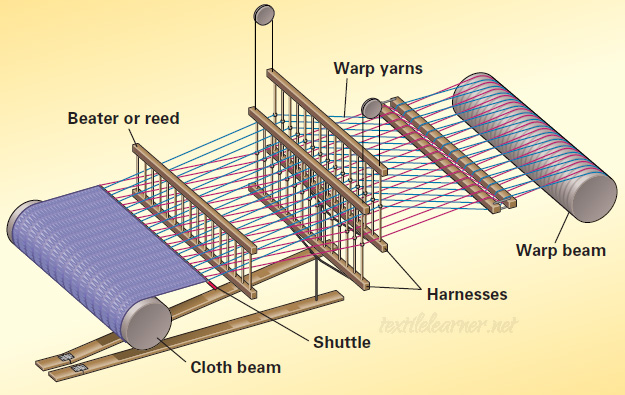
This diagram shows all the essential parts of a loom, with all the supporting structures removed.
- To set up the loom for weaving, Warp threads are run from the Warp beam to the Cloth beam – the former stores the warp threads until they are needed and the Cloth beam accumulates the finished fabric.
- Not labelled are two stick near to the Warp beam which are called Lease Sticks and they help keep the warp threads ordered and form one end of the diamond shaped opening in the Warp threads known as the Shed.
- You can see that the Warp threads alternate blue and red to make things clear and all the blue threads pass through one Harness – all the red ones through a second harness.
- By lifting or pressing down on the Harness[s] the warp threads are separated to form the Shed opening (shedding) and it is through the Shed, that the Weft threads, wrapped up in or around a Shuttle, will be passed to create each row of weaving – this is called Picking (see diagram below).
- After each row, the Beater, or Reed, is used to tamp the row down tightly before passing the Shuttle back through the Shed – this is called Beating In.
- By lifting each Harness in turn, the red or blue warp threads will alternate being to the front face of the fabric and this is the simplest weave pattern – a Tabby Weave
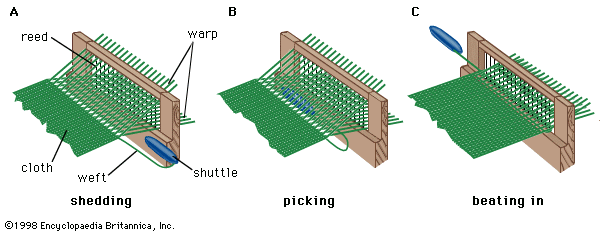
Shedding is creating the “shed” – the gap between the two sets of warp threads through wich the shuttle will pass – an act called Picking, and finally, the weft thread which has just been Picked, is beaten down so that it lies flush against the already woven fabric.
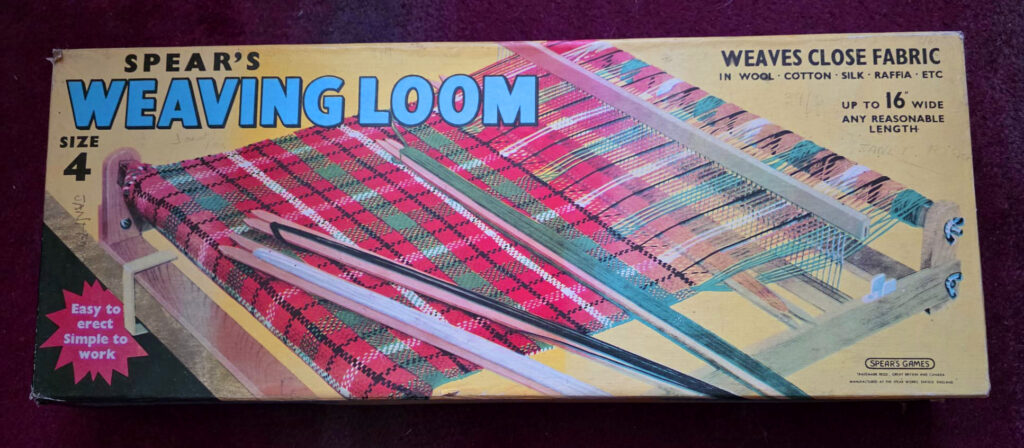
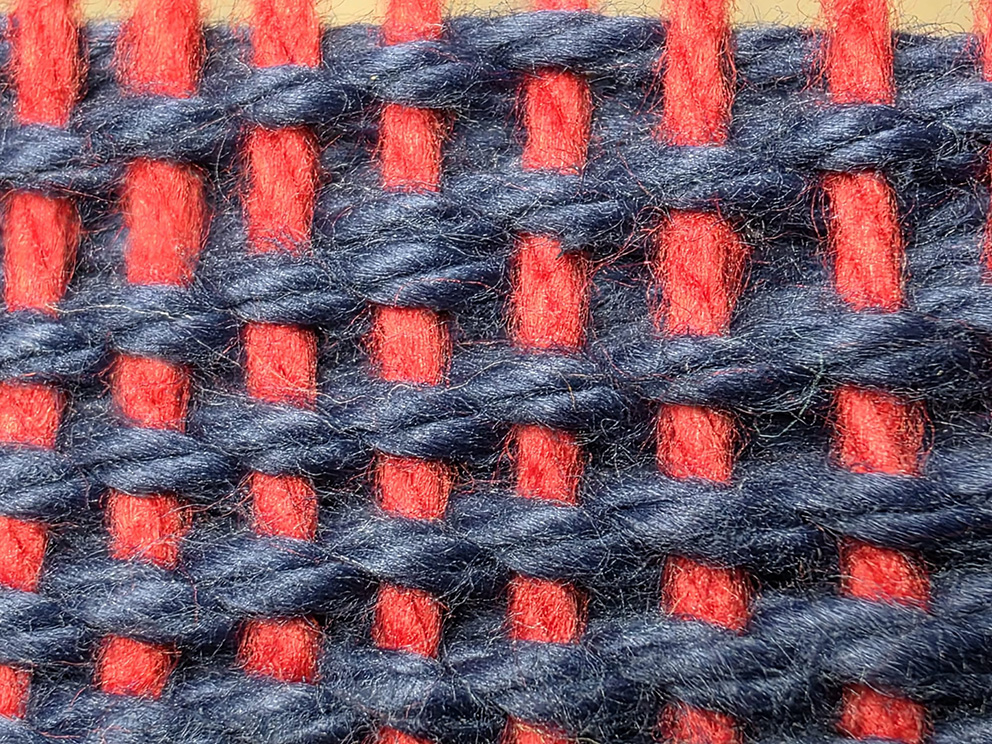
Using a small loom made by Spears – a toy company, in 1957, I made some samples to demonstrate the three most common weave patterns.
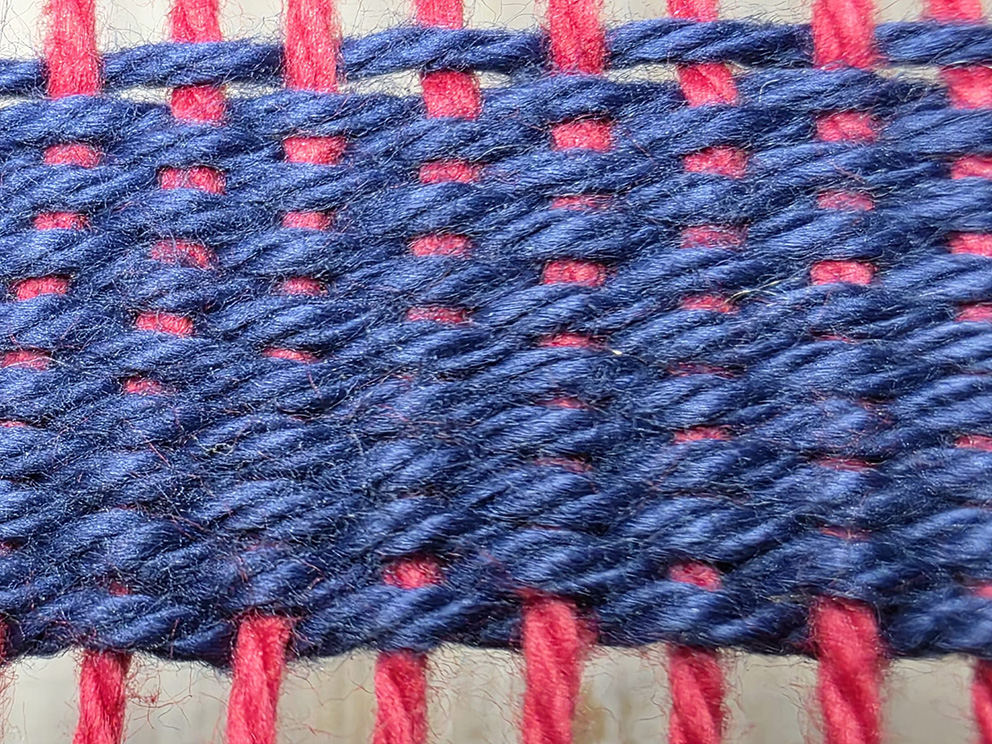
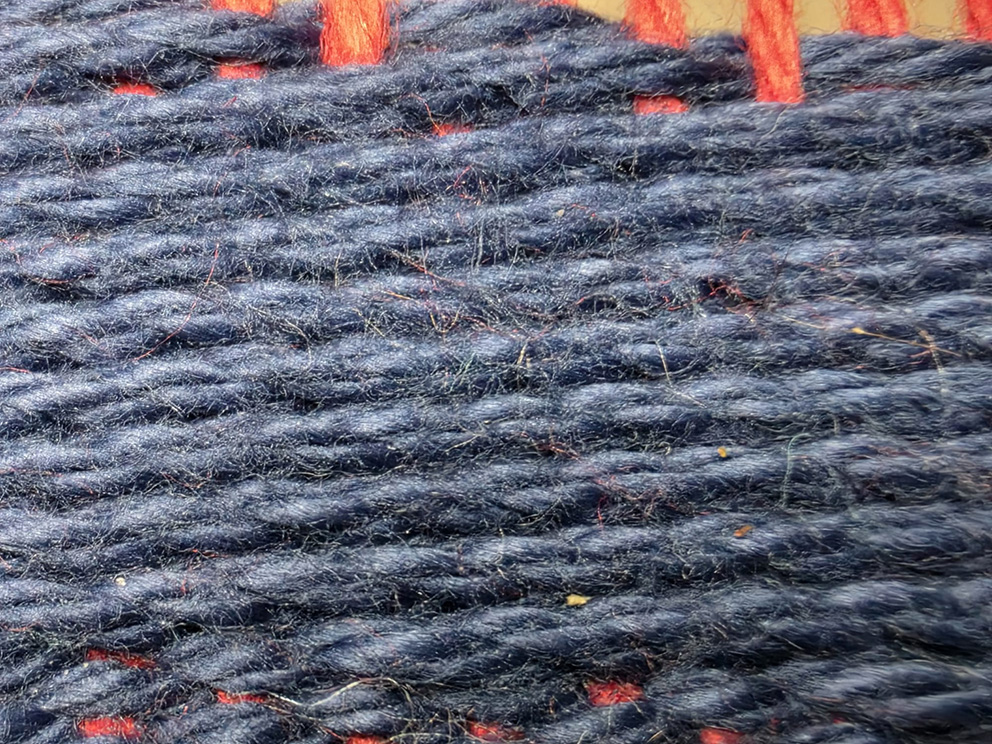
Here you can see how the threads pass in and out of each other – follow any blue weft thread and see how that works – in the top half, the rows of weft are not pressed down as much and you can see the red warp threads appearing and disappearing between alternate weft rows.
In a Twill, the shuttle passes over two warps then one , two and then one and on the next row, that pattern shifts to the right by one warp – this produces a distinctive diagonal pattern.
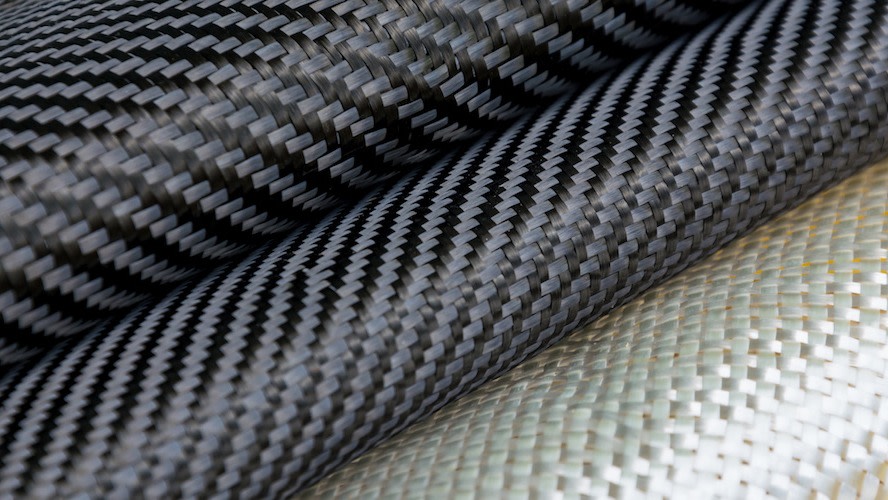
This picture shows it more clearly with the grey weft spanning two black wefts and then a single black warp appearing before the next weft spanning two is repeated. This would be called a 2:1 Twill.
Twill is very durable and hides stains well, and it is used for jeans, chinos, furniture coverings, bags, and more.
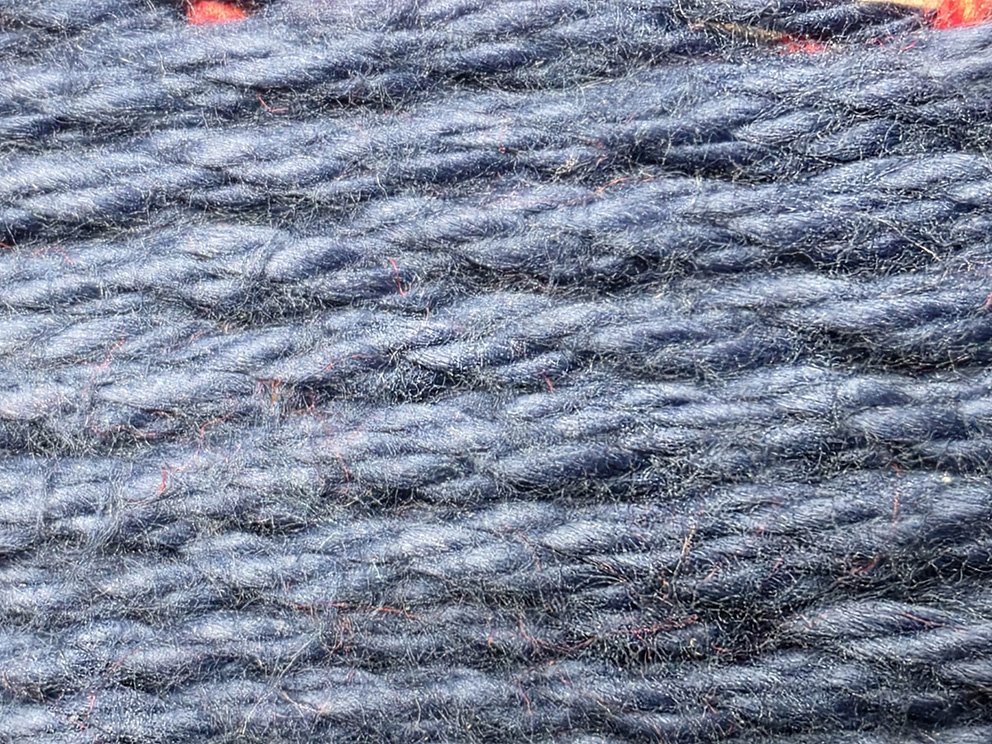
Satin Weave is much the same as twill but one where the weft covers five warps before allowing a warp to anchor the threads down. This means that swathes of uninterrupted weft create the satin face – hard to see in my samples, but if using a really fine thread such as silk, the satin face has a real shine to it. Of course the reverse face looks quite different – more warp and less weft. The picture below shows the diagonal progress of this 5:1 pattern.
If you look at the picture on the Spears Loom box, you can see how by varying the colours of the warp threads and the weft threads, a tartan pattern is achieved, and in the picture below, a recycled rag rug shows many thin warp threads of lots of different colours, binding thick, rolled, recycled dress material used as the weft.
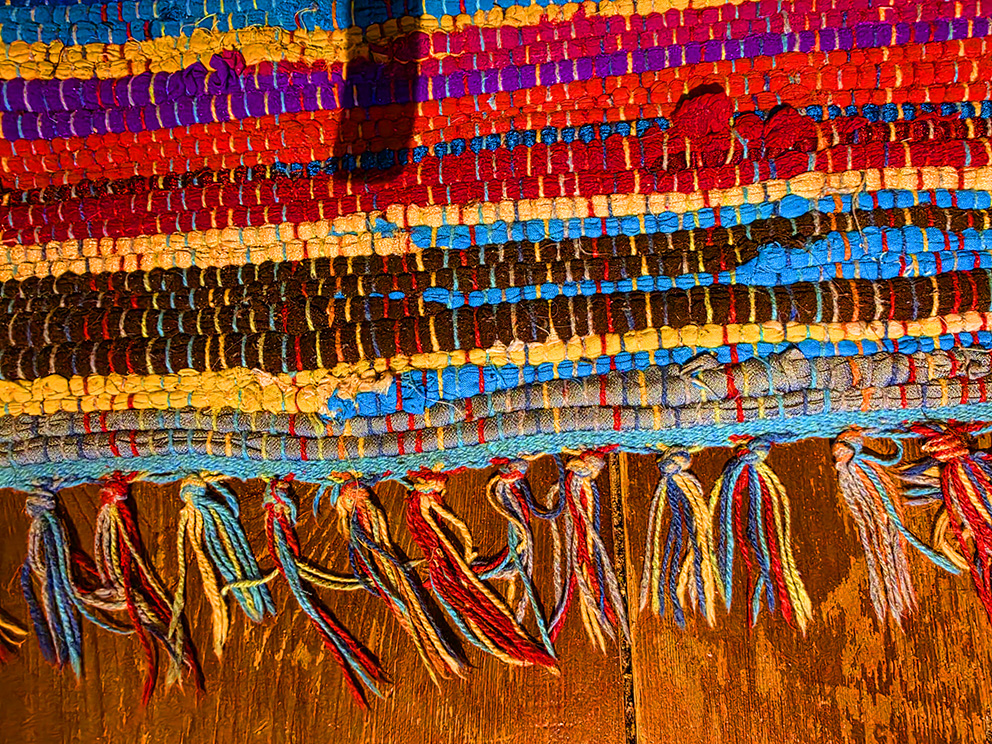
What you can also see here, is how, after completing the rug, the warp threads have been bunched and knotted to form a tassel fringe which prevents the woven fabric unravelling. Follow the colours of the weft up from one of tassels and you can trace the warp threads. You can also see a few rows of weaving with thin thread of the same size as the warps which secures the start of the rug before beginning with the thick wefts.
And that is all I am going to say about weaving for now, but we will look at the huge mills built to weave wool in my part of the world during the Industrial Revolution, at looms that have an extra pile element to make velvets, and how modern weaving machinery uses air to blow the weft through the shed – invisible shuttles!
- World Textiles by Mary Schoeser – A Concise History, Thames & Hudson world of art 2003 pp. 10
- World Textiles by Mary Schoeser – A Concise History, Thames & Hudson world of art 2003 pp. 20
Other pictures by the Author or as credited
I compiled a list of as fabrics, fibres and related items as possible (278 items which I will make available at the end of the A to Z), from several sources, the most comprehensive of which was Wikipedia. Since there are only 26 letters in the alphabet, I could not write in detail about every instance so I have taken snippets of text for the brief descriptions and linked to the source in the name of the item. I am indebted to all the contributors to those Wikipedia pages and the depth of knowledge to be found there…
.
Very interesting. I wove a scarf on a hand loom as a child, although an adult set up the warp threads for me.
Yes – setting up the warps would be tricky for a child – do you still have the scarf?
No. It was a very long time ago.
Quite interesting to know how weaving evolved over the years. Good topic.
I dive into these things and before I know it, I’m lost in it…
A detailed and informative overview that makes a complex process easier to follow. The mix of historical context and practical explanation adds depth to the topic.
Thanks, Tamara, it was a big post to get out of the way and very technical – glad it was clear!
Your post reminds me of my HSC practical work for Art back in 1968. I think a family friend made the loom for me and I chose “Autumn” colours for an abstract design of grasses and trees. It now resides in the garage as I don’t think it was very good but it did earn me a respectable mark in Art.
These blogs don’t half take one back, Linda – one way or another…
Sorry, I put in the wrong website address so posting it again.
I can remember making pot holders with a weaving thing when I was a little girl, kept me and my sister busy for hours on end putting those stretchy strings on the right loops. I’m not sure if I would have the patience to do it now. Thanks for sharing.
Cheers,
Barbie
That sounds like French weaving – was it a circular device with pegs that the yarn looped over?
Nope, square.
https://www.northeastfiberarts.com/product-page/traditional-potholder-loom
An interesting, in-depth topic, Andrew. I love my rag rugs.
Me too, Li, I often see landscapes in them and I turned those visions into painted postcards last year for the Cascadia PoPoFest…
Wow, this is awesome.
I’m glad to have read your “Why is this a W?” info! I know next to nothing, more likely nothing, so a background was helpful.
I think it entirely appropriate that you start the A to Z with the first principles of weaving 🙂
My friend was into weaving in a big way, and made me a lovely rug which I still treasure. That may be a year or two short of fifty years now. I think we must be due a reunion!
Thanks, Jemima, it seemed the best way! My schoolfriends and I still meet up once a year for a long weekend away and we left school 53 years ago!
I’ve enjoyed playing around with some very basic weaving projects over the years, not to mention lots of other fiber arts, so I look forward to what I’ll learn here in the next 25 letters!
https://nydamprintsblackandwhite.blogspot.com/2026/03/a-is-for-apotropaic.html
Glad to have you along for the ride, Anne!
Yeah, weaving is kind of the beginning of it all, isn’t it? I’ve always found the trick to A to Z is in the titling. You can make anything work for any letter if you just find the right title.
You’re right Liz – I have had to resort to “sleight of words” once or twice lol
Tassel fringes for the win – and the more colours the better!
Loved learning about the three ways of weaving.
My first memory of weaving – apart from seeing artwork with my aunt – is in art class in 1991.
We children used a shoebox and wool and splits.
Later on – in 2018 – I used fingerknitted wool to weave on a cane chair as a proof of concept for sea foam.
A shoebox loom! I don’t suppose you have a picture? Thanks for visiting Adelaide…
Andrew:
How I wish I had a picture. [as much for the people reading this blog and who are curious as for myself and my development].
In 1991 camera and film were relatively expensive.
Fortunately my schools had invested a lot in art and in craft.
I also have muscle memory and a visual imagination.
Maybe for another Wordless Wednesday if my browser – and Blogger – would behave!
I love the theme! 🙂 We learned to weave in my Waldorf school, and my mother and grandma also did weaving at home on a large loom as a hobby. I haven’t done it in a long time. Excited to hear more!
Happy A to Z!
The Multicolored Diary
Thanks, Zalka, never too late to weave fibres as well as words…
Fantastic, in-depth post on weaving. 🙂
Thanks, Cai – I see there is a Kai on the A to Z Challenge this year – I had to do a double-take…
A great start to your series!
BTW, Tabby weave is also known as Plain weave!
Thanks, Anne. Indeed it is – but perhaps I will have netted more cat-lovers lol
I LOVE this topic. Tell me more about your fabric hyperfocus!
Glad you are along for the ride, Erin…
So cool! Loved the photos of the different weaves.
Ronel at Ronel the Mythmaker
Barbara brought the loom back when she was woking at a charity shop so it ws good to do something hands on for this challenge…