“Choose any subject you would like to write about…” that is the object of the A to Z Challenge, and thinking of things that interest me is not a problem for me, but choosing a subject not only to write about, but to write in a way that other people will catch my interest – that is the real challenge! This year I turn to a subject, close to our skin if not our hearts, and yet, again, I wonder if this subject will get some people past the title on the list – dismissed as niche? For this year, my theme is What We Wear – Fabrics and Fibres
Compiling my research list of fabrics (which I will make available at the end of this A to Z) I encountered no less than 12 different types of lace and there are almost certainly more – it seems that every different location for lacemaking has evolved its own style…
Traditional lace making primarily uses natural fibers such as linen, silk, and cotton. Linen was a favored choice for its strength and fine texture in early lace, while silk provided smoothness and luster. Cotton became more prevalent in the nineteenth century and remains popular today due to its softness and breathability. In addition to these, precious metals like gold and silver were used for very valuable or decorative laces, and occasionally, wool was used for novelty laces
Lace is a delicate fabric made of yarn or thread in an open weblike pattern, made by machine or by hand. Generally, handmade lace is split into two main categories, needle lace and bobbin lace, although there are other types of lace, such as knitted or crocheted lace. Other laces such as these are considered as a category of their specific craft.
It might be said that lacemaking is all about the holes – in this respect, it achieves something which woven fabrics cannot easily do. Lacemaking is labour intensive – skilled labour at that and so lace is expensive! Lace is, with all its holes, transparent and so not something you would make clothes out of without an inner lining (unless you are very outré) but a little lace trimming on a negligée, brassiere, or edging a decolletage, can go a long way to suggesting more transparency than is actually there…. A bridal dress (suitably lined with an underskirt) has much the same purpose and as for priestly collars and ruffs – well, they are all about the finery and no expense spared!


Bobbin Lacemaking
In case you have ever wondered by what arcane process lace is made, this video gives a little taste…
Here is a site that illustrates a few types of lace…

And a more modern, crafty approach…
Chemical Lace fabric – By embroidering copiously over a soluble fabric which is dissolved away on completion, a fabric can be created even to the point of dress fabric!. I saw this done once with loads of random white free-style embroidery as a base and then green ivy leaves over the top – one needs to be sure that there are no weak points or else a fashion accident might ensue…
Lace, Alencon – Lace originating in France, it is characterised by its delicate tulle and motifs with a raised cord running around the motifs
Lace, Argentan – Argentan lace or Point d’Argentan is an 18th century needle lace from Argentan, Normandy, France. Argentella is derived from Argentan. Argentan lace exhibits a more prominent and larger pattern in contrast to its nearest variant, Alençon lace
Lace, Battenberg – a type of tape lace. It is of American origin, The original Battenberg lace used just one stitich: buttonhole picot. Other stitches that were later used include flat wheel (also known as spider or rosette) and rings or “buttons”
Lace, Burano (Venetian) – Burano Lace is traditionally made from fine cotton thread, which is resistant, flexible, and helps maintain the lace’s structure. Historically, however, it was also made with threads of linen, silk, and even gold or silver. The type of fiber used influences the lace’s final appearance and feel. The fine, white cotton used for Burano lace creates a light, ornate, and precious fabric that can be incredibly durable, lasting for many years with proper care.
Lace, Buratto – An Italian needle lace made by darning on a net. It is quite similar in appearance to filet lace but with one important distinction—it is darned onto a woven net, rather than the knotted net used for filet. Buratto tends to also be heavier in appearance due to the woven nature of the netting used.

Lace, Carrickmacross – a combination of cotton organdie and machine-made net, traditionally laid on top of a paper pattern. The organdie, a sheer but firm fabric, is appliquéd onto the net. Once the design is outlined with a couched thread, the excess organdie is cut away, revealing the delicate net underneath, which is then decorated with various needle-run and picot stitches.
Lace, Chantilly – If Chsantilly Lace is ringing a musical bell in the back of your mind – think The Big Bopper – later covered by Jerry Lee Lewis. If you ever wondered what made Chantilly Lace special – Wikipedia has it covered, of course… Named after the region of France in which it was established. Known for its delicate and dainty look, it is very popular today in bridal wear and lingerie (no wonder The Big Bopper sang about it!)

Lace, Guipure – often heavy and is characterised by not having tulle between the motifs.
Lace, Leavers – is characterised by its bold patterns, it is heavier than a Chantilly and usually lighter than a guipure. It still features tulle between the motifs like Chantilly lace.
Limeric Lace – a hybrid lace of embroidered needle lace or crocheted lace on a machine made net base. It is a ‘mixed lace’ rather than a ‘true lace’, which would be entirely hand made. Limerick lace comes in two forms: tambour lace, which is made by stretching a net over a frame like a tambourine and drawing threads through it with a hook, and needlerun lace, which is made by using a needle to embroider on a net background.
Tambour Lace – Tambour lace refers to a family of lace made by stretching a fine net over a frame[1] (the eponymous Tambour, from the French for drum) and creating a chain stitch, known as tambour, using a fine, pointed hook[2][3] to reach through the net and draw the working thread through. The tambour embroidery technique became popular in western fashion during the 18th century, particularly fashionable in the early 19th century when applied to net fabrics, creating a look similar to lace.
Tennerife Lace – Tenerife lace or “roseta canaria” is a needle lace style often found on the Canary Islands and sharing the name of the island of Tenerife.[1] Despite its name the origin of this lace is uncertain, and in Tenerife it may be referred to as Brazilian lace.

Types of Looms
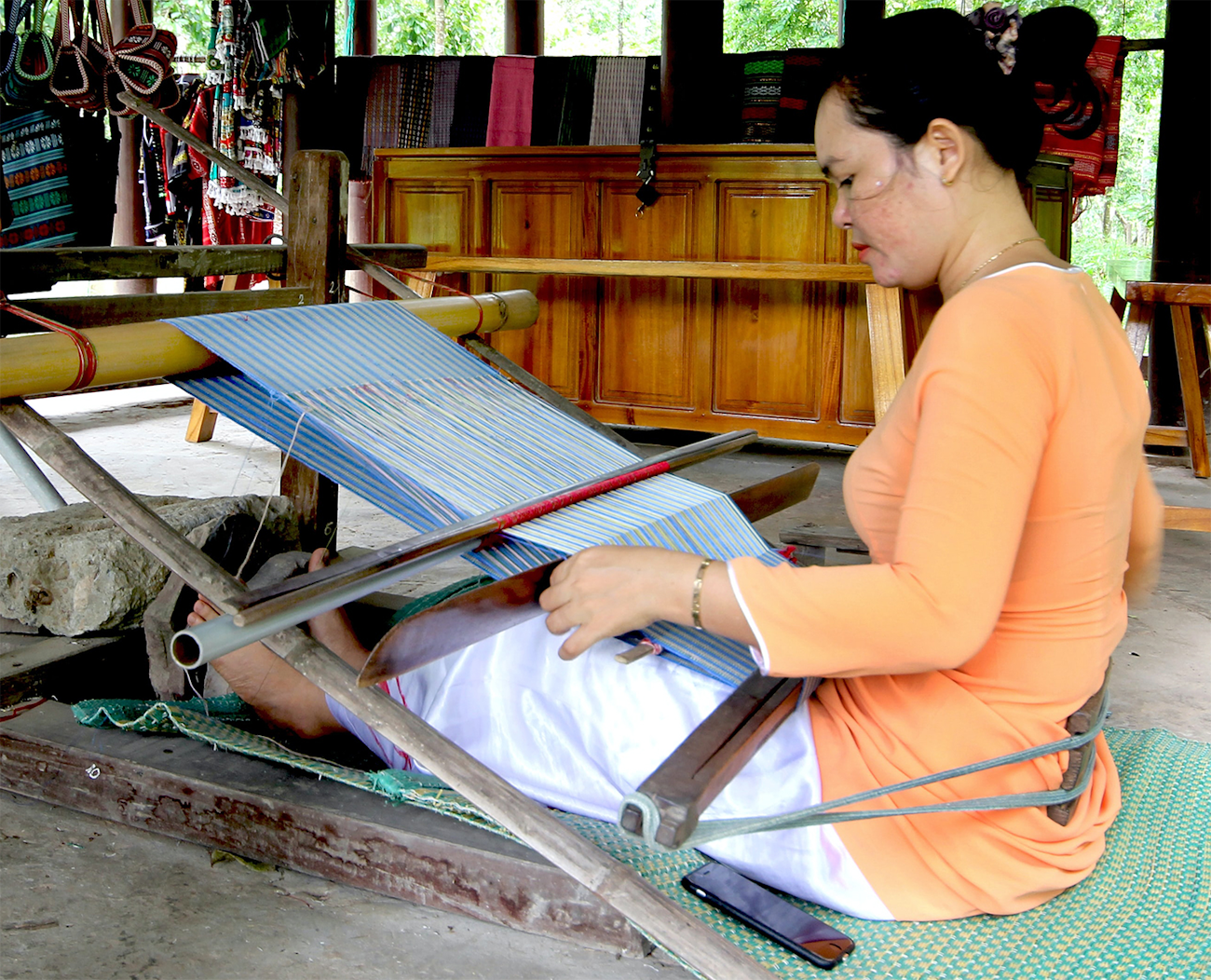
We looked at the process of weaving on a loom in “A” Everything You Need to Know About Weaving (though that title may have been a bit of a stretch) but we didn’t cover the many types of looms. The picture below is from an excellent blog post that illustrates the main types of loom.
Looms can range from the tiny…

To the large – a Mechanical Dobby Loom…

I will not double up on these excellent guides and this is proving to be a long post, so onwards to…
“L” Fabrics
Lame (Lurex) – Can be any type of fabric that is woven with ribbons/yarns of metallic wrapped around or between yarns – the stuff of theatre dreams…/
.jpg)
Lanon – At the core of Lanon woven fabric’s appeal is its outstanding durability and tensile strength. Constructed using tightly interwoven fibers—whether natural, synthetic, or regenerated—this fabric resists abrasion, tearing, and stretching under stress.
Latex – made from the rubber tree, this fabric is very resilient and stretchy…

Lawn – a fine plain weave textile, made with fine combed cotton. Terms also used include batiste and nainsook. Originally the name applied to plain weave linen, and linen lawn is also called “handkerchief linen”. The term lawn is also used in the textile industry to refer to a type of starched crisp finish given to a cloth product. The finish can be applied to a variety of fine fabrics, prints or plain.
Linen – Linen is one of the big, natural, fibre/fabrics alnogside cotton and wool and its history goes way back into pre-history. Linen is very strong and absorbent, and it dries faster than cotton. Because of these properties, linen is comfortable to wear in hot weather and is valued for use in garments. Linen textiles can be made from flax plant fiber, yarn, as well as woven and knitted. Linen also has other distinctive characteristics, such as its tendency to wrinkle. It takes significantly longer to harvest than a material like cotton, although both are natural fibers. It is also more difficult to weave than cotton.
We all love the look of a crisp linen suit – at least before it is creased by a day’s wear, and what better example than Sean Connery in Diamonds are Forever…

Linen fibres come from the Flax plant with its fields of sky blue, and it is labour intensive to harvest, treat to extract the fibres in the longest, highest quality. It involves Retting, scutching, and heckling and you can find a good account of it here.
I met a man in Ireland, whose father had made his first fortune, by taking Irish Linen tablecloths and napkins, sailing to China, hiring a gunboat )to protect against pirates) and sailing up the Yangtse River to a village which specialised in hand-embroidering the monograms on the linen pieces. After the 2nd World War, when the linen trade in Ireland collapsed due to foreign competition, he made a second fortune selling Swiss Watches…
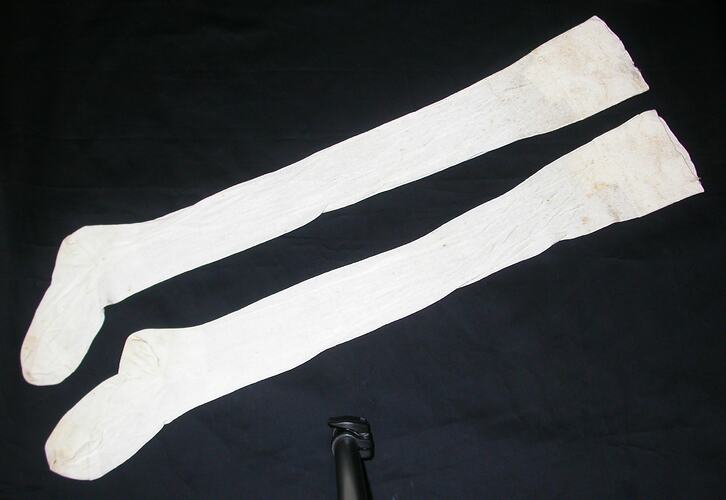
Lisle – a type of finish that was applied to obtain smooth and even yarns, largely employed for goods intended for underwear and hosiery. Yarns made with long-staple fibers such as Egyptian cotton were passed repeatedly and swiftly through gas flames. The action removed the fuzzy and protruding fibers. The finish adds smoothness, gloss, and evenness to the yarn. Another method of “lisle” was on finishing fabrics, in which hosiery fabric was treated with a dilute acid solution such as hydrochloric acid or sulfuric acid, the fabric was then tumble dried without washing at a temperature of a hundred degrees Fahrenheit. The acid and tumble exposure remove the loose ends and fuzziness from the fabric, which is subsequently neutralised with an alkaline solution to prevent further acid damage.
Lisle is a historic name, but “mercesiation” is still used today to obtain smooth fabrics…
I compiled a list of as fabrics, fibres and related items as possible (278 items), from several sources, the most comprehensive of which was Wikipedia. Since there are only 26 letters in the alphabet, I could not write in detail about every instance so I have taken snippets of text for the brief descriptions and linked to the source in the name of the item. I am indebted to all the contributors to those Wikipedia pages and the depth of knowledge to be found there…
This is a great post! Loved all the details about lace. I had never heard of chemical lace. Seems risky!
Thanks, Lori, nothing chemically risky – its just water soluble, but you have to do a massive amount of random stitching (with a free embroidery foot I think) in order to make sure there are no weak areas…
I scroll through the pictures and am delighted each time.
Me too, Li me too, lol…
There were lace makers at our county fair, well, most years, I think. I never really watched them, but it seems like it is labor intensive. They seemed to enjoy the process, though.
I remember watching a “tinker” at a country fair in Ireland, Liz – I stood for fully 45 minutes watching him make a bucket from a copper boiler – the skill, the techniques – there’s a lot to be leant at country fairs…
Lace has many techniques of making it. I seem to recall ever crocheting simple lace trimmings on small items.
That is interesting Cai, I didn’t know you could crochet lace…
My grandmother used to make lace. She mad doilies for the chairs. I have her bobbin but I nver saw her make lace nor have I made any.
A hobby just waiting to capture your attention, Kristin, and imagine – using your grandmothers bobbin… just saying!
I have fooled around with many little handmade looms as a child (including all those pot holders!) It would be fun to play with a proper loom, but that’s a hobby that’s far too expensive and large to get into!
https://nydamprintsblackandwhite.blogspot.com/2026/04/kape-with-lisa.html
Wouldn’t it just – but where to put it – even if one could afford it and then think of the cost in yarns…