“Choose any subject you would like to write about…” that is the object of the A to Z Challenge, and thinking of things that interest me is not a problem for me, but choosing a subject not only to write about, but to write in a way that other people will catch my interest – that is the real challenge! This year I turn to a subject, close to our skin if not our hearts, and yet, again, I wonder if this subject will get some people past the title on the list – dismissed as niche? For this year, my theme is What We Wear – Fabrics and Fibres
Kalamkari, also commonly spelled as qalamkari, originated in the Indian state of Andhra Pradesh and is an ancient textile printing – it has two main styles – The hand painted style that is largely practised in the town of Srikalahasti and block printed that is practised in the town of Machilipatnam, both located in Andhra Pradesh.

Srikalahasti style of Kalamkari, where the “kalam” or pen is used for freehand drawing of the subject and filling in the colours, is entirely hand worked. It is produced in Srikalahasti of Tirupati district of Andhra Pradesh. This style flourished in temples centred on creating unique religious identities, appearing on scrolls, temple hangings, chariot banners as well as depictions of deities and scenes taken from the Hindu epics (e.g. Ramayana, Mahabharata and Purana). – Wikipedia

With the Machilipatnam style of block printing, religion comes into play, since they are Persian in character – the Muslim Mughal Empire in northern India were the patrons of this form of printed fabric and hence, Hindu religious images were banned in favour of Persian motifs like interlacing pattern of leaves and flowers, the cartwheel, different forms of the lotus flower, creepers, birds like parrots and peacock, and other intricate leaf designs. One very popular subject with them is the tree of life.
The Wikipedia entry for Kalamkari, has a very interesting account of the dyeing techniques which could be read in conjunction with my earlier post about dyeing. Kalamkari is still produced today, albeit mostly printed and with some changes to the dyes used. You can see some contemporary products here.

Since there is only one fabric on my list beginning with Q, I am going to deal with Gold and Silver Thread here.
Gold and Silver Thread
For centuries, silver [and gold] has been hammered, spun, and stitched into textiles that signal power, holiness, and wealth.
(The Silver Thread That Runs Through Art History: Metallic Threads, Embroidery, and Symbolism – Ruth Millington)2
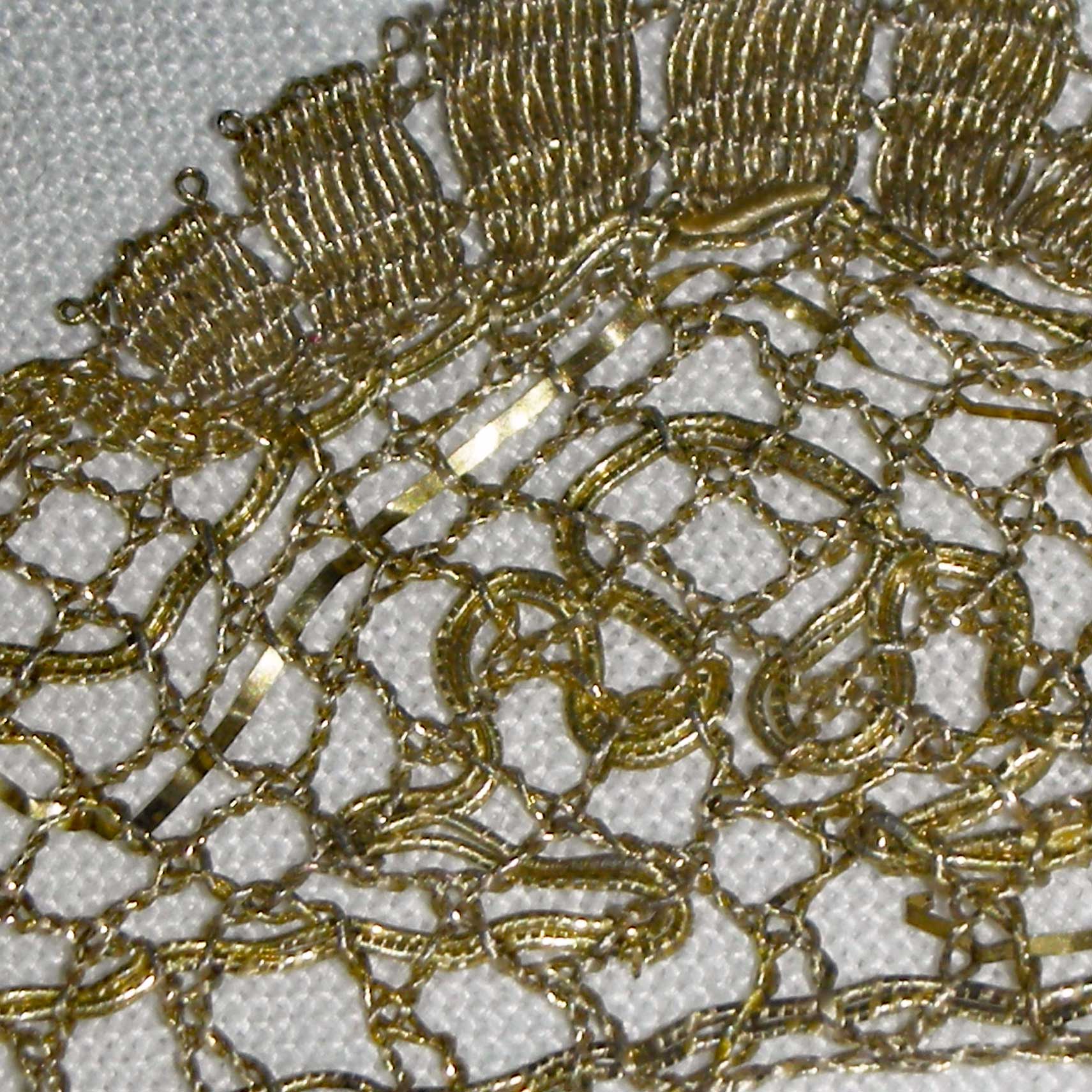
I found many interesting sites that detail the making and use of metallic threads in embroidery as well as the inevitable Wikipedia page and I list some of them at the bottom of the page. But I will precis the main points here. Metals can be used in embroidery in two main ways, as very fine wires or as thin stips of beaten metal wound around a thread which makes them more flexible and durable to work with. Both gold whic won’t tarnish, silver which will, and also copper which tarnishes to verdigris green, can all be beaten into leaf, but gold and other leaves, are very fragile and although “thin strips(filé or lamella) were then woven into a textile (most commonly as a supplemental brocade weft) or embroidered onto a textile ground”1 However, winding the strips, or very finely drawn wire, around a thread is much the preffered method.
Wikipedia defines Goldwork3, as “the art of embroidery using metal threads. It is particularly prized for the way light plays on it. The term “goldwork” is used even when the threads are imitation gold, silver, or copper.” It goes on to say that mostly, goldwork is surface embroidery or free embroidery and that for the most part, it is couched – that is, laid on the surface and tied down at intervals with very fine threads, often silk.

Wikipedia lists the types of metallic tread which I include almost fully as it is so comprehensive:
Passing – the thin strip of metal wound around a core of cotton or silk. [The silk can be yellow or red and the gold is so thin that this makes a difference to the appearance with some historical writers asserting that gold wound on yellow thread soon loses its colour.4]
Japan thread – it appears nearly identical, but rather than a strip of metal, a strip of foil paper is wrapped around the core.
Bullion or Purl – is structurally a very long spring, hollow at the core; it can be stretched apart slightly and couched between the wraps of wire, or cut into short lengths and applied like beads.
Jaceron or Pearl purl – is similar to bullion, but with a much wider piece of metal which has been shaped (rounded) prior to purling it, such that it looks like a string of pearl-like beads when couched down between the wraps of metal. Lizerine is a similar thread that has a flat appearance having not been shaped prior to purling.
Frieze or Check purl – is again similar, but the metal used is shaped differently, producing a faceted, sparkly look.
Faconnee or Crimped purl – is almost identical to bullion, but has been crimped at intervals.
Roccoco and the similar Crinkle cordonnet are made of wire tightly wrapped around a cotton core, with a wavy or kinked appearance.
Milliary wire is a stretched pearl purl laced to a base of passing thread.

Broad Plate – is a strip of metal a 2 millimeters wide; often this is used to fill small shapes by folding it back and forth, hiding the couching stitches under the folds.
Flat Worm or simply Oval thread is a thin plate wrapped around a yarn core and flattened slightly. This is used like plate, but is considerably easier to work with.
Twists or Torsade, threads made of multiple strands of metal twisted together are also sometimes used, some of which, such as Soutache, sometimes have different colored metals or colored non-metal threads twisted together. These are either couched like passing, with the couching thread visible, or with the thread angled with the twist to make it invisible.


References:
1 Metallic Threads – A Background to Their Use in Textile Work – Gina B Silkworks
2 The Silver Thread That Runs Through Art History: Metallic Threads, Embroidery, and Symbolism – Ruth Millington
3 Wikipedia Goldwork (embroidery)
4 The history and the techniques of the spinning of gold thread – Translation by Karen Finch from the original by Sofus Larsen
5 Textile Research Centre – Leiden
I compiled a list of as fabrics, fibres and related items as possible (278 items), from several sources, the most comprehensive of which was Wikipedia. Since there are only 26 letters in the alphabet, I could not write in detail about every instance so I have taken snippets of text for the brief descriptions and linked to the source in the name of the item. I am indebted to all the contributors to those Wikipedia pages and the depth of knowledge to be found there…
I have a machine printed spread in the Pichwai Floral Kota Kalamkari style.
I would love to see a picture of that …
It’s very pretty. It looks very rich.
It surely does – all that complexity too…
Andrew:
I am loving all the purls/threads which I have learnt about in “Q”.
Thanks, Adelaide, glad to have kept your interest – thanks for following this A to Z…
Thanks, Adelaide, glad to have kept your interest – thanks for following this A to Z…
The traditional metal threads involve a great deal of work. Contemporary “metal” threads are pale imitations in comparison.