“Choose any subject you would like to write about…” that is the object of the A to Z Challenge, and thinking of things that interest me is not a problem for me, but choosing a subject not only to write about, but to write in a way that other people will catch my interest – that is the real challenge! This year I turn to a subject, close to our skin if not our hearts, and yet, again, I wonder if this subject will get some people past the title on the list – dismissed as niche? For this year, my theme is What We Wear – Fabrics and Fibres
Before there were fabrics as we think of them today, that is, woven or knitted, there were skins, fur and leather and for fabrics to come about, the concept of “fibres” which could be combined to make a yarn – the basis of all fabrics, had to be conceived. The sources of fibres fell into two groups – animal and plant-based. One can imagine how plants such as cotton,simply cried out to find some way of making their fluffy bolls into some form that would allow them to be combined. The answer was of course, spinning… We all know about spinning wheels from fairy tales like Rapunzel, but before those quite elaborate inventions, there were simpler ways of spinning fibres – the spindle or drop spindle. What all spinning devices do, is to allow you take a pinch of, say, wool, and as you draw it out into a thinner configuration, the device spins the wool into a yarn, which causes the fibre to bind together into a yarn. The video below shows how to use a drop-spindle and the one after that shows some of the ways the process was elaborated on. As we said in the first post on Weaving – Stone Age tooolmakers grasped the significance of twisting, which increases strength by diverting part of any tensile strength into lateral pressure”.1
The video below shows how to use the simplest and oldest form of spinning tool…
Next is a video which takes us through some of the more elaborate forms os hand-spinning tools, up to and including the spinning wheel.
These simple methods could work with animal or plant fibres and once a thin yarn was produced, then two or more thin yarns could be further twisted, or plied, together – hence 2-ply, 3-ply etc.
What happened after that, was simply increased mechanisation and in 1764, James Hargreaves of Lancashire, England, invented the Spinning Jenny, which could spin multiple yarns simultaneously which took the production of yarn from cottage industry where one yarn at a time was produced by hand, to a mill based industry.
In the 20th Century, synthetic and semi-synthetic fibres were added to the possibilities, either by combining fibres in a blend with the natural ones to form blended yarns with improved performance characteristics, or used entirely on their own – I will cover them under “S”, but all I will say for now, is that synthetic fibres need not necessarily be spun since they can emerge as a coherent yarn in the first place and that due to the ability to extrude synthetic fibres at very consistent sizes, they can be used to relace or augment natural fibres from cotton to silk….
So what are the fibres that have clothed us for centuries? Well, on the animal side, the hairs from bovines, camels, goats (Angora, Mohair) horse-hair, rabbit, reindeer and of course sheep (wool) – all of which offer fibres straight from the hide, and, by a much more convoluted process, Silk, which is made from the unwound cocoons of the silk worm. Sinews and gut were also early sources of fibre. Even casein (milk protein) can be treated and spun into fibres.
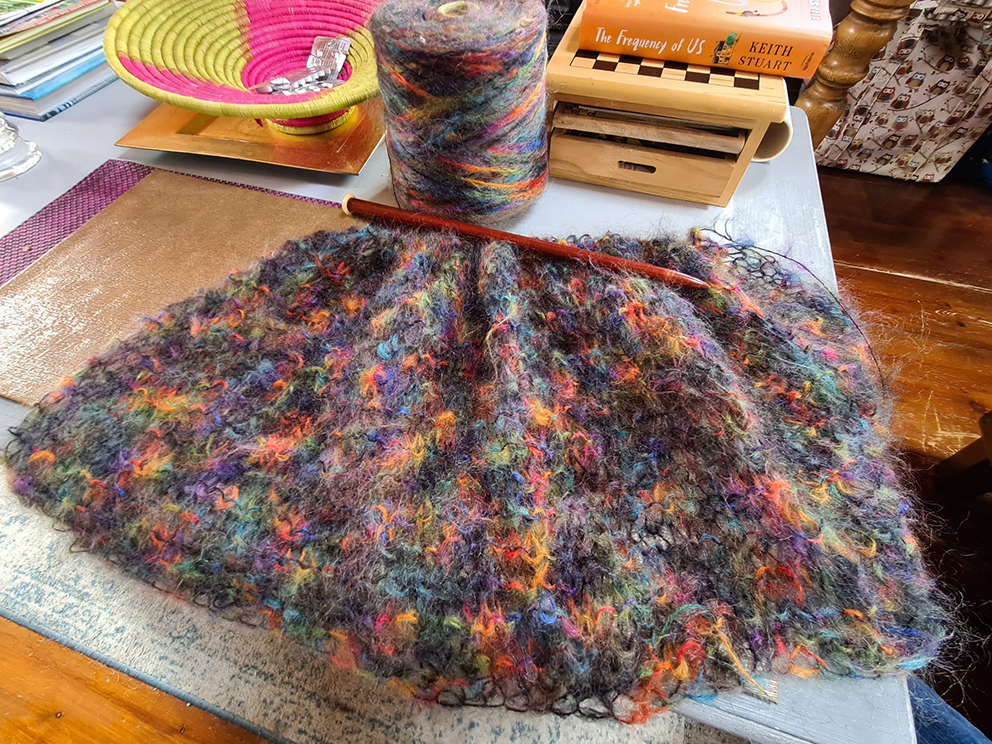
On the plant side, nettles were an early source of fibre for string and rope whilst tree bark – bast, made early non-woven fabrics. Cotton, linen (flax), Jute, Sisal, Palm (Raffia) and Tow (coarse fibres extracted during the preparation of other fibres like linen) were the classic fibres, but today, bamboo, eucalyptus, soybean, aloe vera and even the dried leather from kombucha have been added to the repertoire! Some of these, are sources of cellulose and form the source material of the “semi-synthetics” which we will come to under “S”.
Fabrics beginning with F:
Faille – is a structured fabric characterised by very fine ribs, it is usually made from silk.
Faux Fur, Leather and Suede – these are all fabrics woven to simulate the appearance of other substances.
Felt – felting is a method of producing fabric without weaving by matting, condensing and pressing fibres. It allows fabric to be shaped directly into 3-dimensional shapes such as hats. Although initially produced from natural fibres, felting is a technique that works with almost any kind of fibre. It is fire-retardant and self-extinguishing; it dampens vibration and absorbs sound; and it can hold large amounts of fluid without feeling wet.

Fibre Glass – Glass Re-enforced Plastic (GRP) begins with a matted fabric composed of fine glass fibres which are welded together with a plastic resin to make such things as sailing boats.
Fishnet – is a machine knitted fabric with a diamond shaped hole pattern and has become a staple of hosiery and especially beloved as part of punk fashion.
Flannel (and Flannelette) – is a soft woven fabric of varying fineness. Flannel was originally made from carded wool or worsted yarn, but is now often made from either wool, cotton, or synthetic fibre. Flannel is commonly used to make tartan clothing, blankets, bed sheets, sleepwear, and several other uses.
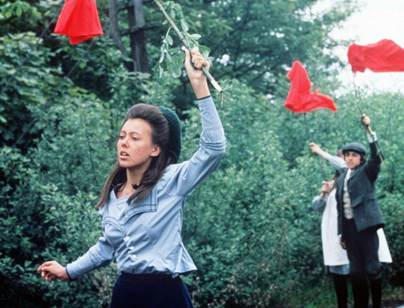
Jenny Agutter waving her red petticoat to prevent disaster in the Railway Children (1970) https://katedaviesdesigns.com/2023/11/02/red-hats-and-petticoats/
Fustian – Fustian means thick cotton cloth – an old fabric, it ranges from straightforward twilled fabric such as denim, to cut textiles that are analogous to velvet and have names such as velveteen, moleskin. In the first fustian fabric, which dates back to the medieval ages, cotton was used for the weft, and linen was used for the warp. It would appear that the phrase quickly lost some of its distinctiveness and eventually came to be used to designate a coarse cloth that was made of wool and linen.
Fustians such as Corduroy, that have added long fibres as well as Faux Furs, require special looms that incorporate the additional fibres which after weaving in, are cut to produce the ridges in the corduroy.

Corduroy: This modern diagram shows the warp (3) and the long (red-4) and short (green-5) weft threads; traditionally the knife (1) and the guide (2) are attached and the cutting motion is upwards.

- World Textiles by Mary Schoeser – A Concise History, Thames & Hudson world of art 2003 pp. 10
I compiled a list of as fabrics, fibres and related items as possible (278 items), from several sources, the most comprehensive of which was Wikipedia. Since there are only 26 letters in the alphabet, I could not write in detail about every instance so I have taken snippets of text for the brief descriptions and linked to the source in the name of the item. I am indebted to all the contributors to those Wikipedia pages and the depth of knowledge to be found there…