“Choose any subject you would like to write about…” that is the object of the A to Z Challenge, and thinking of things that interest me is not a problem for me, but choosing a subject not only to write about, but to write in a way that other people will catch my interest – that is the real challenge! This year I turn to a subject, close to our skin if not our hearts, and yet, again, I wonder if this subject will get some people past the title on the list – dismissed as niche? For this year, my theme is What We Wear – Fabrics and Fibres
What do I mean by “historical” fabrics? After all, many fabrics have a long lineage, in the case of the staples, cotton, linen, and silk, their history goes back many thousands of years and are still in production today, but there are some names that have fallen by the wayside and who only crop up in the context of old novels and histories – Brilliantine, Dowlass (Sailcloth), Holland cloth, Drugget and what the heck is Rum-swizzle? They may have modern equivalents, but these are the names consigned to history, and if they are still in produced today, however modified they may be, I have not included them here.
Broadcloth is a good example – woven at 50-75% wider than the finished width, this dense, plain woven cloth, historically made of wool, was “milled” – subjected to heavy hammering in hot soapy water in order to shrink it to the required width – in effect, it was felted with the thread count much denser than a loom could achieve, making it denser, tougher and more water-resistant. Broadcloth was a natural choice for items like naval uniforms where all those characteristics are needed.
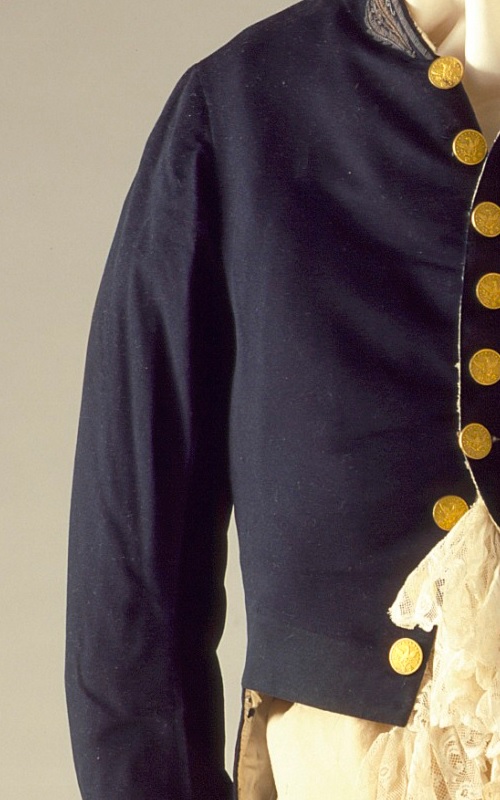
Brilliantine – Lightweight, mixed-fibre fabric popular from the mid-19th century into the early 20th century. Brilliantine can be plain or twill woven, has a lustrous finish and is known for its dust-shedding properties; it was available in solid colors or printed, and was used for dresses, dusters, and linings.
Camlet – also commonly known as camlot, camblet, or chamlet, is a valuable woven fabric of Eastern origin, perhaps originally made from camel hair, but the term became one applied to all imitations of it.
Cannequin – A fabric of unknown origin, possibly a type of fine cotton
Chine – A type of silk fabric where the pattern was printed on the warp threads before weaving, creating a distinctive blurred design. This nugget of information came not from either of my two main lists and in the case of Wikipedia, sources of information. No! The joy of researching is that it connects you with far-flung areas of the internet, and in this case, far-flung geography – and an item about an obscure (today) technique of fabric production. The Dreamstress – sewing, history, and style, is a fabulous blogger, born in Hawaii, living in New Zealand and not only revealing the secrets of historical clothes and the fabrics they are made from, but even designing and selling patterns which you can use to replicate certain historical classics! Chine, on it’s own, as opposed to Crêpe de Chine, is not mentioned in either of my main lists and only a simple search for “Historic Fabrics” connected me with this awesome blog!

So back to Chine, which together with the very similar Ikat and Abr, are examples of warp printed or pre-dyed (resist) fabrics – once the weft is woven in, the designs on the warp threads, show through in a blurred fashion. Leimomi tells us “The ikat dyeing and weaving technique goes back millenia, and was developed independently in different parts of the world: there are very old examples from Japan, Indonesia, Turkey, Yemen, and pre-Columbian South America. […] Ikat, under the name chine, became popular in Europe in the mid-18th century as part of the craze for Eastern designs and fabrics. The name chine literally means ‘Chinese’ in French, because of the fabric’s association with China and the East. Though the first examples probably did come from China, by the 1760s France was producing its own warp printed chine fabrics.”
Dowlass (Sailcloth) – Dowlas was a strong coarse linen cloth of the 16th and 17th centuries, and initially, it was manufactured in Brittany. In the 18th century the fabric was also produced in England and Scotland. Dowlas was identical to sailcloth. The cloth was also imitated in cotton for the same use.
Drugget – “a coarse woollen fabric felted or woven, self-coloured or printed one side”.Jonathan Swift refers to being”in druggets drest, of thirteen pence a yard”. Formerly, a drugget was a sort of cheap stuff, very thin and narrow, usually made of wool, or half wool and half silk or linen; it may have been corded but was usually plain. The term is now applied to a coarse fabric having a cotton warp and a wool filling, used for rugs, tablecloths, etc.
Dungaree – I will cover this in Working fabrics
Haircloth – this conjures up penitents wearing itchy hair-shirts but in fact there are two types of Haircloth that made from the outer, coarse outer “guard” hairs of camelids, bovines, horses, goats, rabbits, hares and reindeers, and that made from the softer (shorter) undercoat and these fabrics can be quite luxurious.

Himroo is a fabric made of silk and cotton, which is grown locally in Aurangabad. Himroo was brought to Aurangabad in the reign of Mohammad Tughlaq, when he had shifted his capital from Delhi to Daulatabad, Aurangabad. The word himroo originated from Persian word Hum-ruh which means ‘similar’. Himroo is a replication of Kinkhwab, which was woven with pure golden and silver threads in former times, and was meant for the royal families.
Hodden (Wadmal – Scandinavian) – is a coarse, undyed cloth made of undyed wool, formerly much worn by the peasantry of Scotland from prehistory. Usually woven in 2/2 twill weave but are also known in plain or tabby weave. Both are a thick, coarse, fulled homespun cloth typically made of natural undyed wool of the vari-coloured Northern European short-tailed sheep breeds.
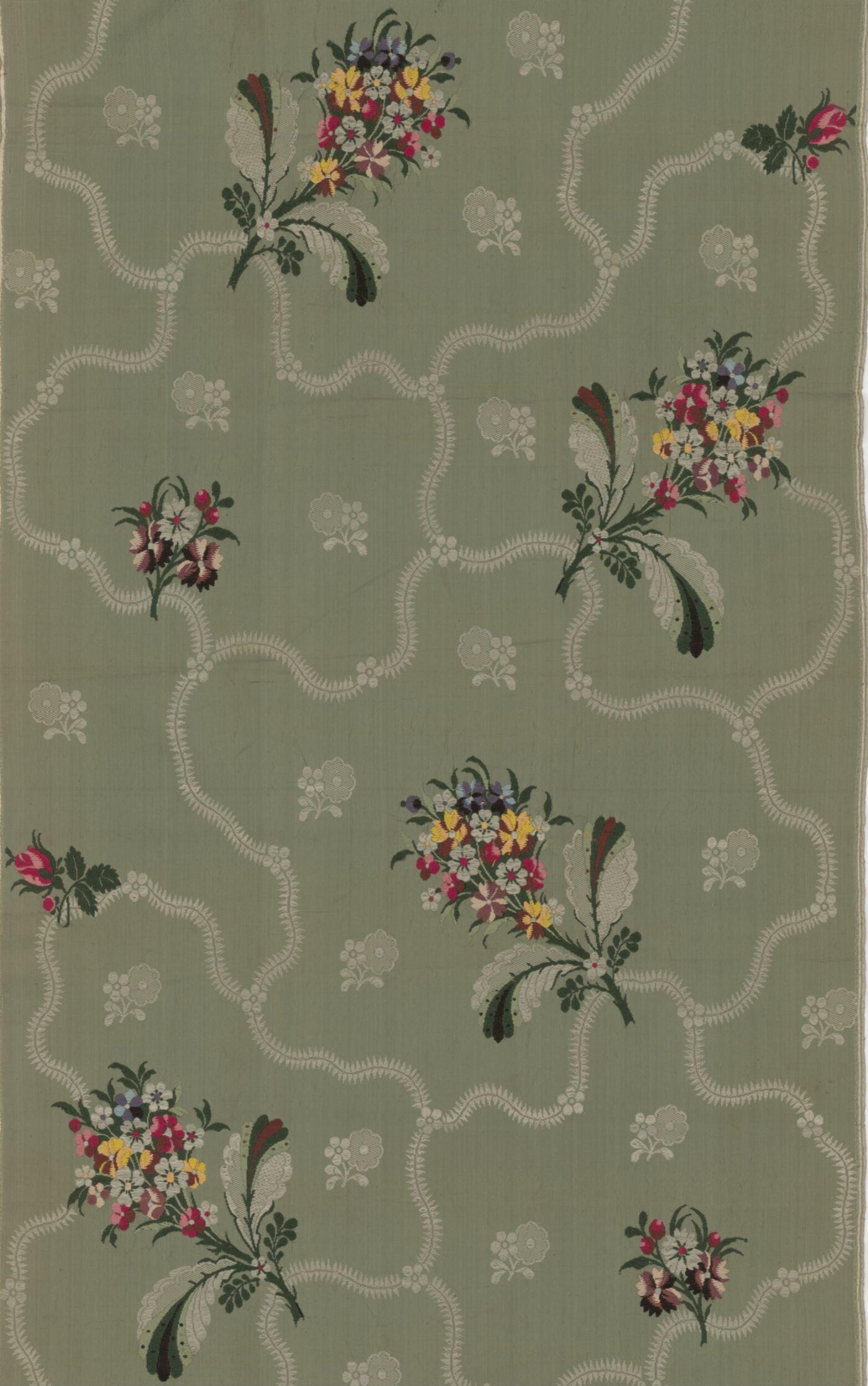
Lustestring – is another fabric that did not appear on either Wikipedia or the silk society’s list and the link is to an item in the Victoria and Albert Museum who have wonderful collections of fabric and fashions throughout the ages. The fabric below is described as “This delicate silk is from a dress said to have belonged to Queen Charlotte, wife of King George III, although this association cannot be proved. Charlotte was seventeen at the time of her marriage to the King in 1761, which was around the time when the silk was woven. It is a lustring, or lutestring, a lightweight silk with a glossy surface.”
Mockado – Mockado (also moquette,moucade) is a woollen pile fabric made in imitation of silk velvet from the mid-sixteenth century. Mockado was usually constructed with a woollen pile on a linen or worsted wool warp and woollen weft, although the ground fabric could be any combination of wool, linen, and silk. Mockado was used for furnishings and carpeting, and also for clothing such as doublets, farthingales, and kirtles.
Osnaburg – a general term for coarse, plain-weave fabric. It also refers specifically to a historic fabric originally woven in flax but also in tow or jute, and from flax or tow warp with a mixed or jute weft.
In the Atlantic plantation complex, prior to the abolition of slavery, osnaburg was the fabric most often used for slave garments.
In the textile industry, a tow (or hards) is a coarse, broken fibre, removed during the processing of flax, hemp, or jute[1] and separated from the shives. Flax tows are often used as upholstery stuffing and oakum. Tows in general are frequently cut up to produce staple fibre.
Rum-Swizzle – Another outlier from my main sources comes from the Oxford English Dictionary in their page on Material world: the language of textiles where, like this post, they explore names of fabrics swirling in historical obscurity, but in the case of rum-swizzle, there is sufficient information preserved in the literary sources for us to have a clear idea of the type of cloth they were. To wit “A a very excellent brownish frieze made in Ireland from undyed foreign wool.” (Frieze: frieze (French: frisé) is a Middle English term for a coarse woollen, plain weave cloth with a nap on one side. The nap was raised by scrubbing it to raise curls of fibre,[1] and was not shorn after being raised, leaving an uneven surface.)
The OED article also mentions novato, puleray, cannequin, grogram, lockram, sannah, shagreen, wadmal, Ticklenburgs, prunella, kreyscloth, gulix, and huckaback (some of these are now under investigation by the Manchester Lexis Medieval Textiles Project). From that project I found another obscure fabric – Sarsnet – a tabby- woven silk cloth, a type of sendal, light and flimsy; made in Europe in the Middle Ages; imports to England probably came from Italy
Scarlet – a type of fine and expensive woollen cloth common in Medieval Europe – a broadcloth (see above) dyed with the red dye – Kermes derived from insects.

Stuff – I couldn’t resist including this item which Wikipedia describes as: any manufactured material. This is illustrated from a quote by Sir Francis Bacon in his 1658 publication New Atlantis: “Wee have also diverse Mechanicall Arts, which you have not; And Stuffes made by them; As Papers, Linnen, Silks, Tissues; dainty Works of Feathers of wonderfull Lustre; excellent Dies, and many others.”
If there are items you expected to see here under “Historical Fabrics” it may be because, though steeped in history, like Calico, for example, they are still being produced today.
There are so many “Historic fabrics” that I couldn’t cover all of them, but they are in the Wikipedia List of Fabrics and include Gulix, Holland cloth, Kerseymere, Korathes, Lockram, Samite, Saye, Swanskin, Toile. At the end of this A to Z, I will include a link to the 248 item spreadsheeet I compiled…
Some non-Historical “H” Fabrics…
Habutai (Japanese silk) – a plain weave cloth commonly used for linings.
Herringbone – also called broken twill weave, describes a distinctive V-shaped weaving pattern usually found in twill fabric. It is distinguished from a plain chevron by the break at reversal, which makes it resemble a broken zigzag. The pattern is called herringbone because it resembles the skeleton of a herring fish.
Hessian (US – Burlap, Crocus – Jamaica) – a woven fabric made of vegetable fibres: usually the skin of the jute plant,] or sisal leaves. It is generally used (in the crude tow form known as gunny) for rough handling, such as to make sacks in which to ship farm products and sandbags (although woven plastics now often serve these purposes), and for wrapping tree-root balls
Houndstooth – Also known as dogtooth, traditional houndstooth check has its origins as far back as 360 BC. However, black and white houndstooth fabric became more mainstream in 19th century Scotland, before emerging into the fashion world in the 1930s.
Back then, houndstooth fabric was known as a symbol of wealth. It was picked up later on by world-famous designers such as Christian Dior, and has dominated fashion and home interior catalogues ever since.


I compiled a list of as fabrics, fibres and related items as possible (278 items), from several sources, the most comprehensive of which was Wikipedia. Since there aer only 26 letters in the alphabet, I could not write in detail about every instance so I have taken snippets of text for the brief descriptions and linked to the source in the name of the item. I am indebted to all the contributors to those Wikipedia pages and the depth of knowledge to be found there…