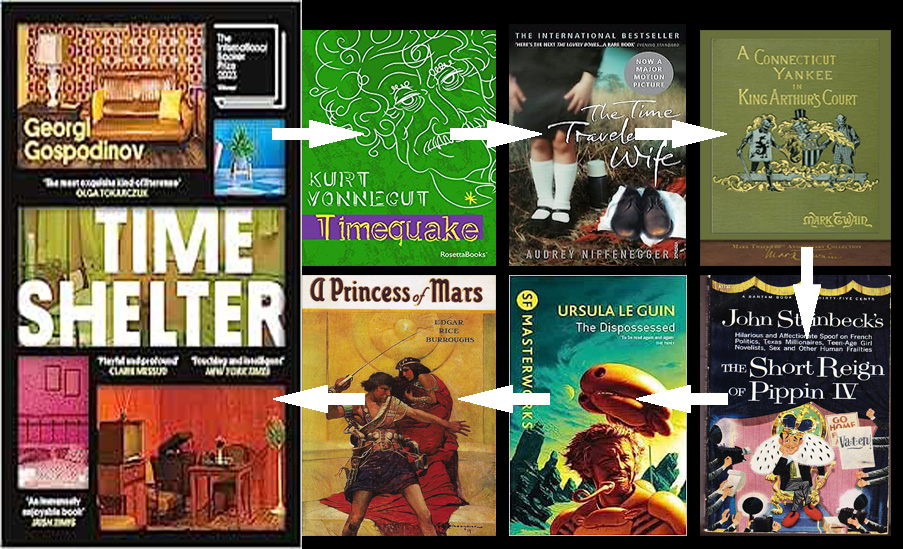
I try to ration myself for prompts, perturbed by the idea that I will be swallowed in an endless cycle of call and response, but one that I will not miss each month, is 6 Degrees of Separation. Starting from a given title, each reader of books – no matter when they read them, summons six links to form a chain that finally links from and back to the beginning book.
I confess I do not make enough time for reading books, words bound between covers on paper as opposed to screens, though I always have one novel and at least one non-fiction on the go – however slow. I confess that the Poets Pub is often the guilty party in keeping me from the books though I do not blame or object because beautiful, moving or informative as books are, the pleasure of company and connection are better still.
I’m afraid my To Be Read list rarely coincides with the 6 Degrees prompt and only sometimes am I moved to purchase the recommendation, but recently I fell hook line and sinker for Time Shelter. The book is a metaphorical creation of memory clinics where sufferers from certain kinds of memory loss may steep themselves – full-immersion – in a room recreating an era from their past and get the backroads to their lost memories cleared of debris. A few weeks or months in which a loved one comes to life again is worth so much to relatives grieving the loss of someone who is still alive…
Dear Readers – I bought the book! I have no regrets and I recommend it even to poets – no! especially to poets so they may dive into a novel length metaphorical fiction that explores memory and loss, health and sickness and if that sounds depressing, I assure you that Time Shelter, by Georgi Gospodinov is most entertainingly told – and now your turn to confess – when is the last time you read a fiction by a Bulgarian?
This is a post in the 6 Degrees of Separation run by Kate W. over at books are my favourite and best in which she gives the starting point of a particular book and invites you to take a journey through 6 other books of your choice, all connecting in some way and perhaps ending up back at the beginning – why not have a go yourself? Challenges are to writing, what scales and arpeggios are to those learning musical instruments, they exercise the faculties, but unlike scales, this challenge is most enjoyable, teasing out as it does, the connections, at a thinking level, between books…
In Time Sheltera 2020 novel by Bulgarian author Georgi Gospodinov, Gaustine, a psychiatrist, creates a clinic for people with Alzheimer’s disease in Zürich which works by immersing patients into rooms containing articles from past decades and stimulating their memories of that period. The narrator is tasked with collecting the artefacts with which the rooms are stocked and travels throughout Europe to complete his mission. But soon the clinic is attracting healthy people who also want to escape a mundane present reality and return, nostalgically to other decades.
This rang a massive bell with me because some thirty-five years ago, I came into contact with a charity called Age Exchange in London, propelled by Pam Schweitzer MBE who pursued funds with the indomitable spirit that is ideal for such a role. They did exactly what the fictional clinic did – trained reminiscence workers to assist suitable dementia patients in recovering memories from the past using a library of artefacts gathered by the charity in Blackheath. The Exchange part of the charity’s name arose because they gathered reminiscences on various themes such as “Can we afford the Doctor?” and turned them into plays (that one was about Britain before the National Health Service) and performed them in schools thus recycling memories through the generations!
Time Shelter is a satire on nostalgia, populism, irony and melancholy and though I had not read it, I have ordered a copy…
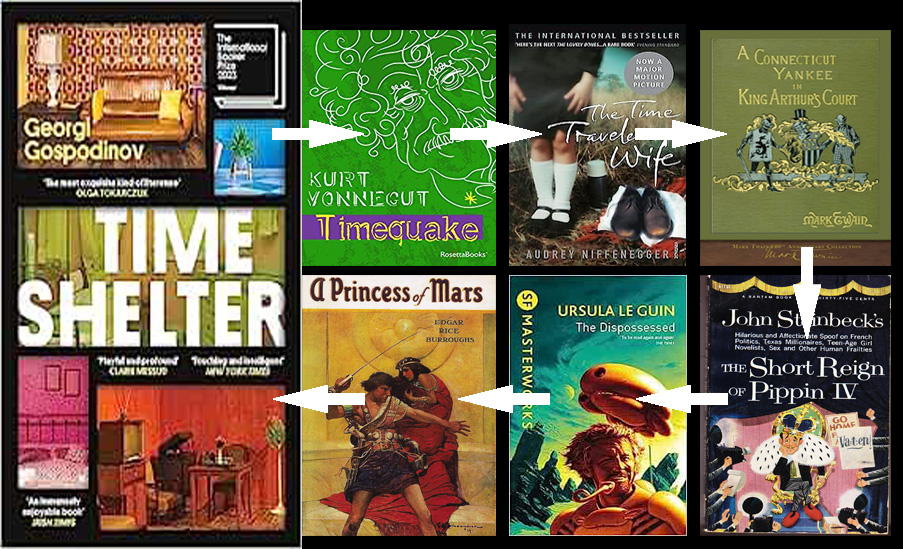
Timequake is a 1997 novel by Kurt Vonnegut Junior (yes – him again!) in which he makes the world relive a decade of their lives with no possibility of change – a study of determinism in which he asserts that people have no free will. As so often with Vonnegut, he weaves personal and family history into the tale with the wry humour which is his hallmark. I think I read this book so long ago that it was back when I still used libraries to source my reading material…
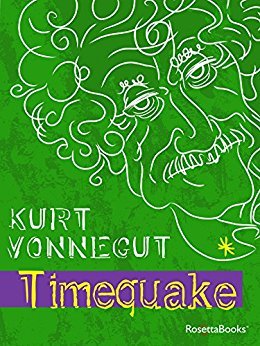
The Time Traveller’s Wife by Audrey Niffenegger (such a Wagnerian-sounding name!) is a book that I had read before watching the film adaptation and although it was a faithful adaptation of it, I still prefer to imagine a story as told in its original form. This book takes further the idea of not being able to be in control of one’s destiny. The eponymous wife is powerless to know when or for how long her husband will disappear into the past or future including her own any more than her husband who is at the mercy of a genetic mutation that plucks him in and out of his timeline at random, each know things about the other’s past and future at different times, often uncomfortably so. This book is a thought experiment, a “what if” but like much speculative fiction, it ultimately reveals more about how we as human beings are than how we might be in the unlikely event that time travel is possible…
A Connecticut Yankeee at the Court of King Arthur by Mark Twain is a satire about monarchy and feudalism. We meet another hapless time-traveller – a Yankee engineer called Hank Morgan who awakes after a bump on the head, to discover that he is in the past at the court of King Arthur. He decides to use his skill to improve the world with his modern knowledge so the book also celebrates Hank’s homespun ingenuity and his sense of the rightness of democracy. Although he ultimately fails (darn that determinism), the book marked a move by Twain from portraying the America of the Gilded Age, to more progressive values.
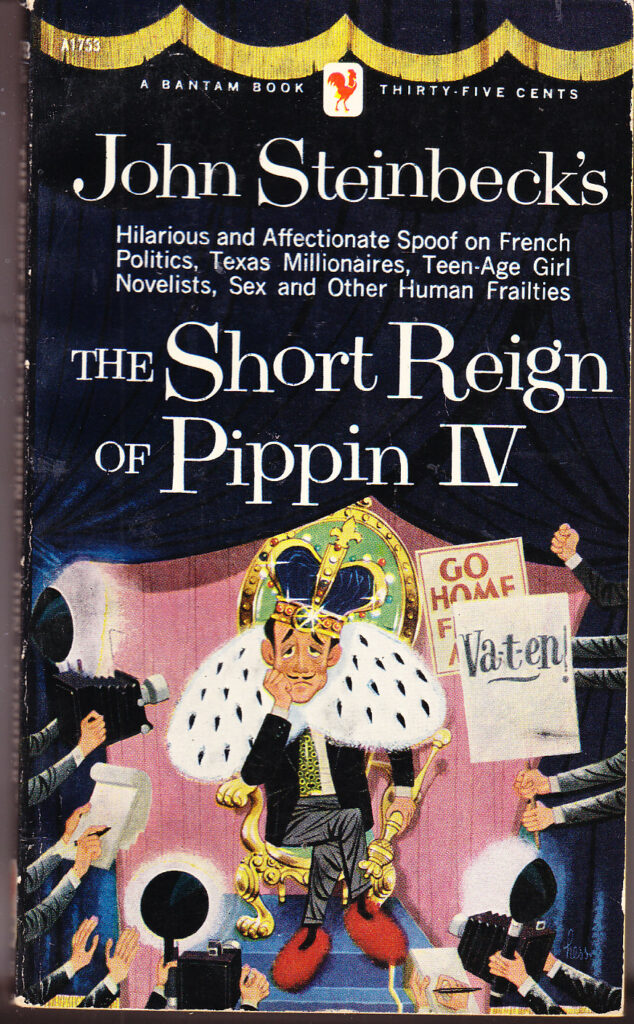
If Hank’s time travel left him in the service of King Arthur, then our next hapless hero is forced to become a king having descended, albeit distantly, from Charlemagne. The Short Reign of Pippin IV by John Steinbeck sits on my bookshelf in a very battered state having belonged first to my father as a young man – it was published when I was just two years old. In a kind of false flag operation by the French communist party, Pippin Héristal, an amateur astronomer is proclaimed King of France (in order that the French people may have something to rebel against – which they eventually do!). Like Hank Morgan, Pippin Héristal tries to make the best of what has been thrust upon him by doing what he thinks might make a difference but fate is already against both of them…
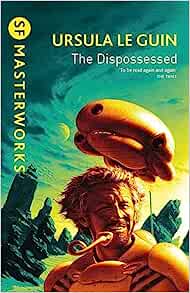
In the next link, another man is tested, this time by two different and opposing societies – in The Dispossessed by Ursula Le Guin, the world of Urras is a capitalist society divided into two competing superpowers – so much like our own world. The habitable, but resource-poor moon of Urras, is Annares and 200 years before, the rebellious factions of Urras have been sent or volunteered to go there where they have formed a society based on anarcho-syndicalism. Given the lack of resources and the inefficiency of the societal model, Annares is not exactly a thriving place to live. The leading character is Shevek, who Le Gin identified as being based on J. Robert Oppenheimer – often referred to as “the father of the atomic bomb” and who regarded his involvement in the Manhattan Project as that of a physicist and on seeing the first test of the Trinity bomb, said he thought to himself “Now I am become Death, the destroyer of worlds.”. Of the subsequent use of nuclear bombs on Hiroshima and Nagasaki, he told President Truman he felt he had “blood on my hands”, which did not go down well. In The Dispossessed. Shevek has a similar quandary when he tries to develop a General Temporal Theory and is blocked by a jealous superior and frustrated by his obligation to contribute manual work to society. He decides to go to Annares where he is welcomed because the capitalists see in his work, the opportunity to develop a spacecraft that will make crossing to the stars possible. But while capitalism thrives on his work, Shevek becomes involved with a new revolutionary underclass… Once again, Ursula Le Guin gives the lie to the writing maxim that “big issues are dead weights” – you just need to be a brilliant writer to incorporate them into the right story!
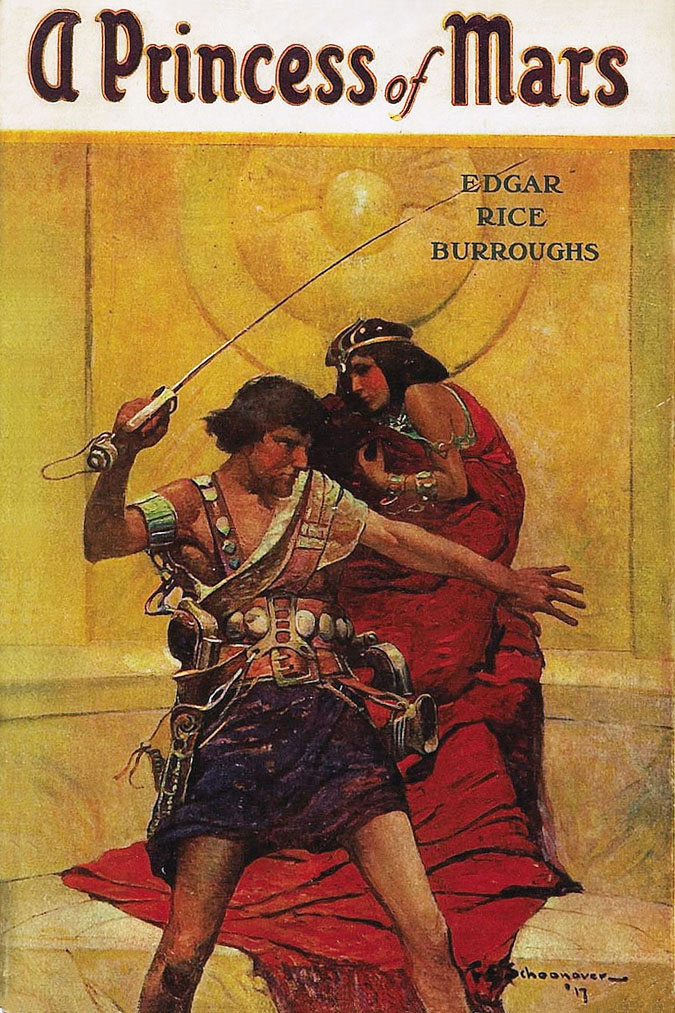
After such erudite stuff, the last book of my six may seem a little frivolous in style, but it contains all the elements we have seen on this journey, a man thrust out of his own time and/or place, into a different world in which he must try to do his best to survive, thrive and even contribute what he knows to the betterment of the society he finds himself in. A Princess of Mars (Barsoom) – is a genre-busting novel by Edgar Rice Burroughs, he of Tarzan fame, and in his Barsoom series, he gives us – planetary-romance, fantasy, sword and planet, and post-apocalyptic speculative fiction from before those terms were even minted! This is not a science fiction book that depends on technology such as spacecraft since the hero – John Carter – transitions to Mars without explanation when in a tight spot on Earth and later returns, again without any control on his part. Edgar Rice Burroughs’ works are full of violent action and derring-do, but the breadth and depth of his imagination made him a huge influence on many later writers – Robert A. Heinlein, Arthur C. Clarke, and Ray Bradbury, H. P. Lovecraft, James Cameron, and George Lucas to name a few.
Finally, what links A Princess of Mars back to Time Shelter, is nostalgia – just as the “healthy” people in Time Shelter, are drawn to use the retro rooms of the clinic because they are fed up with their contemporary lives, so A Princess of Mars harks back to a rose-tinted view of American past – the frontier life when the good were good, you knew who was bad, and men were men and women swooned –” “the good old days”…?