“Choose any subject you would like to write about…” that is the object of the A to Z Challenge, and thinking of things that interest me is not a problem for me, but choosing a subject not only to write about, but to write in a way that other people will catch my interest – that is the real challenge! This year I turn to a subject, close to our skin if not our hearts, and yet, again, I wonder if this subject will get some people past the title on the list – dismissed as niche? For this year, my theme is What We Wear – Fabrics and Fibres
Jamdami
I am going to start with Jamdami, because, in many ways, it proceeds the techniques of Jacquard looms and machine Jersey Jacquard decorative fabric techniques which this post will cover. Jamdami is referred to as extra-weft ornamentation, on-loom embroidery, or discontinuous weft1. Okay, let’s break down the jargon – on a loom which is set up for Muslin (a very fine fabric) portions of the weft are lifted up and threaded with a needle or very small shuttle to produce a design motif.
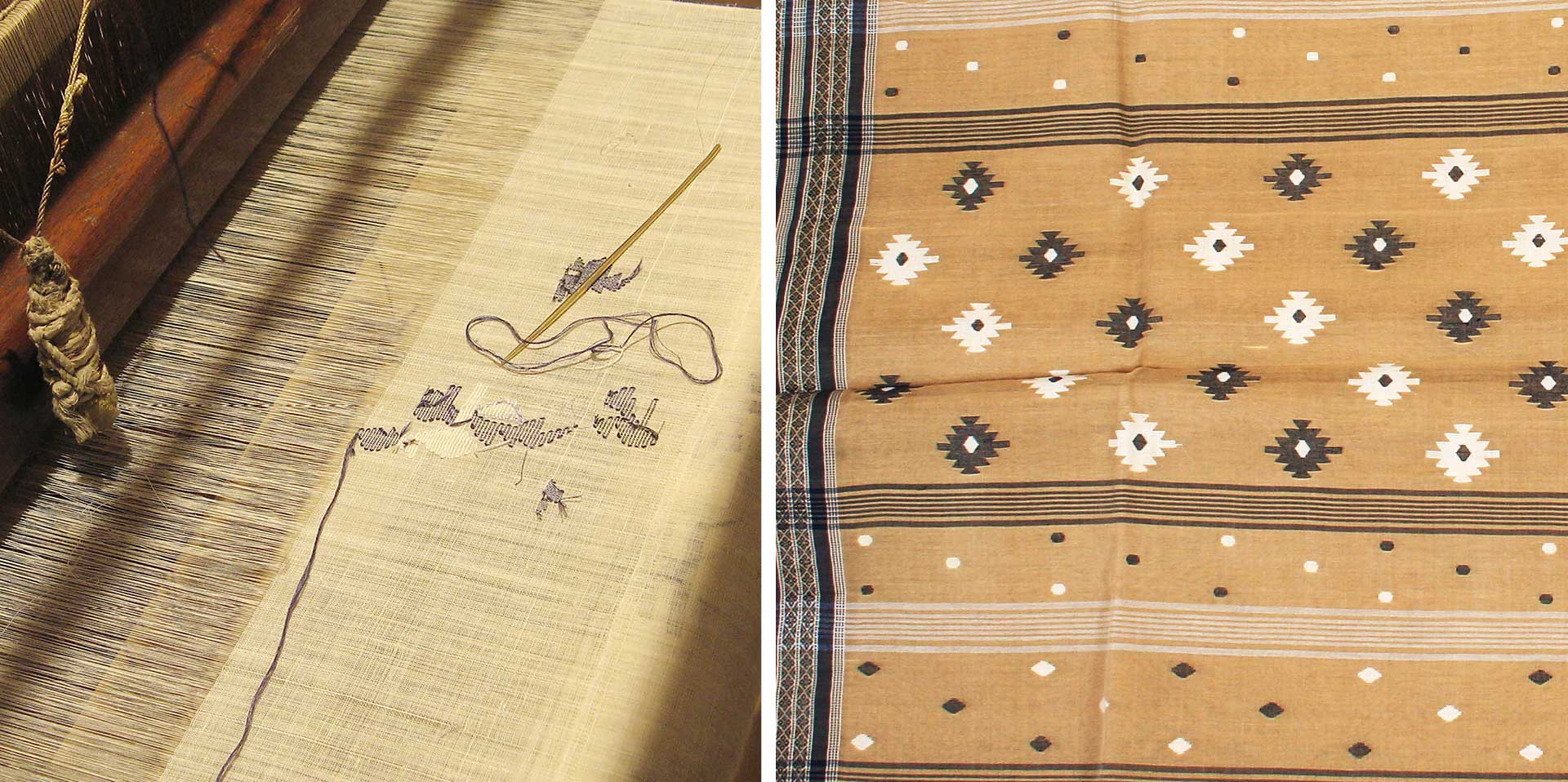
This is a painstaking process and Jamdami was not cheap. Dhaka in Bangladesh was a centre of excellence and Daccia mul was so exquisite that when the city was under British rule, orders were given to cut off the thumbs of weavers to prevent competition with milled British fabrics.1
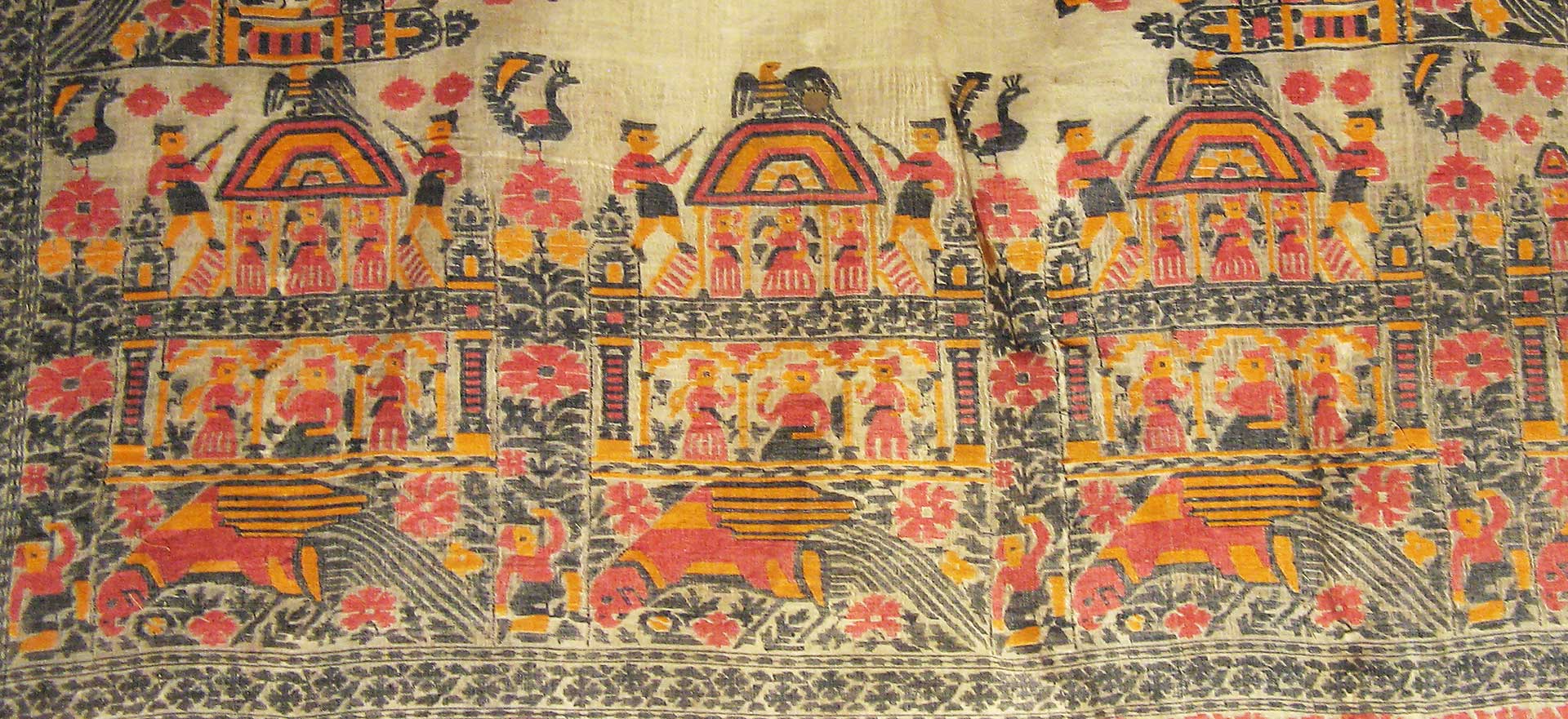
Amir Khusro, the famous thirteenth-century Sufi poet, described fine handspun, handwoven cotton so fine that 100 yards could pass through a needle, with a transparency more like water than cloth. He described a fabric so beautiful that it was likened to air, moonlight, clouds, and water: magnificent muslin. In reality, the fabric was so fine that several layers could pass through a signet ring, and it was so light that if washed and tossed in the air, it would dry before landing. Poetry, romance, royalty, legendary tales, trade worth a king’s ransom, secrecy, cutthroat competition—these are all part of the history of muslin and especially the decorative muslin known as jamdani.1
Jacquard
There are a number of ways to introduce different coloured patches of colour into a fabric, we already encountered Intarsia under “I” – knitting, which changes yarn at the boundaries of a different colour and we also saw Jacquard under the decoration of Fabrics but when you have many repeated motifs in knitting, such as Fair Isle, then its easier to carry the yarn across the back (floats), which, however, carries the risk of snagging .
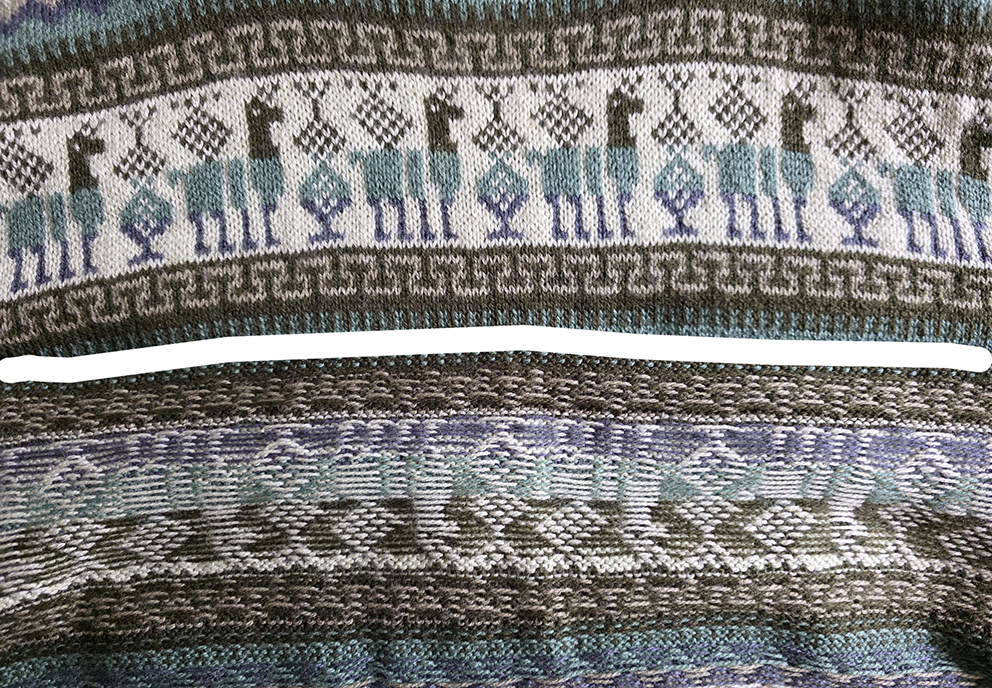
The following video explains how to avoid long carry-over threads on the back of the work, which could be caught by fingers when putting on a sweater, say. Two techniques are mentioned – one is Ladder-backing which catches the carry-over threads (floats) at regular intervals and the other involves double knitting – a second layer of knitting behind the main layer in the second colour, which is then brought forward when required for the design. It raises the question of what is really the front and which the back of a fabric. for example, in a decorative fabric which is not for general wear, it might be fine to have, say, gold threads as floats across the front face without them being interrupted by warps.
Jacquard is also a feature of machine knitting, and in the next section, we shall see machines doing just that! In a way, machine-knit Jacquard is doing, effortlessly, in knitted form, what Jamdami weavers did so painstakingly on a loom…
Jersey – the fabric…
Jersey, named for the fisherman’s sweaters originating in the Channel Island of Jersey, is now given to a wide range of machine-knit fabrics and being knitted, it naturally has a very stretchy quality. Although originally knitted with wool, nowadays, cotton and synthetic yarns are used, and should they require more elasticity (being somewhat stifffer fibres), then Lycra, Spandex or elastane can be added (more of these later).

So far we have seen a lot of woven fabrics – woven on looms, but in Knitting, we came to interlocked loops as a technique – one going back into pre-history, yet it was inevitable that, sooner or later, some ingenious fellow would work out how to mechanise the knitting process. As far back as the 16th Century, that fellow was William Lee was an Anglican clergyman, born in Calverton, Nottinghamshire. “By studying how the fingers of some local hand knitters moved, he came up with a ground-breaking mechanical device (the stocking frame knitting machine).”2 Since then, a plethora of machines have developed and roughly 37% (and growing), of the world’s fabrics are knitted as opposed to woven. The video below shows some of the many types of knitting machines including ones that produce Jacquard decoration.
Note the many yarns being threaded into the machines – this is how most machine-knitting differs from hand-knitting – there a single yarn is worked backwards and forwards, row by row, whereas on these machines, every needle is fed a separate yarn which is passed onto the next needle with each pass.
Types of Jersey
- Single Jersey
- Double Jersey
- Interlock Jersey
- Jacquard Jersey
- Stretch Jersey
For a full description of these types of jersey, go to How to sew jersey fabric: Everything you need to know about sewing with jersey
You can see that some of these machines produce giant tubes of knitted fabric so that it is possible to make the torso of a sweatshirt (providing it is straight and not shaped) to be seam-free and the same with the sleeves – made in a smaller diameter tube, however the following video shows T-shirts being made but cut into panels to allow heat-transfer printing to be put on before stitching the garment up.
If you want to learn how to make your own T-shirt – if, for example, you have one that fits you better than most bought ones, this blog post will show you how… How to Make Your Own T-Shirt Pattern using jersey fabric.
I compiled a list of as fabrics, fibres and related items as possible (278 items), from several sources, the most comprehensive of which was Wikipedia. Since there are only 26 letters in the alphabet, I could not write in detail about every instance so I have taken snippets of text for the brief descriptions and linked to the source in the name of the item. I am indebted to all the contributors to those Wikipedia pages and the depth of knowledge to be found there…
Fantastic u r doing a to z challenge
Good luck :).
Am surprised u know about jamdani 🙂
It’s famous in India too
Good to know in detail about these fabrics
And amir khusro is one of my favs
All the best a to z
Afshan – how lovely to see you here – of course I only know about Jamdani as a result of my deep research dive into the world of fabrics and I am delighted that I found a quote from one of your favourite poets…
It’s fun to look at jersey and see the itty bitty knit stitches on it.
Yes it is!
To me, watching those machines, it feels like magic.
Who was it said that advanced technology could seem like magic – I’m thinking Asimov?
Hi Andrew and Lisa:
It was Arthur C. Clarke.
He is another hard science fictioneer like Isaac Asimov.
The “magic” quote is his Third Law:
https://en.wikipedia.org/wiki/Clarke%27s_three_laws
And he used it to talk about Unidentified Flying Objects [which we now know as Anomalous Phenomena].
I love what other people have done with it.
Relevant for here: Any sufficiently familiar technology is indistinguishable from nature. [Karl Schroeder 2011 in the AEON magazine].
Thanks for that Adelaide – of course it was!
Those are lovely pictures. I have fleece, which keeps me warm but isnt as pretty as those.
Maybe Mummy would make me a jersey fleece?
I’m sure if Mummy brushes your fur out and keeps the resulting fluff, she could have it spun into yarn and knit a jersey of your very own fur!
Great post. My favorite video is the one on how to make your own T shirt pattern by using an old Tee.
That was useful wasn’t it…