A to Z Challenge 2026 – “J” is for Jersey, Jute and Jamdami…

“Choose any subject you would like to write about…” that is the object of the A to Z Challenge, and thinking of things that interest me is not a problem for me, but choosing a subject not only to write about, but to write in a way that other people will catch my interest – that is the real challenge! This year I turn to a subject, close to our skin if not our hearts, and yet, again, I wonder if this subject will get some people past the title on the list – dismissed as niche? For this year, my theme is What We Wear – Fabrics and Fibres

Jamdami

I am going to start with Jamdami, because, in many ways, it proceeds the techniques of Jacquard looms and machine Jersey Jacquard decorative fabric techniques which this post will cover. Jamdami is referred to as extra-weft ornamentation, on-loom embroidery, or discontinuous weft1. Okay, let’s break down the jargon – on a loom which is set up for Muslin (a very fine fabric) portions of the weft are lifted up and threaded with a needle or very small shuttle to produce a design motif.
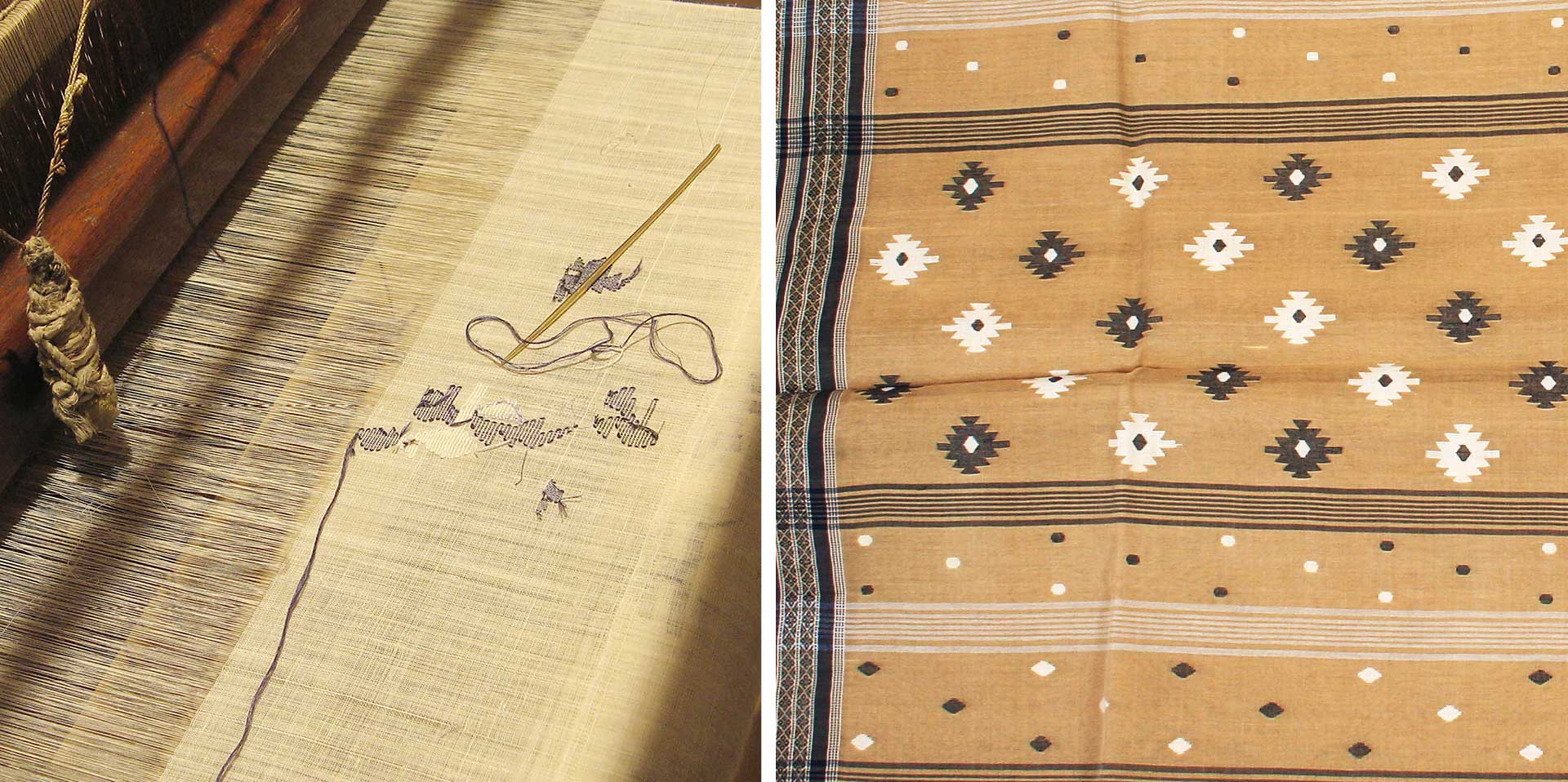
Left: Close-up of jamdani weaving on muslin on the loom, showing the needle and the motifs akin to embroidery. Right: Jamdani weave on the pallav (decorative end) of a saree.1

This is a painstaking process and Jamdami was not cheap. Dhaka in Bangladesh was a centre of excellence and Daccia mul was so exquisite that when the city was under British rule, orders were given to cut off the thumbs of weavers to prevent competition with milled British fabrics.1
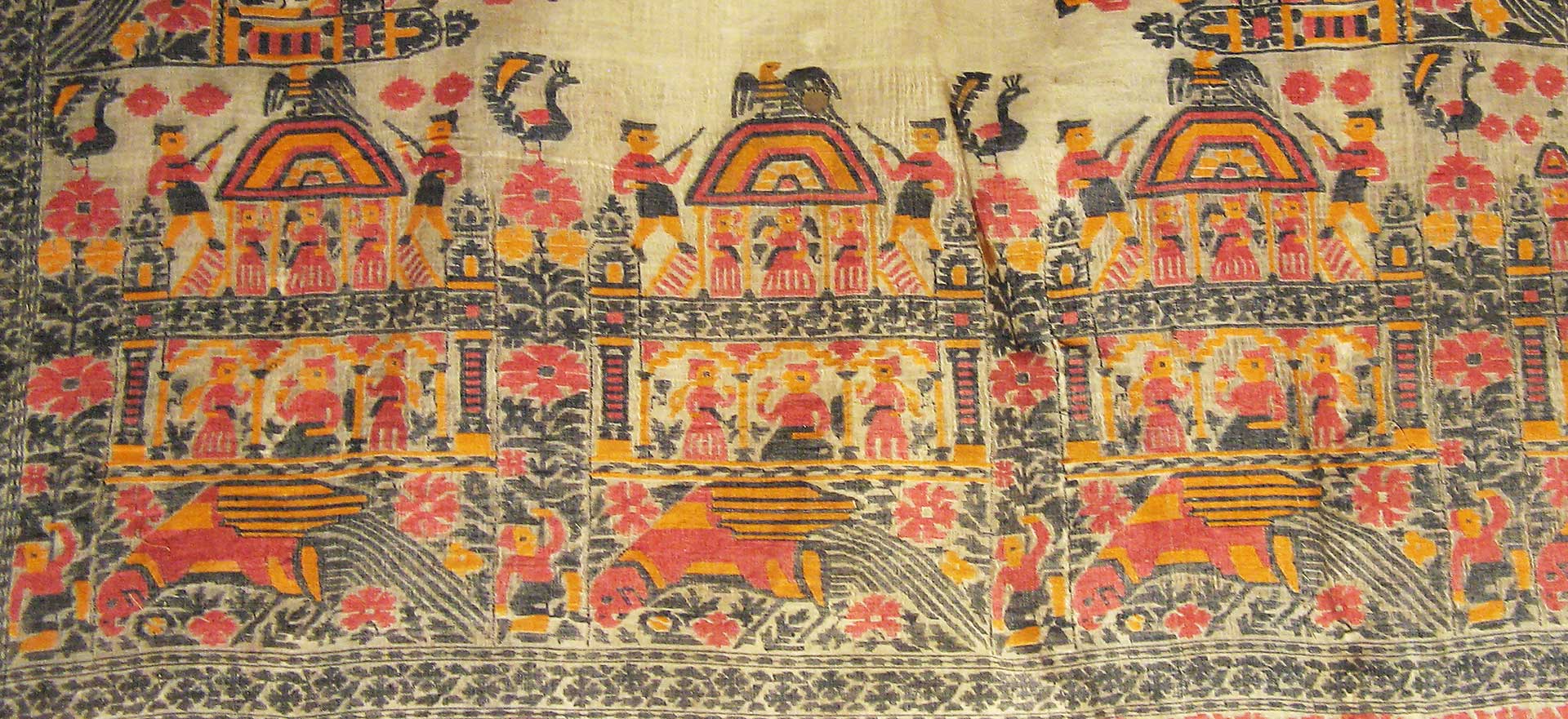
A rare jamdani piece with borders and pallav woven in a multitude of shades on fine cotton muslin.1

Amir Khusro, the famous thirteenth-century Sufi poet, described fine handspun, handwoven cotton so fine that 100 yards could pass through a needle, with a transparency more like water than cloth. He described a fabric so beautiful that it was likened to air, moonlight, clouds, and water: magnificent muslin. In reality, the fabric was so fine that several layers could pass through a signet ring, and it was so light that if washed and tossed in the air, it would dry before landing. Poetry, romance, royalty, legendary tales, trade worth a king’s ransom, secrecy, cutthroat competition—these are all part of the history of muslin and especially the decorative muslin known as jamdani.1

Jacquard

There are a number of ways to introduce different coloured patches of colour into a fabric, we already encountered Intarsia under “I” – knitting, which changes yarn at the boundaries of a different colour and we also saw Jacquard under the decoration of Fabrics but when you have many repeated motifs in knitting, such as Fair Isle, then its easier to carry the yarn across the back (floats), which, however, carries the risk of snagging .
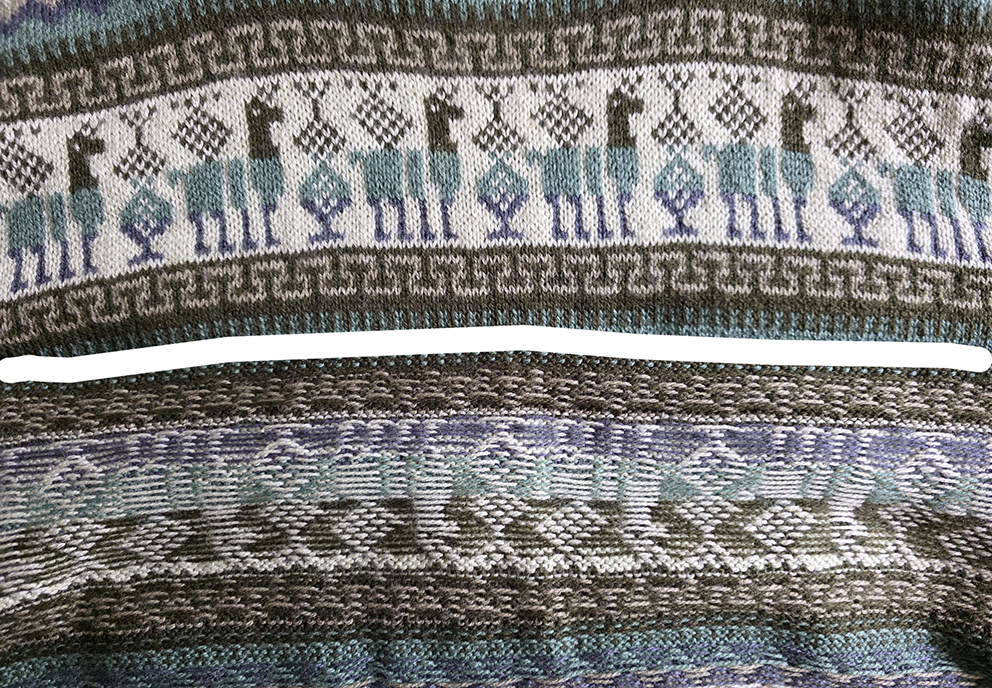
In this beautiful sweater brought for me from the Andes – in the top half you can see the repeated patterns including Llamas, whilst belowthe white line, i have folded it back to show a mirror immage of the reverse of the pattern showing the “floats” resultant from this form of Jacquard knitting.

The following video explains how to avoid long carry-over threads on the back of the work, which could be caught by fingers when putting on a sweater, say. Two techniques are mentioned – one is Ladder-backing which catches the carry-over threads (floats) at regular intervals and the other involves double knitting – a second layer of knitting behind the main layer in the second colour, which is then brought forward when required for the design. It raises the question of what is really the front and which the back of a fabric. for example, in a decorative fabric which is not for general wear, it might be fine to have, say, gold threads as floats across the front face without them being interrupted by warps.

Jacquard is also a feature of machine knitting, and in the next section, we shall see machines doing just that! In a way, machine-knit Jacquard is doing, effortlessly, in knitted form, what Jamdami weavers did so painstakingly on a loom…

Jersey – the fabric…

Jersey, named for the fisherman’s sweaters originating in the Channel Island of Jersey, is now given to a wide range of machine-knit fabrics and being knitted, it naturally has a very stretchy quality. Although originally knitted with wool, nowadays, cotton and synthetic yarns are used, and should they require more elasticity (being somewhat stifffer fibres), then Lycra, Spandex or elastane can be added (more of these later).

Arrangement of interlocking stitches in single jersey

So far we have seen a lot of woven fabrics – woven on looms, but in Knitting, we came to interlocked loops as a technique – one going back into pre-history, yet it was inevitable that, sooner or later, some ingenious fellow would work out how to mechanise the knitting process. As far back as the 16th Century, that fellow was William Lee was an Anglican clergyman, born in Calverton, Nottinghamshire. “By studying how the fingers of some local hand knitters moved, he came up with a ground-breaking mechanical device (the stocking frame knitting machine).”2 Since then, a plethora of machines have developed and roughly 37% (and growing), of the world’s fabrics are knitted as opposed to woven. The video below shows some of the many types of knitting machines including ones that produce Jacquard decoration.

Note the many yarns being threaded into the machines – this is how most machine-knitting differs from hand-knitting – there a single yarn is worked backwards and forwards, row by row, whereas on these machines, every needle is fed a separate yarn which is passed onto the next needle with each pass.

Types of Jersey

  • Single Jersey
  • Double Jersey
  • Interlock Jersey
  • Jacquard Jersey
  • Stretch Jersey

For a full description of these types of jersey, go to How to sew jersey fabric: Everything you need to know about sewing with jersey

You can see that some of these machines produce giant tubes of knitted fabric so that it is possible to make the torso of a sweatshirt (providing it is straight and not shaped) to be seam-free and the same with the sleeves – made in a smaller diameter tube, however the following video shows T-shirts being made but cut into panels to allow heat-transfer printing to be put on before stitching the garment up.

If you want to learn how to make your own T-shirt – if, for example, you have one that fits you better than most bought ones, this blog post will show you how… How to Make Your Own T-Shirt Pattern using jersey fabric.

  1. Jamdani: Fabric of Moonlight
  2. What is jersey fabric?

I compiled a list of as fabrics, fibres and related items as possible (278 items), from several sources, the most comprehensive of which was Wikipedia. Since there are only 26 letters in the alphabet, I could not write in detail about every instance so I have taken snippets of text for the brief descriptions and linked to the source in the name of the item. I am indebted to all the contributors to those Wikipedia pages and the depth of knowledge to be found there…
A to Z Challenge 2026 – “D” for the Decoration of Fabric

“Choose any subject you would like to write about…” that is the object of the A to Z Challenge, and thinking of things that interest me is not a problem for me, but choosing a subject not only to write about, but to write in a way that other people will catch my interest – that is the real challenge! This year I turn to a subject, close to our skin if not our hearts, and yet, again, I wonder if this subject will get some people past the title on the list – dismissed as niche? For this year, my theme is What We Wear – Fabrics and Fibres

Almost as soon as the art of weaving or knitting fabrics was mastered, then the possibilities of creating decorative effects with the craft, blossomed. Mary Schoeser in her World Textiles – A Concise History1, says of the period between 3000BC and 400BC, that although normally categorised historically as the Bronze and Iron Ages, they might equally be termed the Dye and Loom Age. Whilst it is true that iron shears were necessary to shear livestock for fibres to make fabric, the technological and chemical developments are at least as impressive and important as those in Metallurgy.

Dyeing is the simplest of ways to decorate a fabric and if the fibres/yarns are dyed first, before weaving, then the second way of producing decorative effects becomes possible by using different coloured yarns in the same piece of cloth – think stripes, plaid. Tartan not to mention fabrics that use different colours for warp and weft and that is before you use the lifting of some selective warps to give a design. There is alternating stitch patterns in knitting or weave types in weaving, introducing thicker threads – the variety of ingenuity is incredible!

Beyond dyeing, there are ways of embellishing fabrics such as embroidery, adding in beads, using a fabric as a base for some other technique – lacemaking, needlepoint tapestry, hooking or rag-rugging, but let’s start with the advances in chemistry brought about by dyeing.

There are three types of Dye which are each suitable to be applied to different types of fibre using different chemical methods:-

Reactive Dyes: Primarily used for cellulose (plant derived) fibres such as cotton, linen and semi-synthetics like rayon, where the dyes form strong covalent bonds with fibre hydroxyl groups (-OH) resulting in high, wet, fastness of colour.

Direct/Acid dyes:- Utilise hydrogen bonding and Van der Waals forces,  to attach to proteins (animal derived) – amino acid groups attract dyes through ionic interactions.

Disperse Dyes:- Non-water-soluble dyes used for hydrophobic synthetic fibres like polyester, dyes which are absorbed as a solid solution under high heat and pressure.

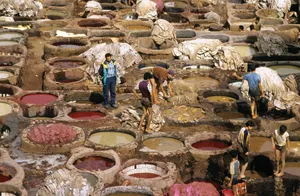
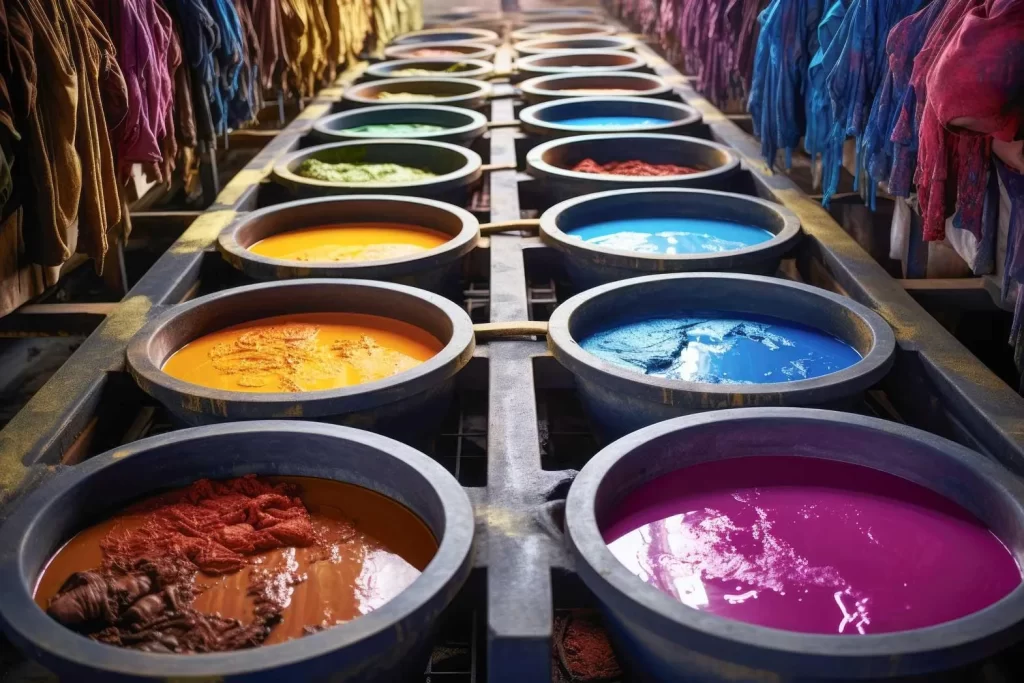
Of course, the early dyers didn’t know the meaning of all this chemistry, they discovered things empirically, no doubt early results were a result of accidental contamination, but the dyer’s vats became the crucible for chemical experimentation. Other chemical factors which were discovered and deployed in dyeing include:-

pH Adjusters: Acids or bases (eg. Acetic acid, urine, caustic sods) crucial to initiate bonding of dyes to fibres.

Electrolytes: Salt (NaCl or Na2 SO4) used to force dyes out of solution and onto the fibres

Mordants: Metal ions (Aluninium, copper, iron) which act as a bridges between natural dye molecules and fibre – these illustrate how empirical learning can occur as simply conducting dyeing in different containers made of different metals would produce more or less effective results.

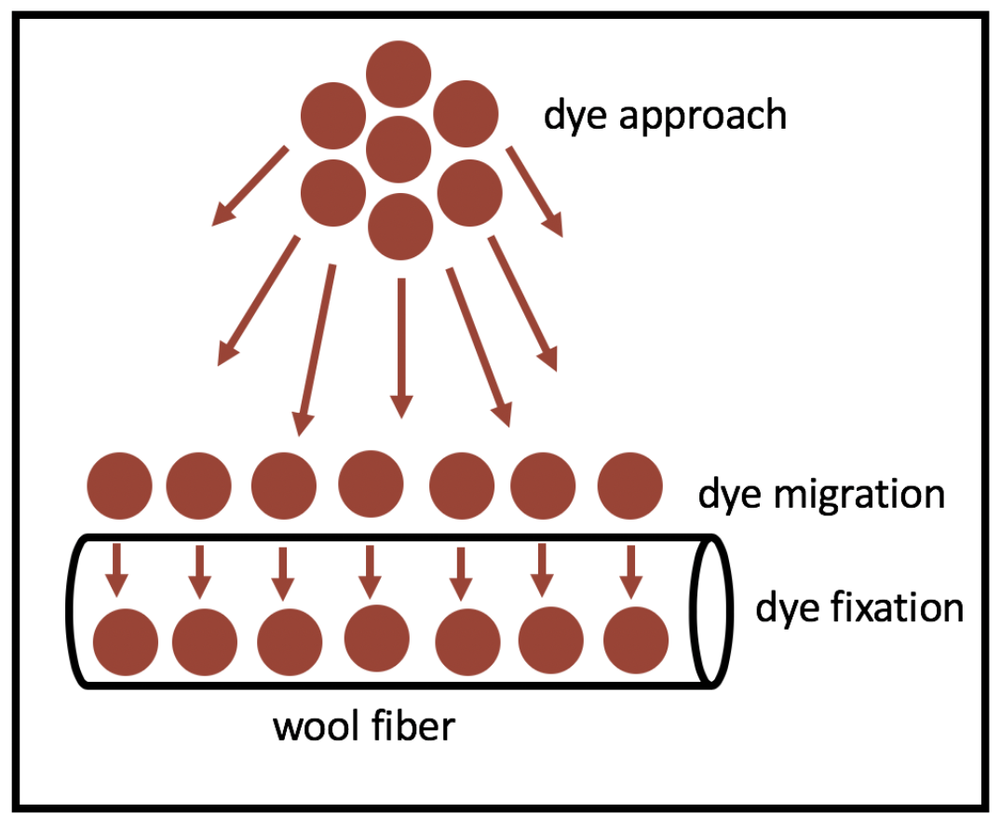
Let’s look at just one dyeing process – that of wool, to understand what happens…

The illustration shows the three stages of wool dyeing, firstly the Dye Approach, in which wool is added to the dye solution and heated up. The dye molecules immediately coat the wool surface but water then moves into the fibre making it swell up and allowing the dye to better penetrate the fibre. Dye Migration – the dye molecules move in and out of the fibre and even themselves out, migrating from darker to lighter areas until an equilibrium of molecules both in the wool fibres and the solution is reached. Dye Fixation – the wool is temporarily removed form the dye bath and a mild acid is added such as citric acid – a mordant that lowers the pH of the bath so that when the wool is returned to the dye bath, the dye molecules are forced to bond with the wool fibre – the bath is heated slightly more and “cooked” for another 60 minutes until the bonding has occurred both on the surface and inside the wool fibres.

and a more modern version from an article on standardisation-of-dyes
 

Textured Weaving Effects are the next simplestway of decorating fabric and we have already encountered the Twill Weave which has produced such classic fabrics as Denim, a tough working fabric which in terms of dyeing, may be warp dyed, undyed, or dyed after weaving – more of denim when we get to working fabrics… but corduroy, cambric (basket weave), and Georgette (made with highly twisted yarns) are all examples of textured weaving.

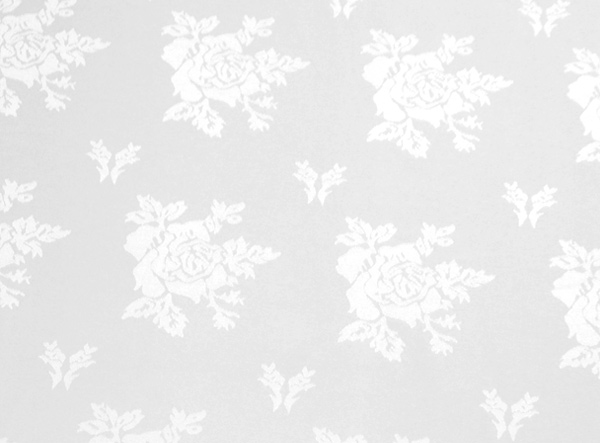
Next, patterns may be woven in – Damask, for example, which at its simplest, achieves patterns with a limited or single coloured yarn by varying the weave texture between satin and plain.

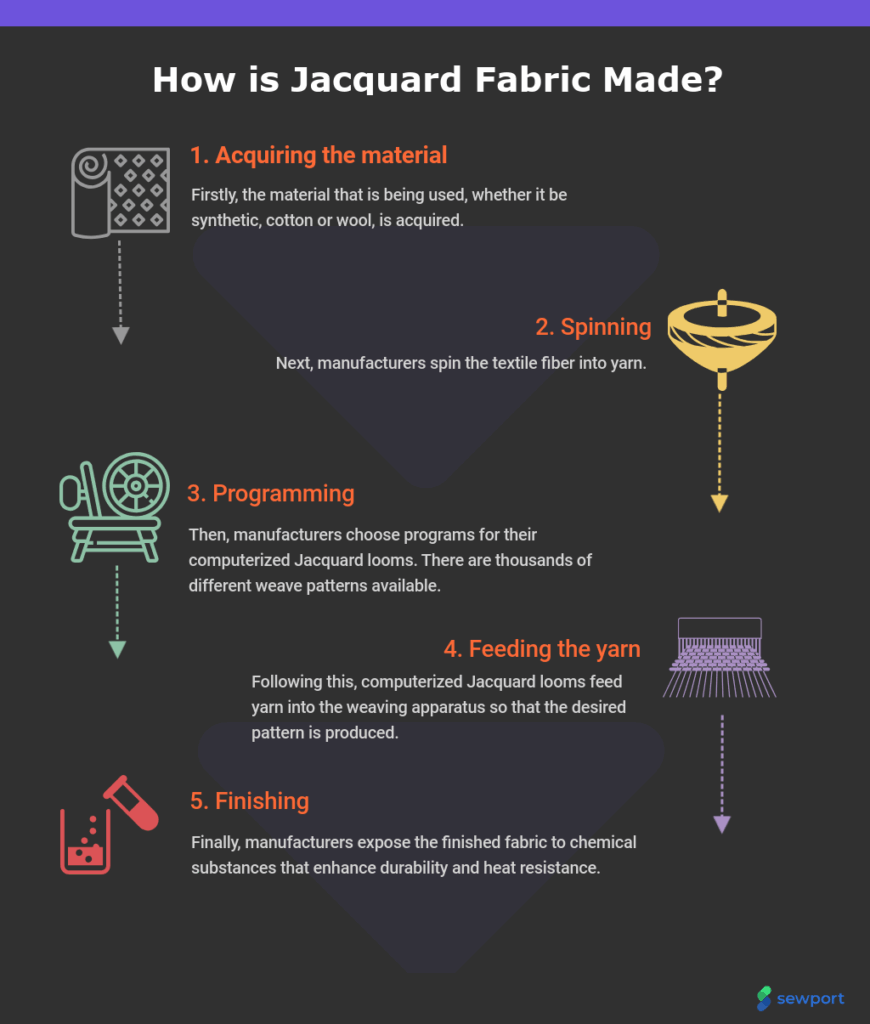
Another fabric in which highly patterned effects are woven in on the loom, is Jacquard – using a Jacquard loom. Producing tough, brocade like fabrics often used for furnishing and curtains.

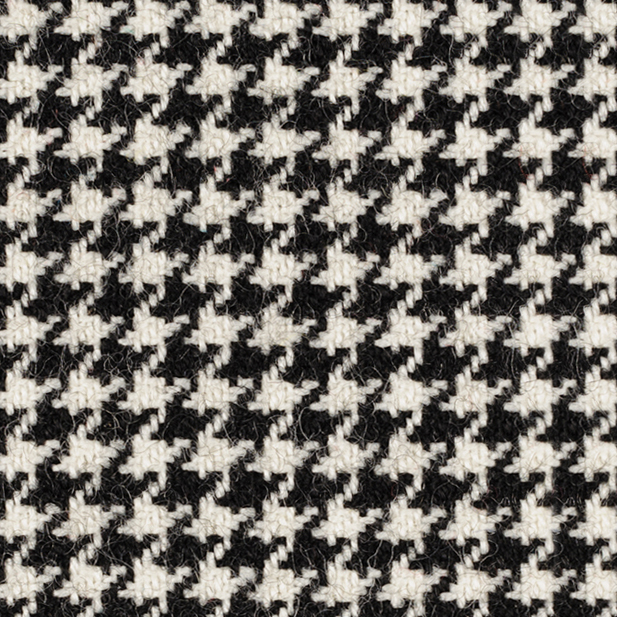
Once you start introducing different coloured yarns you are into a world of plaids and tartan before you even start on more complicated weave patterns like houndstooth.

Troon Houndstooth

This example of houndstooth clearly shows the classic, two-colour weave pattern.

Once a fabric is finished, in can then be embellished with further stitched patterning – Embroidery:- The word embroider has come to mean the addition of anything to anything in order to make it more attractive, detailed, or meaningful – but originally it meant stitching additional threads onto a material. There is so much to say about Embroidery that I am going to give it, it’s own slot tomorrow and Printing on fabrics will be covered when we get to “P”…

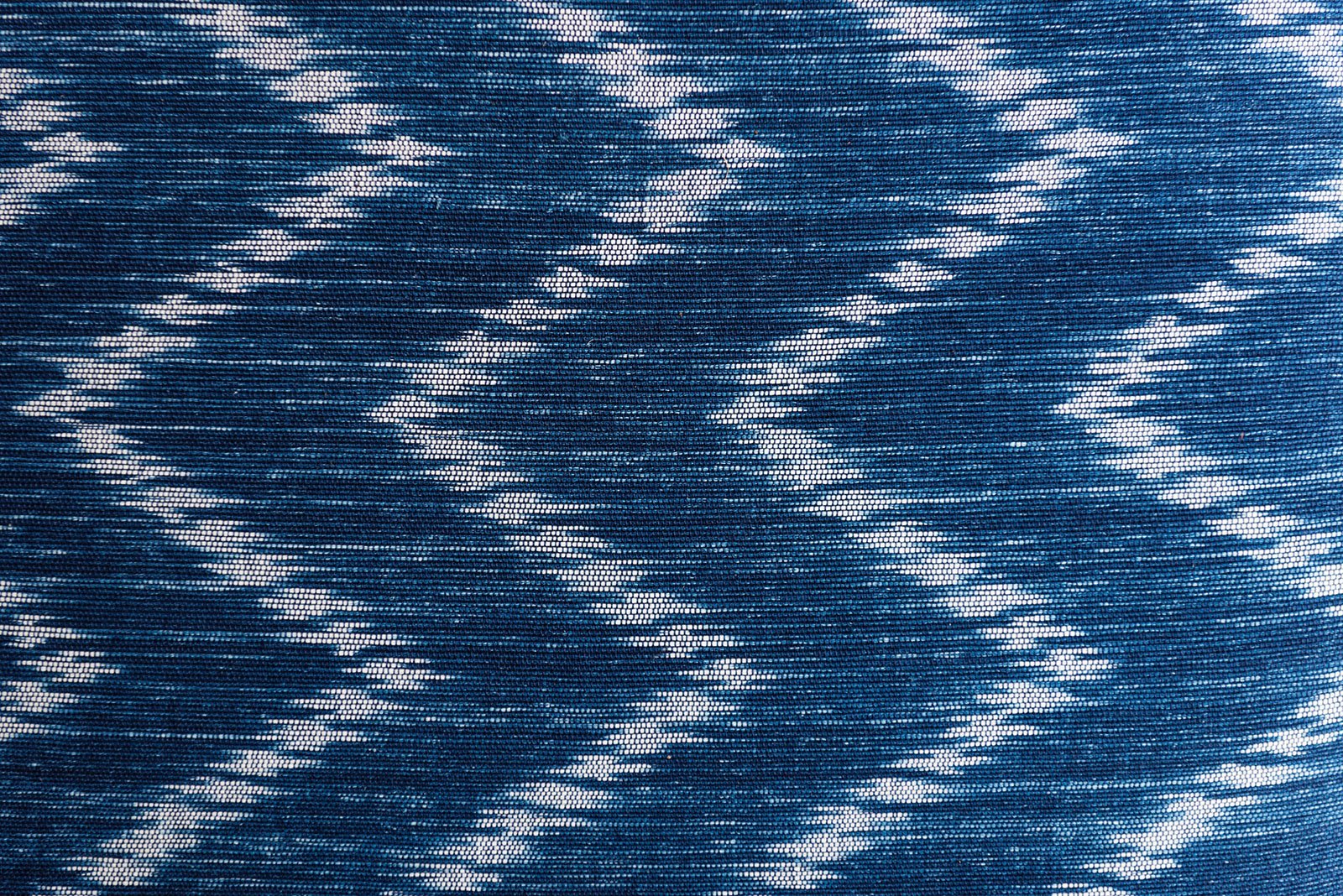
P.S. As Anne M. Bray points out in the comments below, I misssed out Ikat – one of the oldest fabric dyeing techniques – in Ikat, either the warp threads or the weft threads, or both which is the most complex, are bound together in bundles pre-weaving, and treated with wax in patterns that resist the dye and create a pattern in the weave. the patterns have a blurry quality which is quite different to patterns printed on after weaving…

Also from Anne – this excellent link to her SpyGirl: Know Your Plaid…

The decoration of fabric merits n A to Z of its own, but I will leave it there and cover a few “D” fabrics.

Damask Fabric with the pattern woven in. It is reversible, hardwearing and usually made with cotton, silk or linen.

Dimity Collective term for figured cloths of harness loom decorated with designs and patterns. It is a strong cotton cloth with various stripes and illustrations. Dimity is bleached or washed after looming, less often dyed—unlike fustian, which is usually dyed.

Dobby (see also Piqué) a woven fabric produced on the dobby loom, characterised by small geometric patterns and extra texture in the cloth, The warp and weft threads may be the same colour or different. Satin threads are particularly effective in this kind of weave as their texture will highlight the pattern.

Double cloth is a lightweight, sheer cotton fabric, having at least two warp threads thrown into relief to form fine cords. Chiefly, dimity is fashioned into white bed upholstery and curtains, though it is occasionally imprinted with a colourful pattern. Dimity was historically made of silk or wool; however, since the 18th century, it has been woven almost exclusively of cotton.

Double Crepe Heavy textured fabric that is drapey, usually made with silk and wool fibres

Double Georgette Heavy denser version of georgette, characterised by its texture and transparency.

Duchesse Satin weave construction it is a structured cloth characterised by its high shine on one side and matte on the reverse

Dupioni a Plain weave cloth, is characterised by the slubby effect created when raw yarns are woven with more refined silk yarns.

  1. World Textiles by Mary Schoeser – A Concise History, Thames & Hudson world of art 2003 pp. 28

I compiled a list of as fabrics, fibres and related items as possible (278 items), from several sources, the most comprehensive of which was Wikipedia. Since there are only 26 letters in the alphabet, I could not write in detail about every instance so I have taken snippets of text for the brief descriptions and linked to the source in the name of the item. I am indebted to all the contributors to those Wikipedia pages and the depth of knowledge to be found there…