Three fictional responses to the best and worst possibilities that could grow out of present times…
Two roads diverged in a wood, and I—
I took the one less traveled by,
And that has made all the difference.
Two roads diverged in a wood, and I—
I took the one less traveled by,
And that has made all the difference.
Robert Frost
Devolution 1
Gemma – Transformation
I can hardly believe how life has changed since the Covid 19 crisis. And for the better too. Life used to be a merry-go-round of work, kids, husband, sleep, and then work again. Yes, the kids are back at school again – there’s still the husband – lol, and I do work, but it’s different work now. I’m working for myself now. I used to work in a factory, making rubber gloves and my task was to pack the ruddy things into boxes – all day long – mind-numbingly boring! It was a small firm and when the virus struck and the need for personal protection skyrocketed, the boss thought that we’ld be quids in. He wrote to the government offering gloves at a very good price but we heard nothing back and meantime, most of us were on zero-hours contracts and he couldn’t claim the money the government was offering – he had to let us all go. I saw him the other day – coming out of the Social Security Office after claiming for Universal Credit like the rest of us used to – the crisis wiped him out – bankrupt. He said he heard that the PPE contracts all went to some big firm – he said it came out in the paper that some Tory minister had connections with the company… I never trusted the Tories as far as I could throw them – a lot of people I knew went over to them with Brexit, their heads full of nonsense about immigrants and getting our country back, but as far as I can see, the only people who ever stole our country from us, was the sodding Tory government.Anyway, back to lockdown – I went on universal credit and of course, it wasn’t going to come through for weeks, in fact, it took two months – thank God for Mike, my husband and a delivery man, and YES! – his company actually was quids in with the crisis! He worked all through the lockdown flat out and miraculously, managed not to catch the virus. I love Mike to bits but I was so relieved we didn’t have to be locked down 24 hours a day – him, me and the kids – we wouldn’t have made it. Don’t get me wrong, Mike is a lovely man, but he can’t keep still for five minutes so out on the road was the best place for him whilst I did my best with the kids – home-schooling, painting rainbows to thank the NHS, making up quizzes – I didn’t know I had it in me. Course, there were loads of tips on tinternet and that’s where I first saw about people making scrubs for the NHS and Care Home workers – weeks before it was on TV news.
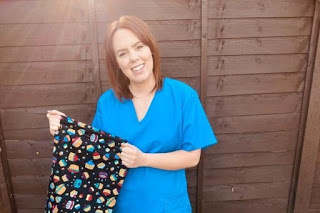
I had my mum’s sewing machine – she used to make clothes for me when I was little but when I was a teenager I had loads of arguments with her because I wanted shop-bought clothes – selfish little minx I was ‘cos she couldn’t afford them. Well, I started teaching myself to use the machine from YouTube videos and soon I downloaded patterns for how to make scrubs. You had to use the right kind of material so they were washable and you made a bag for the scrubs to go in so the workers could put the bag straight in the washing machine without touching the scrubs. It took a bit of practice but soon I got it right and the feeling when I had my first pair collected by the co-ordinator in my area – well! You had to pay to talk to me! Then my kids got interested, Lisa and Liam, they helped me by cutting out the pieces and washing the materials my friends and neighbours dropped off. They still had to do their home-schooling but they went at it with enthusiasm so they could get on to the scrubs. Also, they had a bit more respect for me since they seen what I had done – in the early days I was struggling with their schoolwork – I hadn’t been that hot at school meself but with a bit of patience on their part, we figured stuff out together, mostly. Once the crisis was over, they did their own washing and ironing lol! And I – I started making clothes for a living. While we was still in lockdown, Lisa and I got so fed up with not being able to go shopping for new clothes and we used to watch the Great British Sewing Bee where the contestants had to do a Transformation challenge so we decided – since we couldn’t get any nice fabrics – to take one of my old dresses and make one (a lot smaller) for Lisa. She was so thrilled with it, not just because she had a new outfit ‘cos she couldn’t go out in it (though she shared it on Instagram with all her friends) but because I had made it for her. Who’d have thought it! All that fuss I used to make with my Mum and Lisa went for it! Maybe ‘cos she was proud of what I had done with the scrubs – they weren’t just plain blue or green like regular ones because of the fabrics people gave us, they had patterns and even superheroes from children’s duvets. Then again, all her friends thought her dress was really cool too! I’d never done anything like this and I was so proud of myself and my kids, and how many scrubs we managed to make together! So after the crisis, Lisa and I went to a fabric shop once they opened again and though we started by buying and making a few patterns both for her and me, they were a bit naff and soon I started making up my own ideas. Lisa was using the sewing machine by now and together, we started making clothes for her friends. After a while, the local paper, well it was an online thing, did a feature on me and then a local shop asked if they could show one of my “creations”. Then a small firm asked if they could make one of my “designs” and soon I was making enough money that I came off Universal Credit – what a proud moment that was!
So the crisis did me a big favour, lucky enough, no-one in my family died though one uncle was touch and go, but me, I came out of it with a whole new life and according to the mayor, I have “done something to help the local economy” – result!
Revolution
Annie – 1 – Feral…
God knows we never imagined we’d end up hiding in the Scottish highlands, protected by guns, booby traps and subterfuge, and still the question we keep asking ourselves is – how did it come to this?
Was it that first eleven days when the government dithered around the idea of sacrificing unknowable numbers of people to, possibly, arrive at herd immunity? Of course, they knew at that stage that the elderly were affected more by Covid 19 and who knows whether, in the Cabinet meetings, they dared to whisper the idea that culling of the ever more expensive baby-boom generation would solve a lot of problems, reduce the pressure on the NHS costs, liberate inheritance money to the next, less fortunate generation. Of course, there was the unfortunate fact that these were the Tory party’s traditional power base voters, but heck, they had five years till the next election and maybe that next generation would be grateful and pick up the votes…
I am on Guard duty, as usual. Mr McPherson, Jock is tending to his animals with help around the farm from my husband Tom whilst Mrs McPherson, Maggie, is baking bread and making jam from the strawberries that grow well in the sheltered hollow where the farm is nestled. The hollow is completely hidden by a bend at the top of the long straight valley that leads up to it so that you would have no idea that there was a farm here when you look up from the main road below – except for the track leading up the valley. And that was a problem when we arrived with our unwelcome news, two months ago. Tom had been in the army reserves when he was younger so he and Jock worked out a plan to put off anyone tempted to investigate the farm track. We had passed a car whose occupants had been shot at close range where they sat and Tom and Jock loaded up onto Jock big trailer and brought it back to the farm. Carefully positioned in the entrance to the farm track, as if trying to leave, the car with its gruesome occupants, both blocked the track entrance and hopefully suggested that death had already passed this way and there was nothing to be had here. As long as the group who had murdered the car’s occupants didn’t return and recognize their handiwork – it might work, but then again…
I’m getting ahead of myself. The first two months of lockdown went better than expected in the UK, the hospitals were not overwhelmed by the rising numbers of patients and the people, by and large, accepted the restrictions imposed on them without complaint and clapped every week in appreciation of the bravery and dedication of first, NHS workers, then delivery drivers and anyone not locked down but continuing to work and support the rest of us who were. Then the problem of people living and working in the care sector became apparent. A bit of the shine went off the NHS when it was realized that the people sent back from hospitals to residential homes without testing, in the early days of the crisis when hospitals were being cleared for action, were probably the reason why the virus decimated those homes so quickly and completely. In turn, this reflected on the government for their failure to prepare for a pandemic and the more specific failures in this particular case as well as the suspicion that they just didn’t care enough about the residential homes’ occupants. Under increasing pressure from the press and the public, the government did what it always did, looked for distraction and scapegoats.
People, perhaps orchestrated behind the scenes and in tabloid papers, were clamouring to go back to work and the government stoked it by unclear messages about the safety of doing so, sowing confusion so that no blame could attach to them, or rather nothing that would stick. Lots of people had lost their jobs, mainly in the lower end of the job market, the gig economy, the zero hour contract end of the market. There were a lot of unhappy people as what aid there was to be had from the government, came through slowly – food banks grew in importance. Those that did return to, or find new jobs, were forced to accept lower wages – companies claimed they couldn’t afford more after the lockdown and it was “take it or leave it”.
Of course, nobody in government would have dreamed of officially suggesting the affluent old as scapegoats, but the forces on the right have always pulled the strings in a sly way, whether it’s the Nazis, Moseley’s Blackshirts or the National Front – there’s always someone behind the scenes, whispering in the ears of yobs and disaffected youth. Of course, the concept of an age war had been around before the Covid 19 crisis, babyboomers living in comparative luxury and drawing down NHS services in increasing numbers, and as more things became treatable, demanding those treatments. The younger generation was facing the prospect of paying for this older generation on the “strength” of inadequate jobs, unable to get on the housing ladder, which Margaret Thatcher had sold to the nation as the inalienable right of British citizens. But these rumblings and grumblings might never have come to much without the Covid 19 crisis…
I squint down the telescopic sight on my automatic rifle and check that the farm track is clear right down to the road. There are grass and weeds growing up on it now, which is what we want – no indication that anyone travels up it or that there is anywhere to go to at the top of it. We travel a different route to the road now when we need to, and its usually only Jock and Tom who go, driving a four-wheel-drive buggy over the hills surrounding the farm, and down to the road further along from the now disused farm track, and being careful not to leave evidence of their passage. They make occasional, very discrete outings to check up on other local farms, farms not as lucky as the McGregor’s, lucky that we arrived when we did. The friends who were our first destination, were not so lucky. When the troubles threatened us at our home on the outskirts of Newcastle, we decided to visit Pat Tricia and Steve, some farmer friends near Aberdeen who agreed to our plan – safety in numbers and Tom’s military background was reassuring. We loaded our aged camper van with food and anything we thought might be useful, we locked down our house as best we could in the limited time we felt we had. Gangs were already raiding nearby suburbs on a random basis, the rumours were of scores being settled, particularly conspicuous consumption, flash cars, big houses – they were drawing the attention first. We didn’t expect that our friends’ place would be a target at all – remote as it was, but it turned out, the remote farms, far from being safe in their isolation, were easy pickings for the feral gangs, Killing the occupants if they were older and sometimes even if they were younger – the yobs failed to distinguish between landowners and tenant farmers. They robbed whatever valuables they could find, often torched the property, took the odd sheep for celebratory barbeques back in the cities.
When we arrived at the farm, we could see immediately that there was something wrong – there were a lot of cars parked in the farmyard although we couldn’t see anyone about. Tom parked off the approach track, behind a group of trees. He instructed me to watch the farm from cover, with binoculars and keep in touch with him using our mobile phones on earphone for silent operation. He crept up to the farm along a hedge line. As he made it to the corner of the house, I saw a man with a gun come out of the front door, lean the gun next to the door and wall over to some bushes and start to urinate. Thanks to my silent warning, Tom had flattened himself to the wall and the intruder, wiping some blood on his trousers as he went, passed almost within touching distance of Tom, his Bowie knife already drawn. The intruder didn’t have time to react as Tom cut his throat and fell silently to the ground and Tom dragged his body out of sight. Tom quickly secured the gun – an automatic rifle he told me when he had moved to the cover of a wall on the opposite side of the yard – a position which gave him command of the whole yard. I knew Tom had been on lots of training exercises, but he had never been deployed in an active combat situation – to see him kill a man in cold blood with such decisive efficiency, shocked me to the core. Now he waited until someone else came outside calling a man’s name. A couple of others drifted out, laughing and swigging from a bottle of brandy and joined in the shouting of the missing man’s name. Suddenly Tom started shooting from his concealed position, sweeping the yard with a long burst of automatic fire that dropped all the men to the ground. One other man emerged gun in hand but by the time he had realized all his companions were on the ground, a short burst from Tom despatched him too. He told me he was going around the back of the house to check whether there were any more invaders inside and to keep watch. It was as if I had not known this Tom and yet I realized I that I had always known him – just expressed in different ways – how he packed for a journey, knew where to find things. I felt safe with him – as I always had, but more so. Ten minutes later Tom appeared at the front door and shouted and beckoned to me to come to him. I ran down and into the house and found Tom bent over Patricia on the floor, bleeding. Steve was face down on the other side of the room, not moving.
” You’ll have to go to Jock and Maggie now – warn them, they’re good friends” Patricia was saying weakly “you’ll find their number in my phone, you’ll be safe there -they’re way up in the highlands.” She winced and her eyes screwed shut. “Thank you Pat” I said, “typical you thinking of others first but we will get you to a hospital!” But it was too late, Pat’s body gave a little spasm and she was gone. I turned to Tom and burst into tears, so much had happened, had changed in the last twenty minutes. He held me tight for as long as I needed but then as soon as I let him go, he said, “We must do what she said Maggie – it’s obviously not safe even here – we need to move as soon as possible.” And so it was that we buried Pat and Steve together, left the intruders where they were as some sort of warning, gathered all their weapons and the stash of ammunition from their vehicles, plus Steve’s shotguns “God knows where they got the automatic weapons!” Tom said. We packed them along with more food, into the camper van and left a couple of hours later just as it was getting dark. We had found Jock and Maggie’s number in Pat’s phone, she hadn’t bothered with locking and passwords, and we rang and told them what had happened. I heard Maggie gasp but they said to come on up and gave us their address. We pulled into some forestry off the road and slept in the front seats for a few hours, the back was too full and resumed the journey in the early hours of the morning when we thought we would be less likely to encounter trouble…
As soon as reports of violence against older, richer people began, the government deployed the army and whilst the sight of a few patrols calmed things down in the trouble spots, mostly in deprived northern cities, it soon became apparent that most of the army had moved south and were deployed to protect what used to be called “the Home Counties”. Soon the press reported that the government had lost control of the northern half of the country and formed a protective cordon south of Birmingham and that’s when law and order really broke down – riots, retaliation from the police, all-out attacks on police stations and of course, looting. Once the shops were looted, picked clean, then the mobs turned their attention to individual houses and that’s when Tom and I had decided to leave. Pat and Steve had been longtime friends who we went to stay with most years – being farmers it was harder for them to do the opposite. Jock and Maggie were like them in some ways, not dourer but a bit more reserved. They were shocked by our tale when we arrived but practical, Tom clearly knew how to defend us and he and Jock quickly went off to hatch a defensive strategy and Maggie and I unpacked the food from the van and bonded over the act of stowing it in her pantry and cups of strong tea.
The television was still going then, still showing a semblance of the news, but it was clear that either less was known about what was going on “up north”, or that the government was censoring the news. As the days went on, the untroubled south became less and less real or relevant to us though there was coverage of what was happening in other parts of the world. More right-wing governed countries like Poland and Hungary had suffered worse from the virus, not locking down soon enough, their hospitals overwhelmed and there too violence flared and soon there were no more reports coming out of those countries either. We had the internet for a bit but only by going up onto the hill and connecting Tom’s laptop via his mobile phone – Jock and Maggie were had not bothered with the internet before – but soon the phone network went down just as the landline had done a few weeks before. We cannot contact our children any more though Tom and mine at least know where we are, the authorities do not know about us or our fate. We are completely on our own now.
It’s getting too dark to see now and in the unlikely event that anyone comes past the dead people at the bottom of the track and makes it up to the farm, there are booby traps on tripwires. They are meant to be blank shotgun cartridges to scare foxes and maybe poachers, but we have loaded them with live cartridges – we need the upper hand in the event of an attack. I extricate myself from my hide and walk round the bend to the farmhouse where the lights are on and supper will be ready for us all.
Tom and I used to talk, in the early days of the lockdown, about how the pandemic had not turned out like in the movies and tv dramas – lots of dead bodies everywhere and the survivors going feral in the ruins of civilisation – little did we know. Back then, it all seemed very unreal, the government and the media quickly adopted the language of war, – fighting the virus, the workers on the front-line and so on, but that’s not how it felt, you looked out of the window and the streets were calm and empty and the TV and web were full of diversions to occupy adults and children alike and re-runs of old comedies. It all changed and went downhill so quickly so still we ask ourselves – how did it come to this…
Devolution 2
Annie – 2 – Reformation
We had always been Tory voters and everyone around us in our posh suburb of Newcastle voted that way too, as far as we could tell. When lockdown happened, we were comfortable enough in our detached house with a big enough garden to walk around in and work on but we started to feel cut off by the high fences and hedge that separated us from the neighbours. We could hear them but not see them and if we wanted to talk to them, we had to shout an invitation and then meet them on the pavement out front – socially distanced of course. Thursday night clapping for the NHS seemed a feeble affair when we were all so far apart – not like the enthusiastic affairs pictured on the news from terrace streets in inner cities.
We did our social duty, of course, surveyed the area to see if there were any older people who needed shopping doing for them, but either they had children nearby or insisted on driving to the shops themselves – masked and gloved. There are no corner shops in the suburbs so it was always a trip to the supermarket and the chances of running into people we knew in the queue to get in, was slim. Our only contact with the outside world then, was via the internet and the telephone. It was lonely.
Newcastle, whilst socially and architecturally vibrant, was still impoverished or rather socially divided into well-off and deprived, affluent suburbs and older inner-city terraces. Years of austerity had whittled away at the local authority provided services, drug and alcohol services, school facilities, hospitals – for people like us, with BUPA and no vices, this was not a problem although the prospect of having to go into an NHS hospital in the event of catching the virus, added to our determination to avoid catching it. not that we were snobs, but just afraid of being treated in an overwhelmed or failing facility. But for most of the population there would be no choice. London succumbed to the virus first and then spread unevenly, thriving in hotspots which it appeared, were related to areas of deprivation – including Newcastle. Scientists speculated as to causal links, shifted their thinking from a flu-like disease to a multi-organ attacking complaint, from one strategy to another. And the numbers of infections and deaths in Newcastle, rose steadily.
The press started asking more searching questions. What was the government’s exit strategy? When would lockdown end? Did the government accept any blame for the slow start to lockdown, the return of infected elderly patients to care homes and so on? And gradually, Tom and I started to question the government’s record too. I should say that Tom was a retired barrister but who was a member of the Army Reserve and I had used to spend many weekends on my own whilst he went off on training weekends. So Tom was used to both incisive, analytic thinking, and also, to decisive action plans. He moved from default Tory voter to “They couldn’t organise a piss-up in a brewery!” in about six weeks.
We both watched the daily briefings from the government but Tom started to read far and wide on the internet – seeking answers to the mysteries of the virus which seemed to deepen rather than achieve resolution and to the evaluation of different governments performance in tackling the pandemic.
My research was rather more prosaic, mostly centred on Facebook and Tom had to disabuse me of a few conspiracy theories and other examples of fake news but Tom had to concede that the articles which were shared showing that countries with women premiers had acted faster and better and got better results – certainly than our own government’s performance. And so between us, our knowledge grew and our views changed.
Furthermore, as time went on, we both grew more and more frustrated at not being able to contribute anything to “the war” on the virus – language you would imagine Tom, as a part-time soldier, would have embraced, but no! He read an article showing how such language is not helpful except for whipping people up with speeches. By the time lockdown ended, Tom and I had sustained a Damascene conversion, we were anti-austerity, anti-centralised government, pro-local sourcing, pro-devolution. When the lockdown ended, in a muddled way that we suspected was designed to prevent blame attaching to the government, Tom and I joined our local branch of the Labour Party but after attending a few meetings, we were disillusioned with them too and turned to local government and Tom decided to try and stand in the next council election. I supported him, acting as his promoter and social secretary until he said that we should both try and stand.
But then came the second wave of Covid 19 – a much worse one than the first wave – deaths soared – lockdown resumed and all of the government’s dissembling and attempted blame-shifting fell flat – people saw through it! The regions had become increasingly bolshie about the strictures being handed out by central government, they took their own line, tried to obtain information about their own regions in order to base their decisions on. More importantly, they talked to their neighbours, co-operated, shared resources, sourced local solutions. This rebellion against the government was not lost on the government and their five-year, massive majority started to implode. The opposition party eventually called for a vote of no confidence and incredibly, enough Tory MP’s rebelled and the government fell in only the second year of its term. For the first time ever, the recent local elections had attracted a larger turnout than the national election which resulted in a hung parliament which dragged on in useless stalemate and decreasing their role even more. That scuppered the no-deal Brexit that the Tories had plainly been headed for and with all the other problems faced by ourselves and our European neighbours, the whole thing just seems to have slid into inactivity and things between us are changed more by Covid 19 than Brexit.
Tom and I failed to get selected by local Labour Party – still too middle-class looking, but we did become activists working with the councillors who were elected, and in many ways, this proved better for us because we were free to work, liaise and support whatever causes and issues we wanted to – keeping homeless down, encouraging synergy between local businesses. People made unemployed by the lockdown have found new and innovative ways to make a living – we watched a piece about a woman who taught herself to sew scrubs for key-workers during the lockdown and now designs clothes that are made by a local firm and sold in local shops. No transport costs, no foreign sweat-shops or possible child-labour. Farmers markets have returned bigger and better, not just for the middle-class but for everyone. Okay, the vegetables are more seasonal but people are more experimental with their cooking – not in terms of exotic foreign ingredients but home-grown things. It’s not just necessity now, it’s an informed choice by consumers – old-style, growth-based capitalism seems to have died…fingers crossed. Yes we miss travel, foreign holidays, but you can’t argue with the figures on reduced pollution – same with commuting, much reduced as people now insist on working from home and those who have to physically go to work, are gradually moving to be nearer rather than do the big commute – and who ever enjoyed that – really!
From sleepy semi-retirement, we were drawn into a new and active life. We have new friends and we have purpose and meaning. We act as sentinels against the excesses of central government and campaign to keep local government strong – we won’t look back…