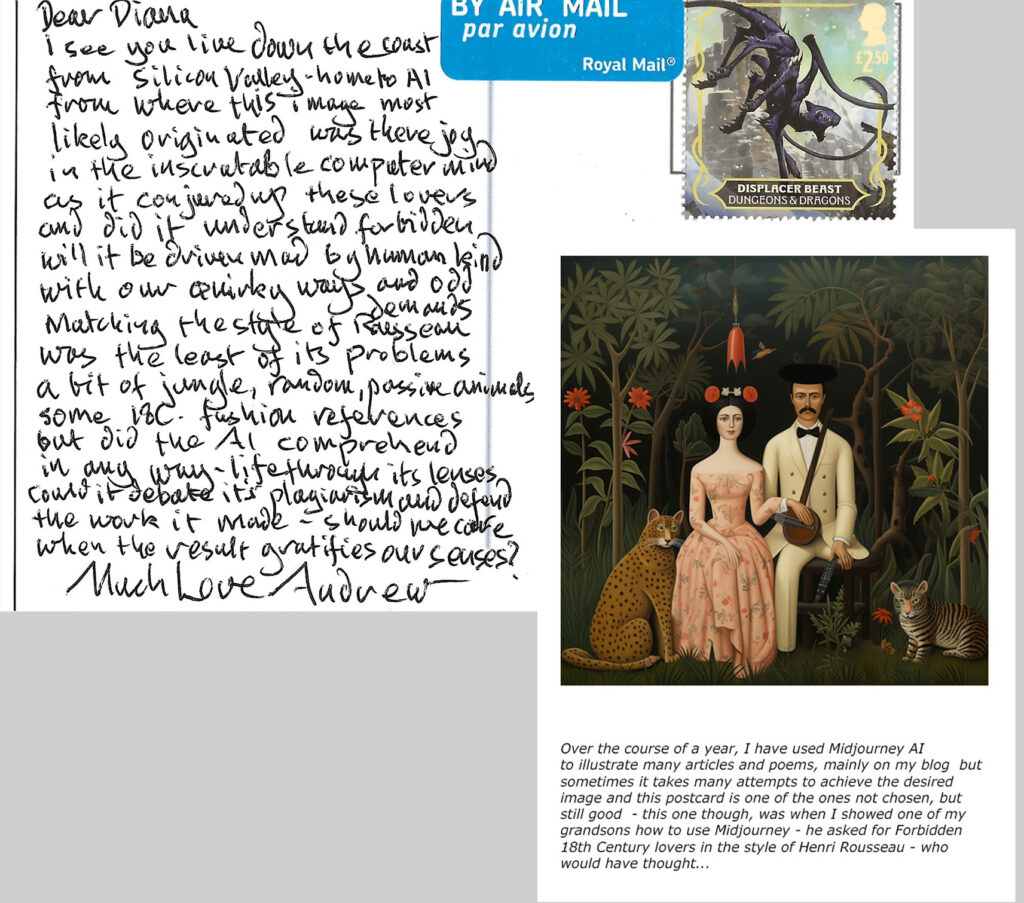
Merril D. Smith – a dVerse Poets Pub aficionado and I have made a collaborative project over on Collaborature, run by another dVerse luminary and friend, Melissa Lemay!
Rousseau Exchange #1
by Merril D. Smith and Andrew Wilson
Dear Merril,
I confess I am quite envious of your recent visit to the Henri Rousseau Exhibition since I have never seen his work in the flesh and I suspect it is even more vibrant than the many reproductions suggest. I wonder if the painting The Representatives of Foreign Powers Coming to Greet the Republic as a Sign of Peace was one of the paintings you saw?
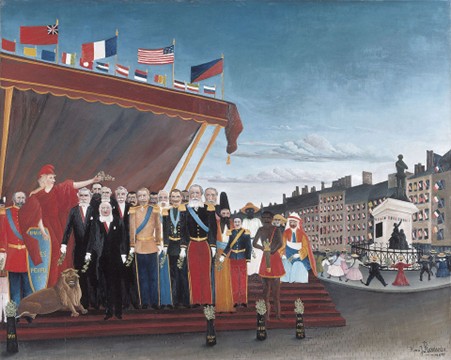
For a celebration symbolic of Peace
why are there so many military uniforms in evidence?
Why is the celebration of the Republic by citizens dancing
more convincing than Rousseau’s imaginary “photo-op”?
How did the delegates who only merited small flags
wave their Olive branches with greater vigour to compensate?
Did the French people, whose fields hosted the First World War
appreciate the true irony of this painting…?
Best – Andrew
Dear Andrew,
Thank you for your letter. I send you good wishes on
the autumn winds blowing here, but who knows what destruction
they will bring.
I did not see The Representatives of the Foreign Powers Coming to Salute the Republic as a Gesture of Peace at the exhibition.
Did you know Picasso once owned it? And that he threw a party for the artist,
nicknamed “douanier,” the customs officer—though he called Rousseau a joke.
Perhaps, it’s not irony, but innocence,
a painting painted before either world wars,
perhaps it’s optimism or hope. Mostly, I wonder
about the lion. Rousseau seemed very fond of lions.
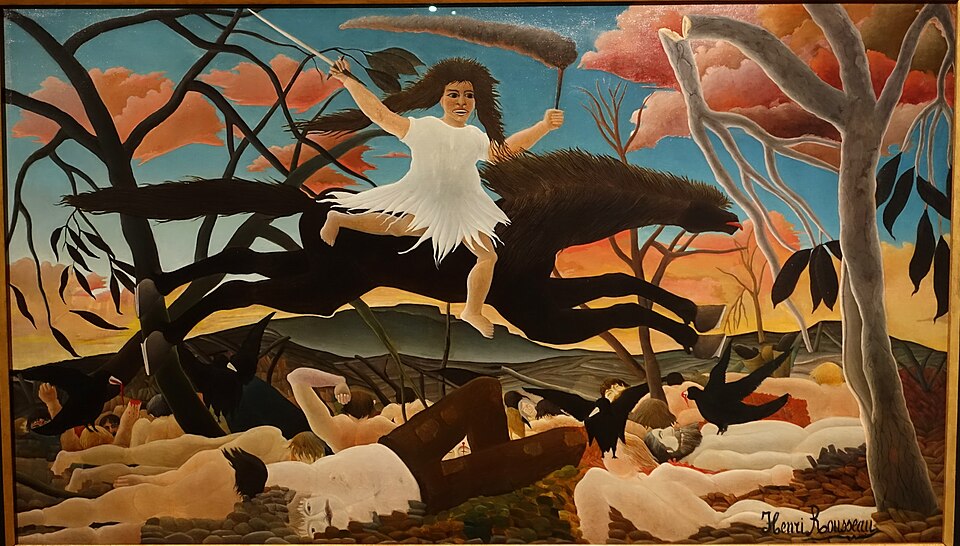
I think about his earlier work, La Guerre painted in 1894,
with its avenging-revenging goddess, an otherworldly horse,
a nightmare scene of broken bodies and devouring crows,
no attempt to make it heroic, this is visceral, brutal–
yet when I look at it again,
the white torsos of the fallen men
seem almost angelic.
What do you think, Andrew?
Rousseau Exchange #2
by Merril D. Smith and Andrew Wilson
Dear Merril
Thank you for your good wishes, borne on the wind,
sooner or later, every breath of America wends Eastward
you may have to wait a little longer for mine to reach you West-about…
I agree that the lion is fascinating, not just because, it is suggested, it represents French power, and as such, looks remarkably docile; but also, the lion is very strange looking. Rousseau was considered a Naïve or Primitive artist, but that doesn’t mean he can’t draw well but he had never been outside France, his animals are taken from illustrations in children’s books, and tableaux of taxidermy wild animals.
why did Rousseau choose to make the figure of War female
why is the French word for war, La Guerre feminine
dressed in blinding, angelic white as she leaps from her jet black horse
brandishing a sword and Death’s scythe to alight on the field of the fallen
is it for modesty that the one fallen person on the battlefield
whose front we see is fully-dressed – all others naked…
even before the big guns of the First World War
cannons could lay waste to trees as well as people
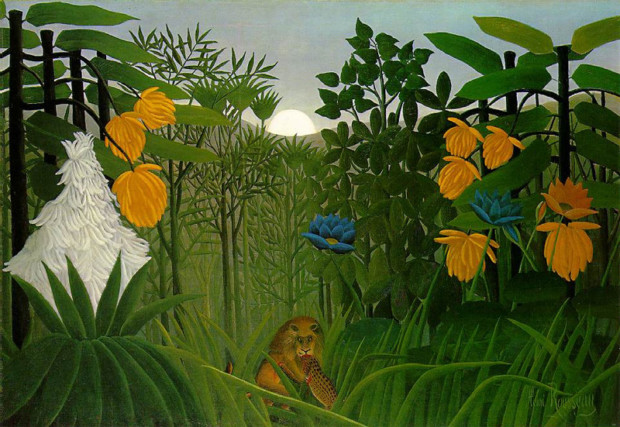
Here is another Rousseau painting of a lion “The repast of the Lion” – this time its head is quite lion-like…
if artists only painted what they had seen with their own eyes
and writers wrote only what they had experienced
though passed by the sensitivity readers
would we survive the dullness of reading or looking…
if the jungle was so plentifully provident of bananas
would we have ever left the trees and evolved
did the lion get indigestion from wolfing down the crocodile headfirst
and how well hidden are the elephants in Rousseau’s hothouse jungle
What are your thoughts, Merril?
Dear Andrew,
Thank you once again for your letter and good wishes. With climate change, who knows when and where the winds might blow? Or where they might blow us.
As for war and lions—it’s impossible
to know what Rousseau was thinking.
Perhaps the lion was symbolic—
lying down with peace?
Perhaps it was merely fantasy
or exoticism.
War, “la guerre,” must be female,
I suppose. But this one is striking,
a savage, feral child.
Not that era’s ideal image of childhood
or womanhood, for that matter.
No sugar and spice there. Only blood.
Nightmarish.
A curator said Rousseau was a story-giver,
not a storyteller—the pieces there,
for us to weave together.
Perhaps it’s better then, not to wonder
what he intended, but simply
to see where the images take us.
Did you know his lawyer got him acquitted—
in a trial for passing bad checks—
he told the judge Rousseau was too naïve
to commit the crime, just look at this painting,
he said,
where an American Indian wrestles
with a gorilla.
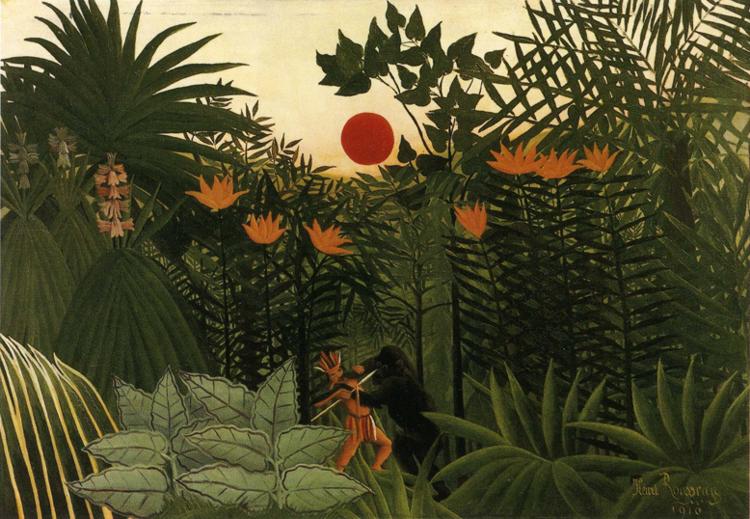
Rousseau probably knew
what the lawyer was going to say,
maybe even wrapped that persona
around himself, wearing It proudly,
the naif, the self-taught genius,
he was extremely self-confident, it seems.
I can see how his work with its
dream-like quality
appealed to the surrealists,
But in fact, I’m still not certain
if I like it.
No, I take that back,
I like some of it,
I do have a fondness for dreams.
You mentioned the odd-looking lion,
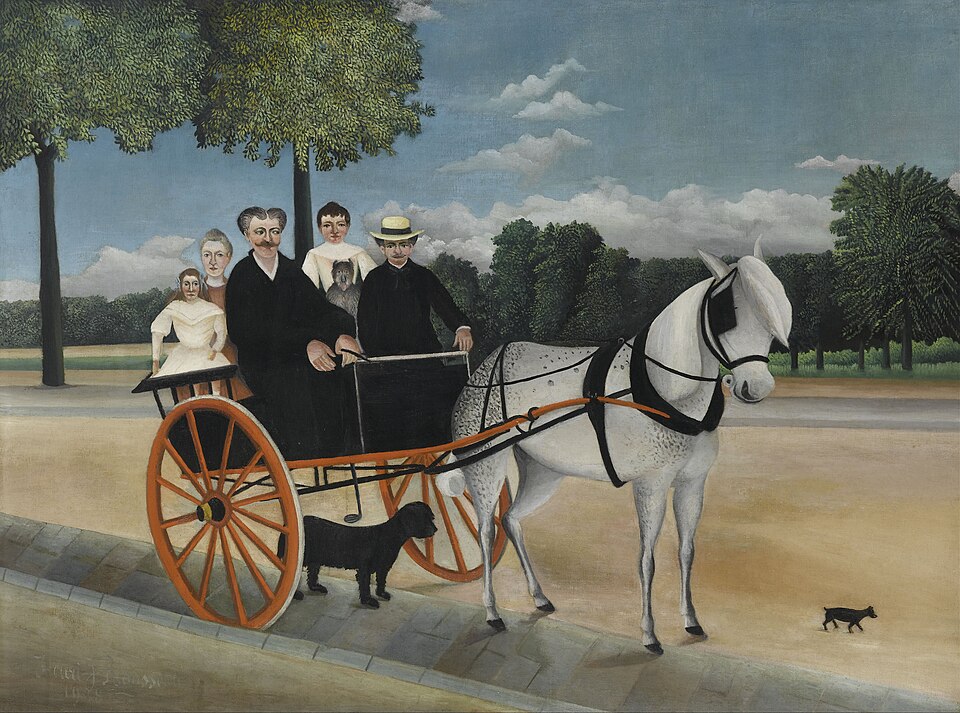
but Andrew have you seen the children
Rousseau painted?
Look at the daughter in the carriage here—
how tiny she is! How large the father driving!
And the dogs.
I think Rousseau must have liked dogs.
There is a third and final post to come and I will append it here when it “drops”!