A to Z Challenge 2026 – Non-woven and “N” Fabrics…

“Choose any subject you would like to write about…” that is the object of the A to Z Challenge, and thinking of things that interest me is not a problem for me, but choosing a subject not only to write about, but to write in a way that other people will catch my interest – that is the real challenge! This year I turn to a subject, close to our skin if not our hearts, and yet, again, I wonder if this subject will get some people past the title on the list – dismissed as niche? For this year, my theme is What We Wear – Fabrics and Fibres

Why, when our Bonobo chimp-like ancestors were forced by climate change to emerge from the shrinking forests and live out in the open, did they become less hirsute such that as we spread to almost all parts of the world, there were places we could only survive by clothing ourselves in the fur of other animals. In warmer places, we had used other things to fashion clothes out of, such as bark, and possibly even the apocryphal fig-leaves! When agriculture enabled us to produce food more efficiently, we had the time to develop new skills like spinning and weaving, but we still use leather and fur to this day, even if, for ethical or economic reasons, we prefer faux-leather and faux-fur. Of course, most leather is also a byproduct of the meat industry (just as much wool is a byproduct of rearing sheep for meat rather than wool) and until true acceptance of the reality of our current climate change forces us to eat less meat, we will continue to produce leather…

Leather

I am not going to lift the entire and very excellent Wikipedia article on making leather, but suffice it to say that there are three main stages – Preparatory (10 possible sub-stages), Tanning, and Crusting with an optional stage of Surface Coating. The reason all this is necessary is because without it, animal skin would be stiff when dried and once wetted again, would resume rotting. So elements of the skin are removed, acidity levels ar manipulated at several points in the process and dyeing and surface treating are used to make the leather we use for shoes, handbags and clothes.

Non-woven Fabric

Nonwoven fabric or non-woven fabric is a fabric-like material made from staple fibre (short) and long fibres (continuous long), bonded together by chemical, mechanical, heat or solvent treatment. The term is used in the textile manufacturing industry to denote fabrics, such as felt, which are neither woven nor knitted.[1] Some non-woven materials lack sufficient strength unless densified or reinforced by a backing. Wikipedia

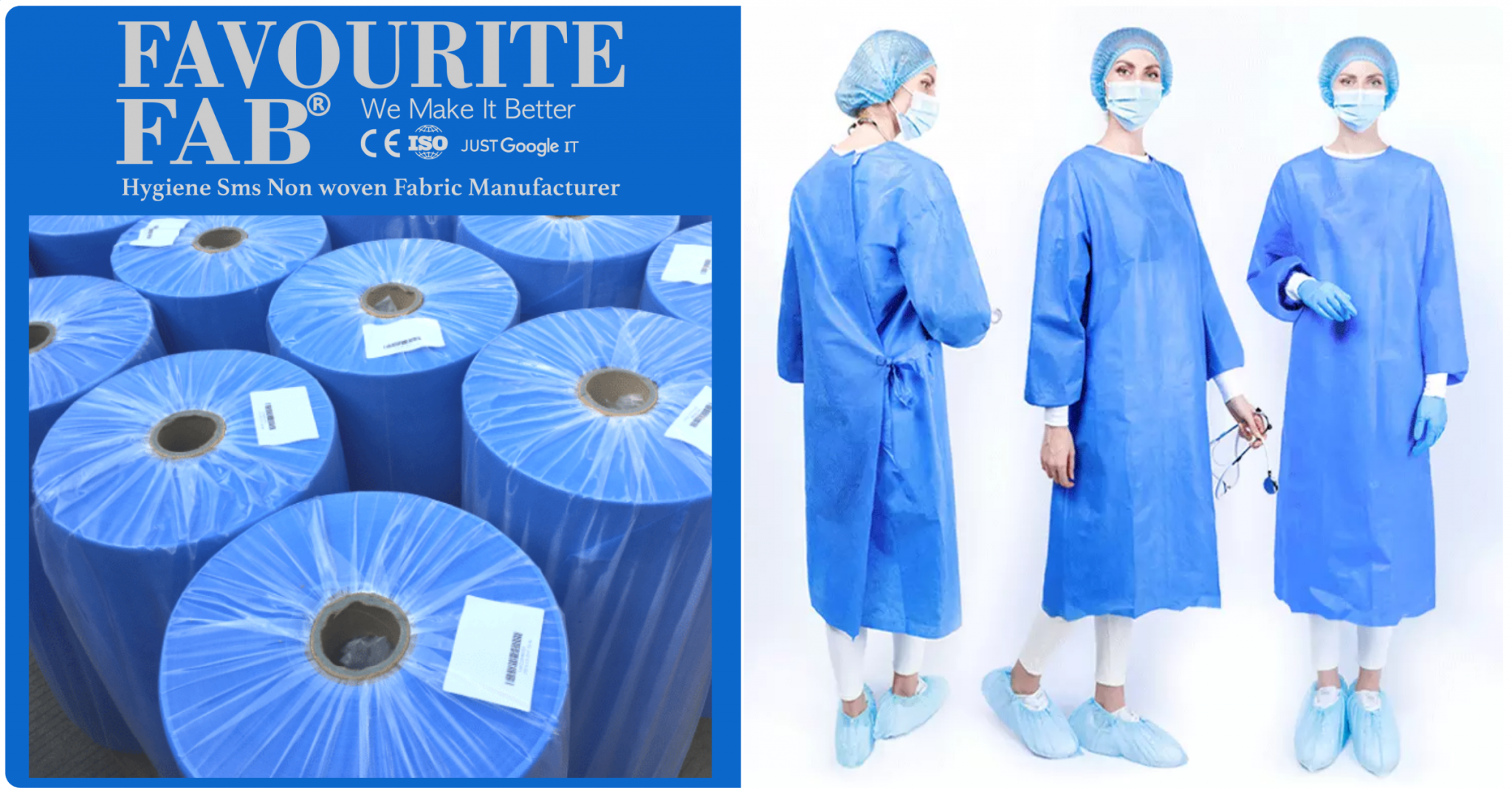
This category of fabrics includes a number of production processes but often, some form of felting (mechanical entanglement of fibres), is followed by heat-treating to melt the “felt” into one cohesive fabric, possibly with some additional filler materials introduced into the felt first. You may not have heard the term non-woven but you are likely using any number of them every day! Check out the links in the picture captions for more…

Felt

Felt from wool is one of the oldest known textiles. Excavations at Çatal Hüyük in Anatolia have revealed possible evidence of felting about 6000 BCE; more definitely, felt hats found in the Mongolian Autonomous Region of China date to c. 1800 BCE. – Wikipedia – Felt

Although Felt can be made from both natural and artificial fibres, natural fibre felt has special properties, it is “fire-retardant and self-extinguishing; it dampens vibration and absorbs sound; and it can hold large amounts of fluid without feeling wet…” and for one of the oldest fabrics, it is still produced for many commercial purposes todat, but is also hugely popular in crafting circles where both matted felting and needle felting are carried out. Both of these processes have their place in industrial felt production too. Here is a great piece of jargon from a description of that industrial felting process – “Fibers are first spun, cut to a few centimeters length, and put into bales. The staple fibers are then blended, “opened” in a multistep process, dispersed on a conveyor belt, and spread in a uniform web by a wetlaid, airlaid, or carding/crosslapping process.”

Felt has been one of the principal materials for Millinery – hat-making due to its ability to stretch into 3-D shapes and then retain that shape…

Paper

Making paper is very similar to felt-making – the fibres – and many materials can be used, including recycled textiles – are dispersed in a water bath and then lifted out in a dekle – a kind of sieve that is agitated to make the fibres “fel” together as the water drains out. The resulting layer is pressed and treated in various ways to make it less porous and more durable. This also makes the paper stiff, but take a brown paper bag, screw it up, carefully smooth it out and repeat several times and you will have a flexible fabric. Add some tougher long fibres into the paper mix and you have a material that can make clothing, albeit of limited lifespan…
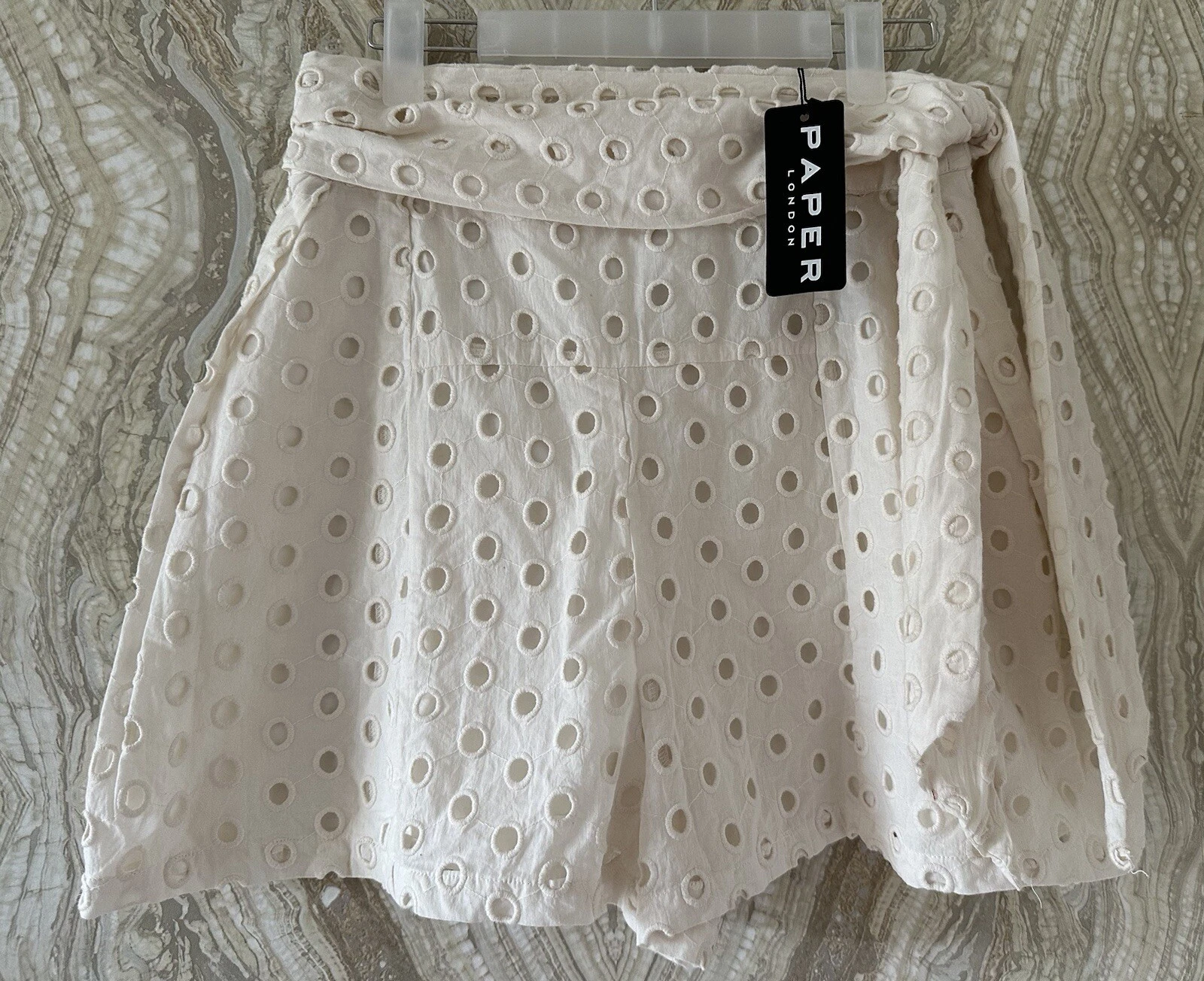
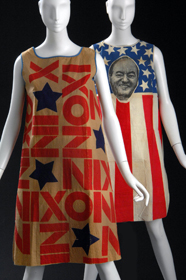
PAPER London women’s US 6 Antigua SHORTS Cream Spot Eyelet

Latex

If the fear with paper clothes might be that of them tearing or dissolving in a rain-shower, then the fear (however unfounded) around wearing latex clothing, must surely be that the item might pop like a balloon, shrivelling away to nothing in what would surely be the ultimate fashion accident!
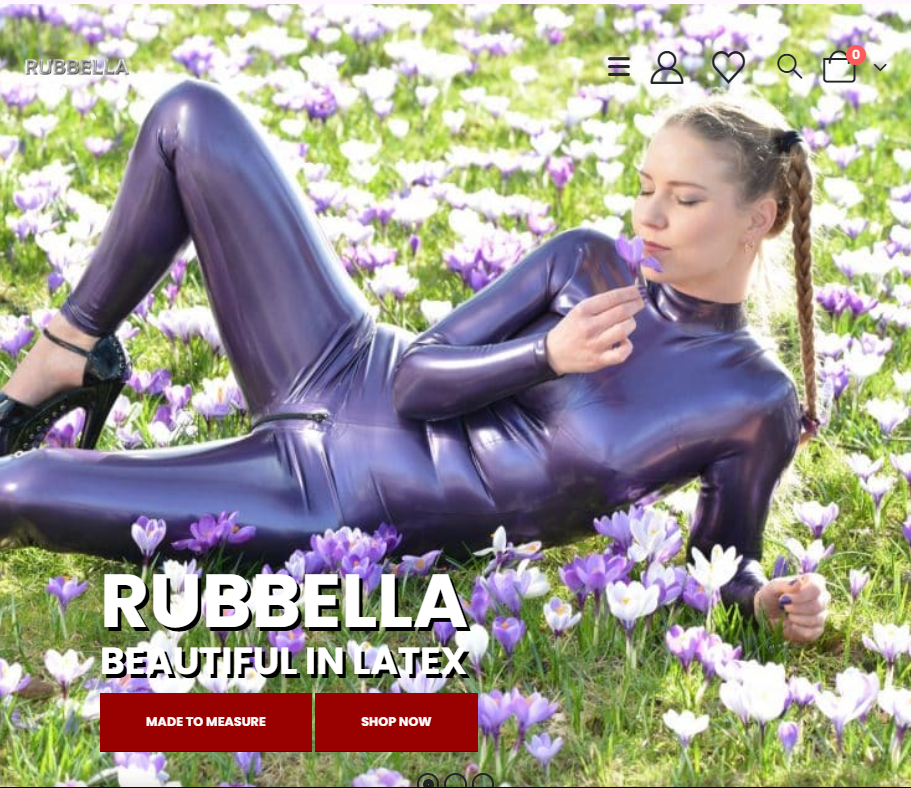
https://www.rubbella.nl/?lang=en

Latex rubber is used in the manufacture of many types of clothing. It has traditionally been used to make protective clothing, including gas masks and Wellington bootsMackintoshes have traditionally been made from rubberized cloth. However, rubber has now generally been replaced in these applications by synthetic polymers.

Latex rubber as a clothing material is common in fetish fashion and among BDSM practitioners, and is often worn at fetish clubs. It is sometimes also used by couturiers for its unusual appearance. Several magazines are dedicated to its use. Latex clothing tends to be skin-tight, but can also be loose-fitting. – Wikipedia

Moving swiftly on…

“N” Fabrics

Nankeen – (also called Nankeen cloth) is a kind of pale yellowish cloth originally made in NanjingChina from a yellow variety of cotton, but subsequently manufactured from ordinary cotton that is then dyed.
The term blue nankeen describes hand-printed fabric of artistic refinement and primitive simplicity, which originated on the Silk Road over three thousand years ago.

Noil – refers to the short fibres that are removed during the combing process in spinning. These fibres are often then used for other purposes.
Fibres are chosen for their length and evenness in specific spinning techniques, such as worsted.[1] The short noil fibres are left over from the combing of wool or spinning silk. We already encountered one form of Noil in Matka, made from damaged silk cocoons resulting in a slubby finished silk. Noil is similar in the fabrics spun and then woven from it. Noil fibres can also be added to other fibre blends.

I compiled a list of as many fabrics, fibres and related items as possible (278 items which I will make available at the end of the A to Z), from several sources, the most comprehensive of which was Wikipedia. Since there are only 26 letters in the alphabet, I could not write in detail about every instance so I have taken snippets of text for the brief descriptions and linked to the source in the name of the item. I am indebted to all the contributors to those Wikipedia pages and the depth of knowledge to be found there…
A to Z Challenge 2026 – “J” is for Jersey, Jute and Jamdami…

“Choose any subject you would like to write about…” that is the object of the A to Z Challenge, and thinking of things that interest me is not a problem for me, but choosing a subject not only to write about, but to write in a way that other people will catch my interest – that is the real challenge! This year I turn to a subject, close to our skin if not our hearts, and yet, again, I wonder if this subject will get some people past the title on the list – dismissed as niche? For this year, my theme is What We Wear – Fabrics and Fibres

Jamdami

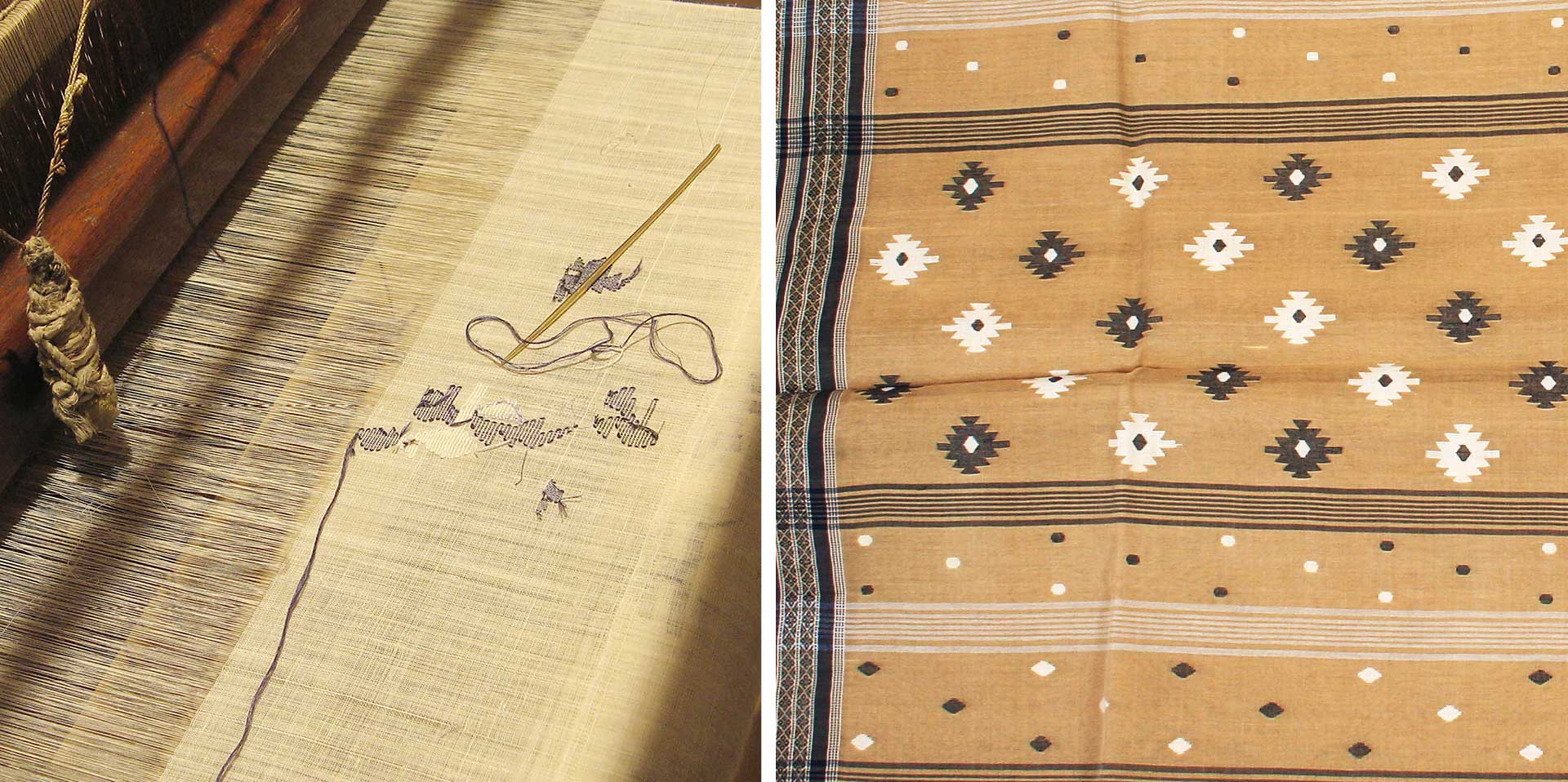
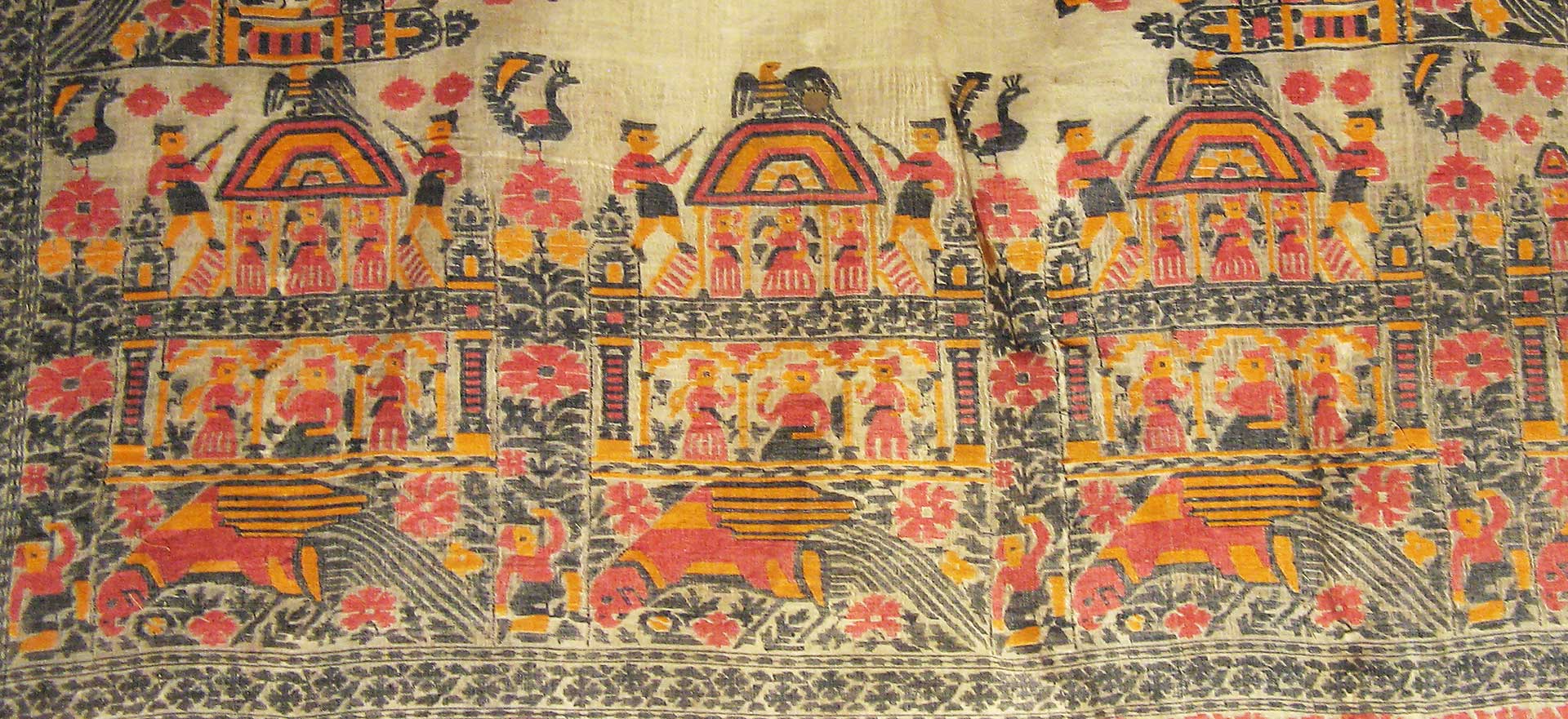
I am going to start with Jamdami, because, in many ways, it proceeds the techniques of Jacquard looms and machine Jersey Jacquard decorative fabric techniques which this post will cover. Jamdami is referred to as extra-weft ornamentation, on-loom embroidery, or discontinuous weft1. Okay, let’s break down the jargon – on a loom which is set up for Muslin (a very fine fabric) portions of the weft are lifted up and threaded with a needle or very small shuttle to produce a design motif.

Left: Close-up of jamdani weaving on muslin on the loom, showing the needle and the motifs akin to embroidery. Right: Jamdani weave on the pallav (decorative end) of a saree.1

This is a painstaking process and Jamdami was not cheap. Dhaka in Bangladesh was a centre of excellence and Daccia mul was so exquisite that when the city was under British rule, orders were given to cut off the thumbs of weavers to prevent competition with milled British fabrics.1

A rare jamdani piece with borders and pallav woven in a multitude of shades on fine cotton muslin.1

Amir Khusro, the famous thirteenth-century Sufi poet, described fine handspun, handwoven cotton so fine that 100 yards could pass through a needle, with a transparency more like water than cloth. He described a fabric so beautiful that it was likened to air, moonlight, clouds, and water: magnificent muslin. In reality, the fabric was so fine that several layers could pass through a signet ring, and it was so light that if washed and tossed in the air, it would dry before landing. Poetry, romance, royalty, legendary tales, trade worth a king’s ransom, secrecy, cutthroat competition—these are all part of the history of muslin and especially the decorative muslin known as jamdani.1

Jacquard

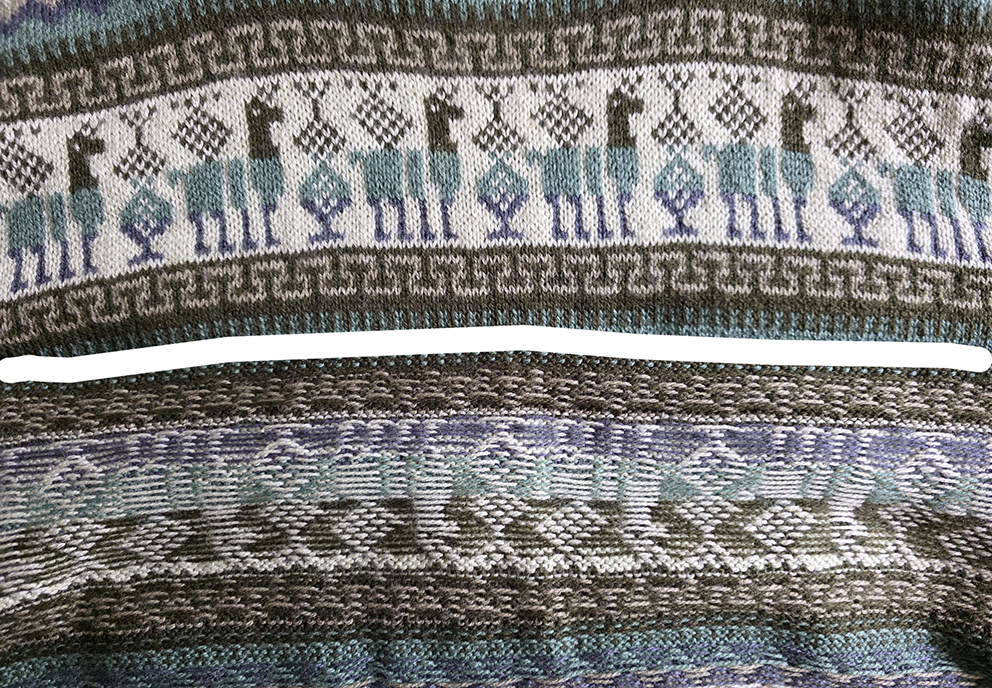
There are a number of ways to introduce different coloured patches of colour into a fabric, we already encountered Intarsia under “I” – knitting, which changes yarn at the boundaries of a different colour and we also saw Jacquard under the decoration of Fabrics but when you have many repeated motifs in knitting, such as Fair Isle, then its easier to carry the yarn across the back (floats), which, however, carries the risk of snagging .

In this beautiful sweater brought for me from the Andes – in the top half you can see the repeated patterns including Llamas, whilst belowthe white line, i have folded it back to show a mirror immage of the reverse of the pattern showing the “floats” resultant from this form of Jacquard knitting.

The following video explains how to avoid long carry-over threads on the back of the work, which could be caught by fingers when putting on a sweater, say. Two techniques are mentioned – one is Ladder-backing which catches the carry-over threads (floats) at regular intervals and the other involves double knitting – a second layer of knitting behind the main layer in the second colour, which is then brought forward when required for the design. It raises the question of what is really the front and which the back of a fabric. for example, in a decorative fabric which is not for general wear, it might be fine to have, say, gold threads as floats across the front face without them being interrupted by warps.

Jacquard is also a feature of machine knitting, and in the next section, we shall see machines doing just that! In a way, machine-knit Jacquard is doing, effortlessly, in knitted form, what Jamdami weavers did so painstakingly on a loom…

Jersey – the fabric…

Jersey, named for the fisherman’s sweaters originating in the Channel Island of Jersey, is now given to a wide range of machine-knit fabrics and being knitted, it naturally has a very stretchy quality. Although originally knitted with wool, nowadays, cotton and synthetic yarns are used, and should they require more elasticity (being somewhat stifffer fibres), then Lycra, Spandex or elastane can be added (more of these later).

Arrangement of interlocking stitches in single jersey

So far we have seen a lot of woven fabrics – woven on looms, but in Knitting, we came to interlocked loops as a technique – one going back into pre-history, yet it was inevitable that, sooner or later, some ingenious fellow would work out how to mechanise the knitting process. As far back as the 16th Century, that fellow was William Lee was an Anglican clergyman, born in Calverton, Nottinghamshire. “By studying how the fingers of some local hand knitters moved, he came up with a ground-breaking mechanical device (the stocking frame knitting machine).”2 Since then, a plethora of machines have developed and roughly 37% (and growing), of the world’s fabrics are knitted as opposed to woven. The video below shows some of the many types of knitting machines including ones that produce Jacquard decoration.

Note the many yarns being threaded into the machines – this is how most machine-knitting differs from hand-knitting – there a single yarn is worked backwards and forwards, row by row, whereas on these machines, every needle is fed a separate yarn which is passed onto the next needle with each pass.

Types of Jersey

  • Single Jersey
  • Double Jersey
  • Interlock Jersey
  • Jacquard Jersey
  • Stretch Jersey

For a full description of these types of jersey, go to How to sew jersey fabric: Everything you need to know about sewing with jersey

You can see that some of these machines produce giant tubes of knitted fabric so that it is possible to make the torso of a sweatshirt (providing it is straight and not shaped) to be seam-free and the same with the sleeves – made in a smaller diameter tube, however the following video shows T-shirts being made but cut into panels to allow heat-transfer printing to be put on before stitching the garment up.

If you want to learn how to make your own T-shirt – if, for example, you have one that fits you better than most bought ones, this blog post will show you how… How to Make Your Own T-Shirt Pattern using jersey fabric.

  1. Jamdani: Fabric of Moonlight
  2. What is jersey fabric?

I compiled a list of as fabrics, fibres and related items as possible (278 items), from several sources, the most comprehensive of which was Wikipedia. Since there are only 26 letters in the alphabet, I could not write in detail about every instance so I have taken snippets of text for the brief descriptions and linked to the source in the name of the item. I am indebted to all the contributors to those Wikipedia pages and the depth of knowledge to be found there…
A to Z Challenge 2026 – “I” is for Intarsia and Illusion Tulle…

“Choose any subject you would like to write about…” that is the object of the A to Z Challenge, and thinking of things that interest me is not a problem for me, but choosing a subject not only to write about, but to write in a way that other people will catch my interest – that is the real challenge! This year I turn to a subject, close to our skin if not our hearts, and yet, again, I wonder if this subject will get some people past the title on the list – dismissed as niche? For this year, my theme is What We Wear – Fabrics and Fibres

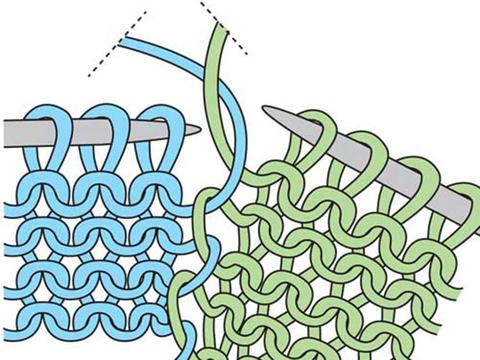
Intarsiaa knitting technique used to create large, distinct blocks or panels of colour within a garment without carrying yarn across the back, resulting in a smooth, non-bulky fabric. It involves using separate bobbins or balls of yarn for each colour area, twisting yarns at colour changes to prevent holes.

The diagram above shows how, when transitioning from one area of colour to another, the yarns are twisted around one another – the green will be picked up again on the return row. This is different from, say, Fair Isle knitting where the colour not currently in use, is carried across the back of the piece until it is required again – this suits patterns with a lot of tiny repeated motifs in each row whereas Intarsia could be used , say, to produce a map of the world with each country in a different colour. This means that the fabric is less bulky any and there are no loops across the back to get caught and pulled…

Illusion Tulle – Tulle is a family of semi-transparent fabrics similar to gauzes but finer and whilst made originally of silk, the advent of synthetic fibres, which tend to be translucent in the first place, has made them the fibres of choice for tulles; moreover, Illusion Tulle is made by fusing the yarns together, this tulle is very fine giving it the ability to disappear on the skin. This makes it ideal for wedding dresses, often embellished with embroidery which then seems to float and for those ballroom dresses you see on Strictly Come Dancing, which seem to have no visible means of support…

Or is this a flounce too far…

I compiled a list of as fabrics, fibres and related items as possible (278 items), from several sources, the most comprehensive of which was Wikipedia. Since there are only 26 letters in the alphabet, I could not write in detail about every instance so I have taken snippets of text for the brief descriptions and linked to the source in the name of the item. I am indebted to all the contributors to those Wikipedia pages and the depth of knowledge to be found there…
I will be making my list available at the end of the A to Z…

A to Z Challenge 2026 – “H” is for “Historical” Fabrics…

“Choose any subject you would like to write about…” that is the object of the A to Z Challenge, and thinking of things that interest me is not a problem for me, but choosing a subject not only to write about, but to write in a way that other people will catch my interest – that is the real challenge! This year I turn to a subject, close to our skin if not our hearts, and yet, again, I wonder if this subject will get some people past the title on the list – dismissed as niche? For this year, my theme is What We Wear – Fabrics and Fibres

What do I mean by “historical” fabrics? After all, many fabrics have a long lineage, in the case of the staples, cotton, linen, and silk, their history goes back many thousands of years and are still in production today, but there are some names that have fallen by the wayside and who only crop up in the context of old novels and histories – Brilliantine, Dowlass (Sailcloth), Holland cloth, Drugget and what the heck is Rum-swizzle? They may have modern equivalents, but these are the names consigned to history, and if they are still in produced today, however modified they may be, I have not included them here.

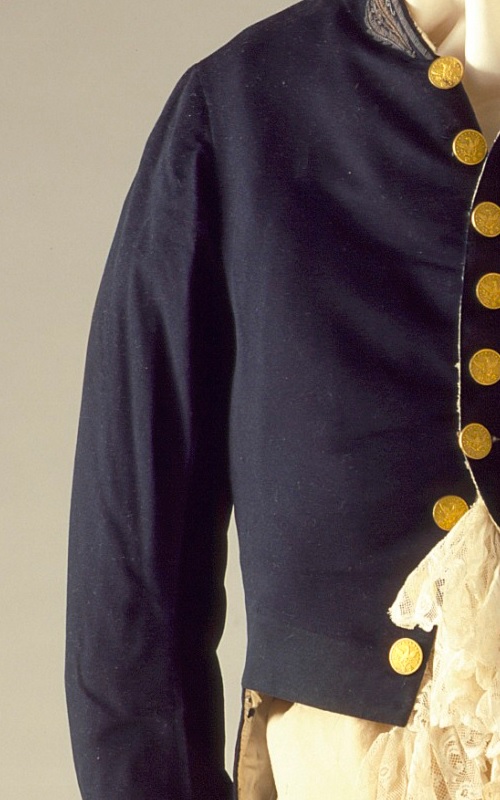
Broadcloth is a good example – woven at 50-75% wider than the finished width, this dense, plain woven cloth, historically made of wool, was “milled” – subjected to heavy hammering in hot soapy water in order to shrink it to the required width – in effect, it was felted with the thread count much denser than a loom could achieve, making it denser, tougher and more water-resistant. Broadcloth was a natural choice for items like naval uniforms where all those characteristics are needed.

Brilliantine – Lightweight, mixed-fibre fabric popular from the mid-19th century into the early 20th century. Brilliantine can be plain or twill woven, has a lustrous finish and is known for its dust-shedding properties; it was available in solid colors or printed, and was used for dresses, dusters, and linings.

Camlet – also commonly known as camlot, camblet, or chamlet, is a valuable woven fabric of Eastern origin, perhaps originally made from camel hair, but the term became one applied to all imitations of it.

Cannequin – A fabric of unknown origin, possibly a type of fine cotton

Chine – A type of silk fabric where the pattern was printed on the warp threads before weaving, creating a distinctive blurred design. This nugget of information came not from either of my two main lists and in the case of Wikipedia, sources of information. No! The joy of researching is that it connects you with far-flung areas of the internet, and in this case, far-flung geography – and an item about an obscure (today) technique of fabric production. The Dreamstresssewing, history, and style, is a fabulous blogger, born in Hawaii, living in New Zealand and not only revealing the secrets of historical clothes and the fabrics they are made from, but even designing and selling patterns which you can use to replicate certain historical classics! Chine, on it’s own, as opposed to Crêpe de Chine, is not mentioned in either of my main lists and only a simple search for “Historic Fabrics” connected me with this awesome blog!

One of Leimomi Oakes historic designs at Scroop Patterns

So back to Chine, which together with the very similar Ikat and Abr, are examples of warp printed or pre-dyed (resist) fabrics – once the weft is woven in, the designs on the warp threads, show through in a blurred fashion. Leimomi tells us “The ikat dyeing and weaving technique goes back millenia, and was developed independently in different parts of the world: there are very old examples from Japan, Indonesia, Turkey, Yemen, and pre-Columbian South America. […] Ikat, under the name chine,  became popular in Europe in the mid-18th century as part of the craze for Eastern designs and fabrics.  The name chine literally means ‘Chinese’ in French, because of the fabric’s association with China and the East.  Though the first examples probably did come from China, by the 1760s France was producing its own warp printed chine fabrics.”

Dowlass (Sailcloth) – Dowlas was a strong coarse linen cloth of the 16th and 17th centuries, and initially, it was manufactured in Brittany. In the 18th century the fabric was also produced in England and Scotland. Dowlas was identical to sailcloth. The cloth was also imitated in cotton for the same use.

Drugget – “a coarse woollen fabric felted or woven, self-coloured or printed one side”.Jonathan Swift refers to being”in druggets drest, of thirteen pence a yard”. Formerly, a drugget was a sort of cheap stuff, very thin and narrow, usually made of wool, or half wool and half silk or linen; it may have been corded but was usually plain. The term is now applied to a coarse fabric having a cotton warp and a wool filling, used for rugs, tablecloths, etc.

Dungaree – I will cover this in Working fabrics

Haircloth – this conjures up penitents wearing itchy hair-shirts but in fact there are two types of Haircloth that made from the outer, coarse outer “guard” hairs of camelids, bovines, horses, goats, rabbits, hares and reindeers, and that made from the softer (shorter) undercoat and these fabrics can be quite luxurious.

Himroo is a fabric made of silk and cotton, which is grown locally in Aurangabad. Himroo was brought to Aurangabad in the reign of Mohammad Tughlaq, when he had shifted his capital from Delhi to Daulatabad, Aurangabad. The word himroo originated from Persian word Hum-ruh which means ‘similar’. Himroo is a replication of Kinkhwab, which was woven with pure golden and silver threads in former times, and was meant for the royal families.

Hodden (Wadmal – Scandinavian) – is a coarse, undyed cloth made of undyed wool, formerly much worn by the peasantry of Scotland from prehistory. Usually woven in 2/2 twill weave but are also known in plain or tabby weave. Both are a thick, coarse, fulled homespun cloth typically made of natural undyed wool of the vari-coloured Northern European short-tailed sheep breeds.

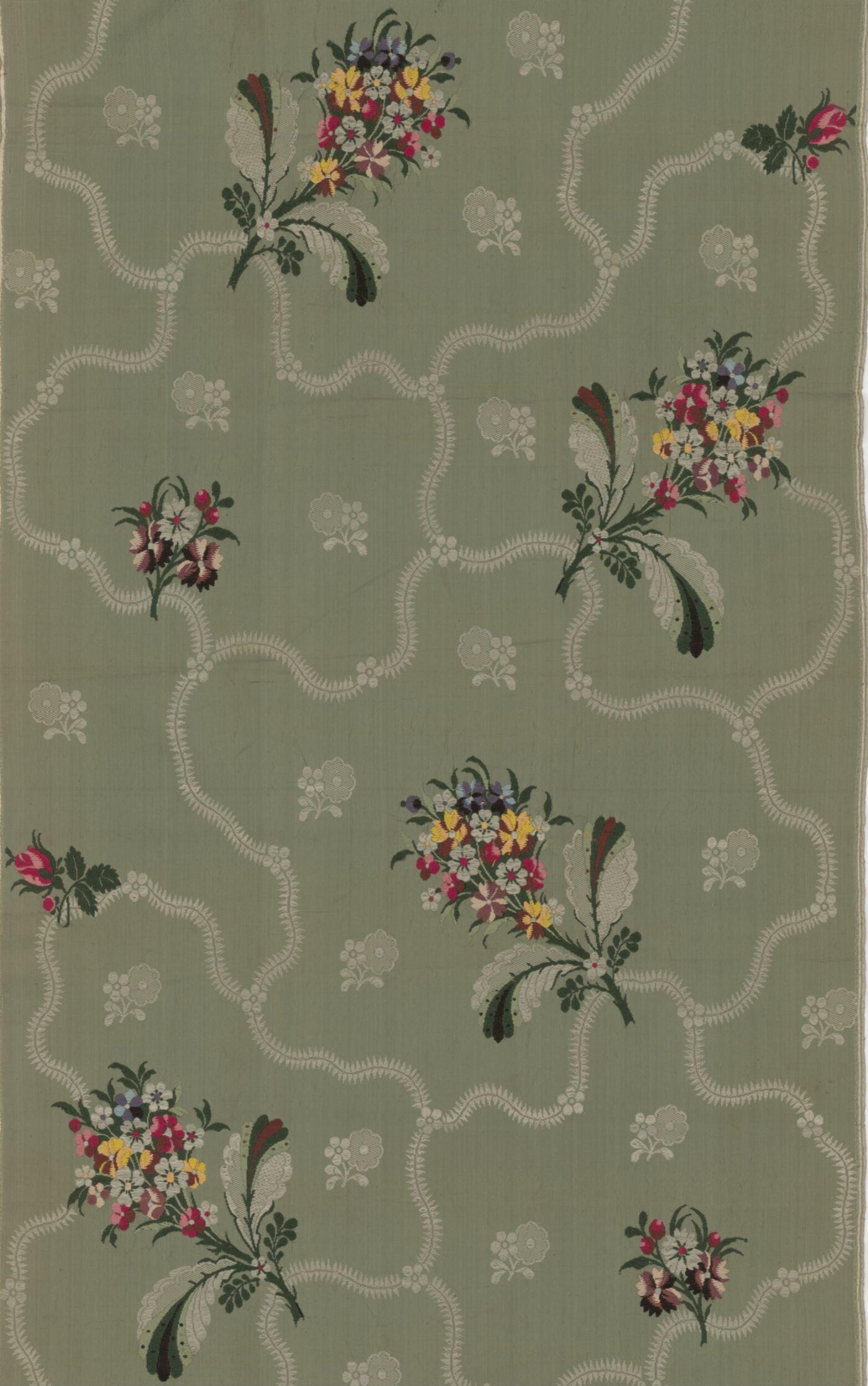
Lustestring – is another fabric that did not appear on either Wikipedia or the silk society’s list and the link is to an item in the Victoria and Albert Museum who have wonderful collections of fabric and fashions throughout the ages. The fabric below is described as “This delicate silk is from a dress said to have belonged to Queen Charlotte, wife of King George III, although this association cannot be proved. Charlotte was seventeen at the time of her marriage to the King in 1761, which was around the time when the silk was woven. It is a lustring, or lutestring, a lightweight silk with a glossy surface.”

From the Victoria and Albert Museum.

Mockado – Mockado (also moquette,moucade) is a woollen pile fabric made in imitation of silk velvet from the mid-sixteenth century. Mockado was usually constructed with a woollen pile on a linen or worsted wool warp and woollen weft, although the ground fabric could be any combination of wool, linen, and silk. Mockado was used for furnishings and carpeting, and also for clothing such as doublets, farthingales, and kirtles.

Osnaburg – a general term for coarse, plain-weave fabric. It also refers specifically to a historic fabric originally woven in flax but also in  tow or jute, and from flax or tow warp with a mixed or jute weft.
In the Atlantic plantation complex, prior to the abolition of slavery, osnaburg was the fabric most often used for slave garments.
In the textile industry, a tow (or hards) is a coarse, broken fibre, removed during the processing of flax, hemp, or jute[1] and separated from the shives. Flax tows are often used as upholstery stuffing and oakum. Tows in general are frequently cut up to produce staple fibre.

Rum-Swizzle – Another outlier from my main sources comes from the Oxford English Dictionary in their page on Material world: the language of textiles where, like this post, they explore names of fabrics swirling in historical obscurity, but in the case of rum-swizzle, there is sufficient information preserved in the literary sources for us to have a clear idea of the type of cloth they were. To wit “A a very excellent brownish frieze made in Ireland from undyed foreign wool.” (Frieze: frieze (French: frisé) is a Middle English term for a coarse woollen, plain weave cloth with a nap on one side. The nap was raised by scrubbing it to raise curls of fibre,[1] and was not shorn after being raised, leaving an uneven surface.)
The OED article also mentions novato, puleray, cannequin, grogram, lockram, sannah, shagreen, wadmal, Ticklenburgs, prunella, kreyscloth, gulix, and huckaback (some of these are now under investigation by the Manchester Lexis Medieval Textiles Project). From that project I found another obscure fabric – Sarsnet – a tabby- woven silk cloth, a type of sendal, light and flimsy; made in Europe in the Middle Ages; imports to England probably came from Italy

Scarlet – a type of fine and expensive woollen cloth common in Medieval Europe – a broadcloth (see above) dyed with the red dye – Kermes derived from insects.

The Coronation Mantle of Roger II of Sicily, silk dyed with kermes and embroidered with gold thread and pearls. This kind of cloth seems to have been denoted by the Arabic siklāt. Royal Workshop, Palermo, Sicily, 1133–34. Kunsthistorisches Museum, Vienna.

Stuff – I couldn’t resist including this item which Wikipedia describes as: any manufactured material. This is illustrated from a quote by Sir Francis Bacon in his 1658 publication New Atlantis: “Wee have also diverse Mechanicall Arts, which you have not; And Stuffes made by them; As Papers, Linnen, Silks, Tissues; dainty Works of Feathers of wonderfull Lustre; excellent Dies, and many others.”

If there are items you expected to see here under “Historical Fabrics” it may be because, though steeped in history, like Calico, for example, they are still being produced today.

There are so many “Historic fabrics” that I couldn’t cover all of them, but they are in the Wikipedia List of Fabrics and include Gulix, Holland cloth, Kerseymere, Korathes, Lockram, Samite, Saye, Swanskin, Toile. At the end of this A to Z, I will include a link to the 248 item spreadsheeet I compiled…

Some non-Historical “H” Fabrics…

Habutai (Japanese silk)a plain weave cloth commonly used for linings.

Herringbonealso called broken twill weave, describes a distinctive V-shaped weaving pattern usually found in twill fabric. It is distinguished from a plain chevron by the break at reversal, which makes it resemble a broken zigzag. The pattern is called herringbone because it resembles the skeleton of a herring fish.

Hessian (US – Burlap, Crocus – Jamaica) – a woven fabric made of vegetable fibres: usually the skin of the jute plant,] or sisal leaves. It is generally used (in the crude tow form known as gunny) for rough handling, such as to make sacks in which to ship farm products and sandbags (although woven plastics now often serve these purposes), and for wrapping tree-root balls

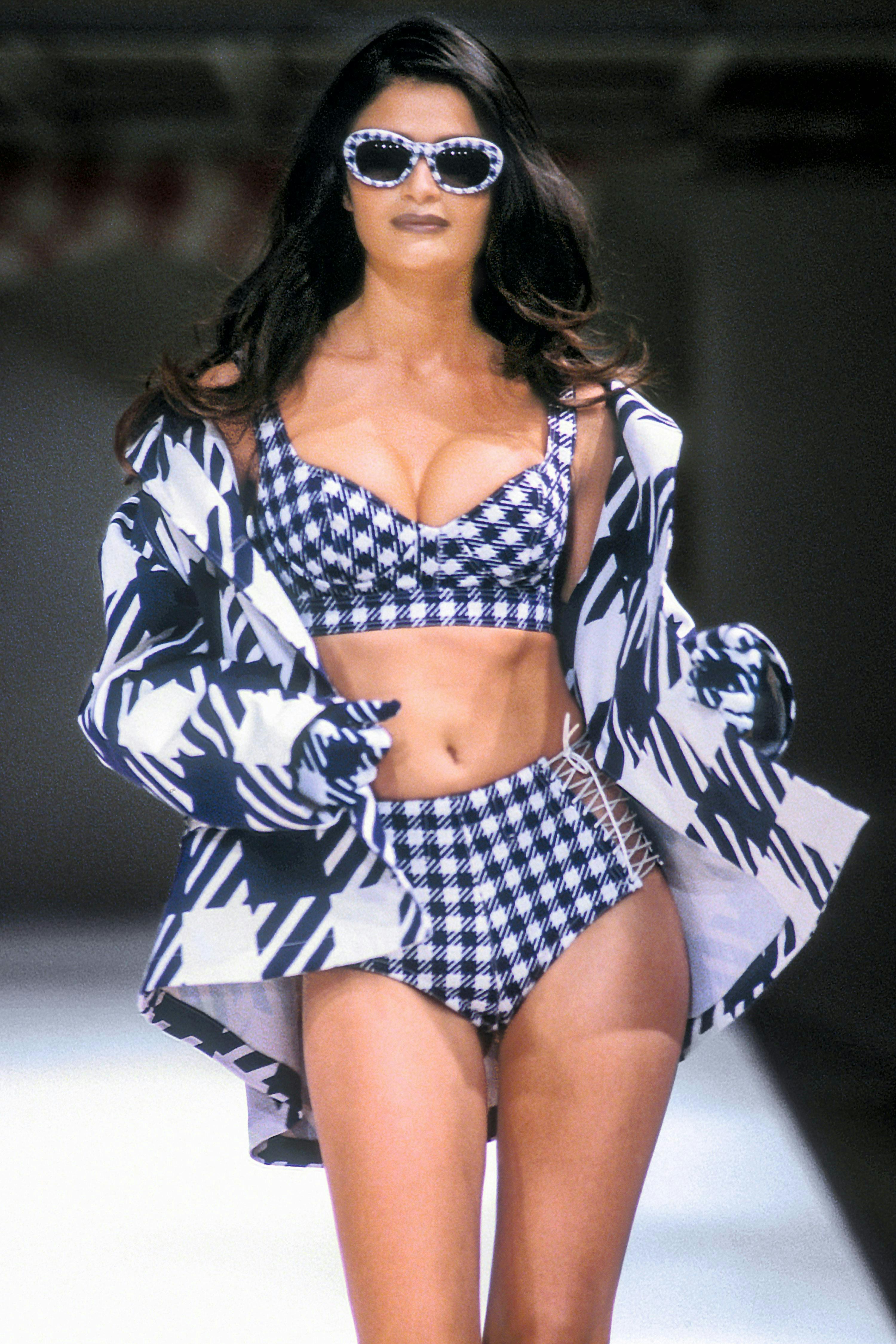
Houndstooth – Also known as dogtooth, traditional houndstooth check has its origins as far back as 360 BC. However, black and white houndstooth fabric became more mainstream in 19th century Scotland, before emerging into the fashion world in the 1930s.

Back then, houndstooth fabric was known as a symbol of wealth. It was picked up later on by world-famous designers such as Christian Dior, and has dominated fashion and home interior catalogues ever since.

I compiled a list of as fabrics, fibres and related items as possible (278 items), from several sources, the most comprehensive of which was Wikipedia. Since there aer only 26 letters in the alphabet, I could not write in detail about every instance so I have taken snippets of text for the brief descriptions and linked to the source in the name of the item. I am indebted to all the contributors to those Wikipedia pages and the depth of knowledge to be found there…

A to Z Challenge 2026 – “G” for Gazar, Gauze and Gingham…

“Choose any subject you would like to write about…” that is the object of the A to Z Challenge, and thinking of things that interest me is not a problem for me, but choosing a subject not only to write about, but to write in a way that other people will catch my interest – that is the real challenge! This year I turn to a subject, close to our skin if not our hearts, and yet, again, I wonder if this subject will get some people past the title on the list – dismissed as niche? For this year, my theme is What We Wear – Fabrics and Fibres

Gauze

Gauze – The transparency of gauze, lends it, on the one hand to wedding veils and on the other, to wound dressings where a fabric that allows breathing without the fibres shifting. This is achieved by twisting the Weft threads after each timr they cross the Warps (as shown below) this locks the position of warp and weft in place and keeps the fabric stable but with very open structure.

The weave structure of Gauze showing the twists that keep the threads in place and the holes open.

Gazar

Gazar – If gauze is an old and functional fabric, even in the fashion sense, then Gazar is the polar opposite – a 20th Century fabric brought into being to suit the very particular needs of an haute Couture fashion designer in order to create some iconic but hardly practical designs.

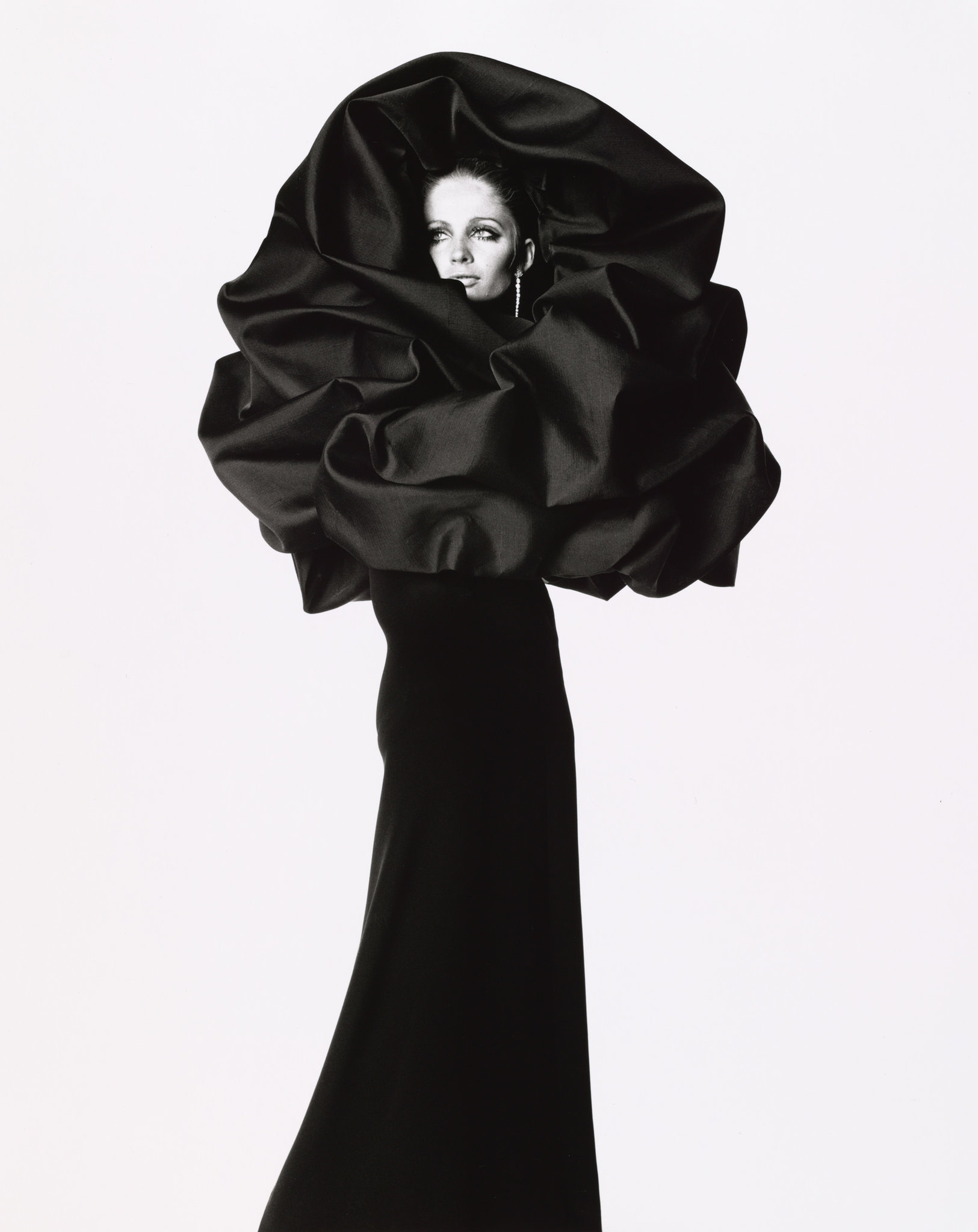
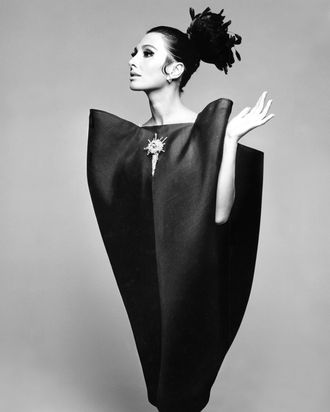
Gazar is a silk or wool plain weave fabric made with high-twist double yarns woven as one. Gazar has a crisp hand and a smooth texture. Balenciaga wanted a fabric he could sculpt and so he turned to Mr. Zumsteg, director of the Abraham company and a great collector of paintings, rightly thinking that he would understand the subtlety of his request. Together, they came up with an organza like fabric (another member of the guaxe family), stiff, unruly except in the hands of skilled seamstresses and it formed the basis of Balenciaga’s collections from 1960-68.

Cristóbal Balenciaga, 1967 | Silk Gazar One Seam Bridal Gown with Matching Hat | Photos Tom Kubin
Cristobal Balenciaga, Indigo blue silk gazar evening dress, 1965 Alain.R.Truong Cristobal Balenciaga, Indigo blue silk gazar evening dress, 1965 (CBM 2000.23 ab) 2016 Cristóbal Balenciaga Museum It belonged to Mrs. Rachel L. Mellon.

Of course, the often impractical, immodest, exorbitantly expensive, wonderful creations of haute couture are said to filter downwards to influence High Street design and occasionally, fabrics from the world of popular fashion, are taken up by Haute Couture and one such staple, is Gingham

Gingham

Around since the 17th century, and possibly named for the French town of Guingamp, gingham was originally striped but evolved into the ubiquitous checked or tartan (plaid) pattern which is simple to achieve on an industrial loom. Indeed, by the 19th century, gingham was a staple product of Lancashire cotton mills.

In fact, Gingham was introduced to France from Malaysia, where it started being produced in Vichy, France, under the reign of Napoleon Bonaparte. In Spain the pattern is known as estampado vichy or cuadro vichy. With the industrial production of gingham, it became popular around the world and retained a special affection in the USA – so much so that on the one hand, the gingham shirt invited mockery, whilst on the other, haute couture rediscovers it periodically.

Rei Kawakubo for her Comme des Garçons Spring/Summer 1997 collection. Known as the “Lumps and Bumps” collection…

Other “G” fabrics:

Georgette – (from crêpe Georgette) is a sheer, lightweight, dull-finished crêpe fabric named after the early 20th century French dressmaker Georgette de la Plante. Originally made from silk, Georgette is made with highly twisted yarns. Its characteristic crinkly surface is created by alternating S- and Z-twist yarns in both warp and weft.

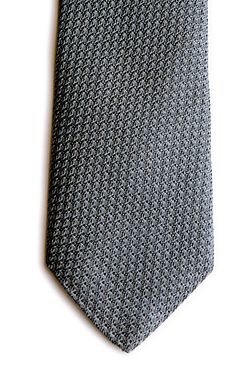
Grenadine – is a weave characterised by its light, open, gauze-like feel, and is produced on jacquard looms. Originally produced in Italy and worn as a black silk lace in France in the eighteenth century, it is now woven with silk for use in ties.

For the most part, ties made from grenadine silk are solid in color with the visual interest being the unique weave.

Grosgrain – a type of fabric or ribbon defined by the fact that its weft is heavier than its warp, creating prominent transverse ribs.

I compiled a list of as fabrics, fibres and related items as possible (278 items), from several sources, the most comprehensive of which was Wikipedia. Since there are only 26 letters in the alphabet, I could not write in detail about every instance so I have taken snippets of text for the brief descriptions and linked to the source in the name of the item. I am indebted to all the contributors to those Wikipedia pages and the depth of knowledge to be found there…
A to Z Challenge 2026 – “F” for Fibres that make Fabrics and some “F” fabrics too.

“Choose any subject you would like to write about…” that is the object of the A to Z Challenge, and thinking of things that interest me is not a problem for me, but choosing a subject not only to write about, but to write in a way that other people will catch my interest – that is the real challenge! This year I turn to a subject, close to our skin if not our hearts, and yet, again, I wonder if this subject will get some people past the title on the list – dismissed as niche? For this year, my theme is What We Wear – Fabrics and Fibres

Before there were fabrics as we think of them today, that is, woven or knitted, there were skins, fur and leather and for fabrics to come about, the concept of “fibres” which could be combined to make a yarn – the basis of all fabrics, had to be conceived. The sources of fibres fell into two groups – animal and plant-based. One can imagine how plants such as cotton,simply cried out to find some way of making their fluffy bolls into some form that would allow them to be combined. The answer was of course, spinning… We all know about spinning wheels from fairy tales like Rapunzel, but before those quite elaborate inventions, there were simpler ways of spinning fibres – the spindle or drop spindle. What all spinning devices do, is to allow you take a pinch of, say, wool, and as you draw it out into a thinner configuration, the device spins the wool into a yarn, which causes the fibre to bind together into a yarn. The video below shows how to use a drop-spindle and the one after that shows some of the ways the process was elaborated on. As we said in the first post on Weaving – Stone Age tooolmakers grasped the significance of twisting, which increases strength by diverting part of any tensile strength into lateral pressure”.1
The video below shows how to use the simplest and oldest form of spinning tool…

Next is a video which takes us through some of the more elaborate forms os hand-spinning tools, up to and including the spinning wheel.

These simple methods could work with animal or plant fibres and once a thin yarn was produced, then two or more thin yarns could be further twisted, or plied, together – hence 2-ply, 3-ply etc.

What happened after that, was simply increased mechanisation and in 1764, James Hargreaves of Lancashire, England, invented the Spinning Jenny, which could spin multiple yarns simultaneously which took the production of yarn from cottage industry where one yarn at a time was produced by hand, to a mill based industry.

In the 20th Century, synthetic and semi-synthetic fibres were added to the possibilities, either by combining fibres in a blend with the natural ones to form blended yarns with improved performance characteristics, or used entirely on their own – I will cover them under “S”, but all I will say for now, is that synthetic fibres need not necessarily be spun since they can emerge as a coherent yarn in the first place and that due to the ability to extrude synthetic fibres at very consistent sizes, they can be used to relace or augment natural fibres from cotton to silk….

So what are the fibres that have clothed us for centuries? Well, on the animal side, the hairs from bovines, camels, goats (Angora, Mohair) horse-hair, rabbit, reindeer and of course sheep (wool) – all of which offer fibres straight from the hide, and, by a much more convoluted process, Silk, which is made from the unwound cocoons of the silk worm. Sinews and gut were also early sources of fibre. Even casein (milk protein) can be treated and spun into fibres.

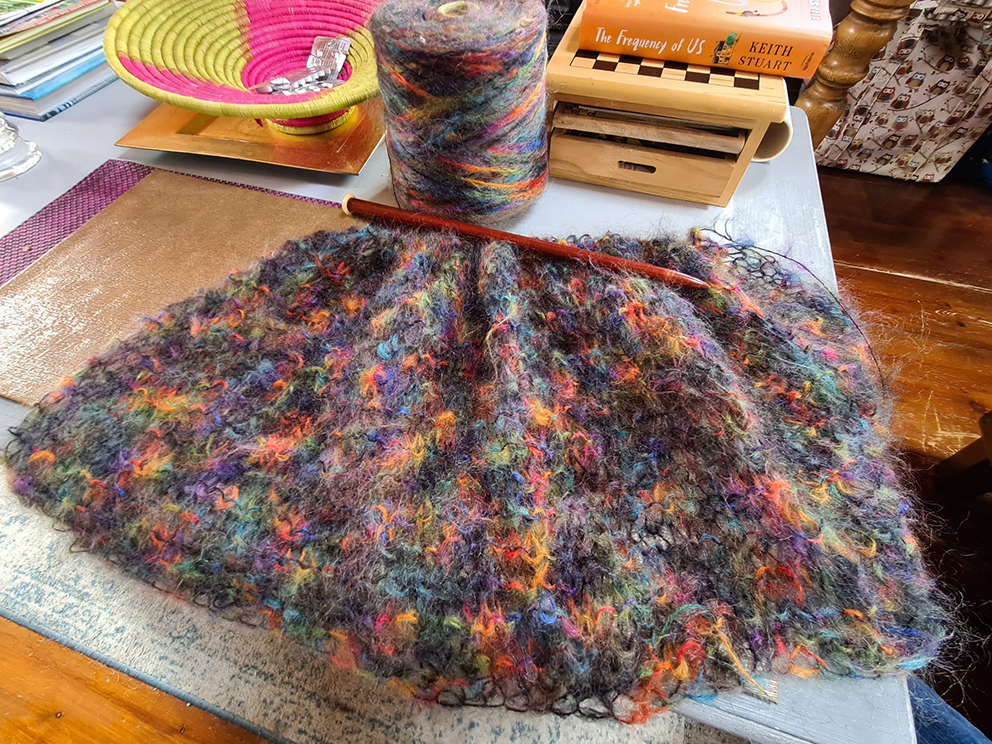
A project of mine – knitted on large needles from Angora Wool – a very fluffy yarn…

On the plant side, nettles were an early source of fibre for string and rope whilst tree bark – bast, made early non-woven fabrics. Cotton, linen (flax), Jute, Sisal, Palm (Raffia) and Tow (coarse fibres extracted during the preparation of other fibres like linen) were the classic fibres, but today, bamboo, eucalyptus, soybean, aloe vera and even the dried leather from kombucha have been added to the repertoire! Some of these, are sources of cellulose and form the source material of the “semi-synthetics” which we will come to under “S”.

Fabrics beginning with F:

Faille – is a structured fabric characterised by very fine ribs, it is usually made from silk.

Faux Fur, Leather and Suede – these are all fabrics woven to simulate the appearance of other substances.

Felt – felting is a method of producing fabric without weaving by matting, condensing and pressing fibres. It allows fabric to be shaped directly into 3-dimensional shapes such as hats. Although initially produced from natural fibres, felting is a technique that works with almost any kind of fibre. It is fire-retardant and self-extinguishing; it dampens vibration and absorbs sound; and it can hold large amounts of fluid without feeling wet.

Fibre Glass – Glass Re-enforced Plastic (GRP) begins with a matted fabric composed of fine glass fibres which are welded together with a plastic resin to make such things as sailing boats.

Fishnet – is a machine knitted fabric with a diamond shaped hole pattern and has become a staple of hosiery and especially beloved as part of punk fashion.

Siouxsie Sioux photographed by Joe Bangay, 1981

Flannel (and Flannelette) – is a soft woven fabric of varying fineness. Flannel was originally made from carded wool or worsted yarn, but is now often made from either wool, cotton, or synthetic fibre. Flannel is commonly used to make tartan clothing, blankets, bed sheets, sleepwear, and several other uses.

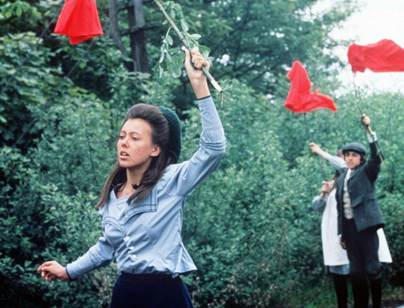
Jenny Agutter waving her red petticoat to prevent disaster in the Railway Children (1970) https://katedaviesdesigns.com/2023/11/02/red-hats-and-petticoats/

Fustian – Fustian means thick cotton cloth – an old fabric, it ranges from straightforward twilled fabric such as denim, to cut textiles that are analogous to velvet and have names such as velveteen, moleskin. In the first fustian fabric, which dates back to the medieval ages, cotton was used for the weft, and linen was used for the warp. It would appear that the phrase quickly lost some of its distinctiveness and eventually came to be used to designate a coarse cloth that was made of wool and linen.

Fustians such as Corduroy, that have added long fibres as well as Faux Furs, require special looms that incorporate the additional fibres which after weaving in, are cut to produce the ridges in the corduroy.

Corduroy: This modern diagram shows the warp (3) and the long (red-4) and short (green-5) weft threads; traditionally the knife (1) and the guide (2) are attached and the cutting motion is upwards.

  1. World Textiles by Mary Schoeser – A Concise History, Thames & Hudson world of art 2003 pp. 10

I compiled a list of as fabrics, fibres and related items as possible (278 items), from several sources, the most comprehensive of which was Wikipedia. Since there are only 26 letters in the alphabet, I could not write in detail about every instance so I have taken snippets of text for the brief descriptions and linked to the source in the name of the item. I am indebted to all the contributors to those Wikipedia pages and the depth of knowledge to be found there…
A to Z Challenge 2026 – Theme Reveal

“Choose any subject you would like to write about…” that is the object of the A to Z Challenge, and thinking of things that interest me is not a problem for me, but choosing a subject not only to write about, but to write in a way that other people will catch my interest – that is the real challenge! When I chose to write about Commodities in 2024, I was more than a little trepidatious, would it be too dry a subject, would it only be of interest to economists, mostly men, nerds? As it happened, I found much to interest me, and, I think, those who read the abecedarium. Last year was more personal – a kind of memoir told in topics rather than chronologically, but this year I return to a subject, close to our skin if not our hearts, and yet, again, I wonder if this subject will get some people past the title on the list – dismissed as niche? For this year, my theme is What We Wear – Fabrics and Fibres

For this year, my theme is What We Wear – Fabrics and Fibres

Both men and women are involved with Fabrics on a professional level – manufacturing first the Fibres and then the cloth, by weaving, knitting or more arcane processes and then there are those who make things out of cloth – clothes, fashionable and functional, bags, art, bandages and all manner of things. On a craft level, I suspect that women still outnumber men, despite the Tom Daley’s and Kaffe Fassett disciples of this world. Yet anybody who reads books must surely have a moment’s curiosity upon encountering such names as grosgrain, huckaback and hair cloth. Who is even sure about more common names such as flannel [nighties or draws], what is English about Broderie Anglaise or Dutch about Holland Cloth.

We all wear clothes and for some people, reading the little labels that give the fibre mix is a matter of life or itch whilst for others, it’s all an irrelevance they skip over on the way to the How to Care label which tells them whether to wash (hot or cold), tumble or drip-dry, or that dire warning Dry Clean Only! For some, the choice of fabric and constituent fibre, is an ethical one – “I only wear “natural” fibres, but what makes for genuine sustainability? Sheep caused much of Great Britain, even unto the Scottish Highlands, to be stripped of trees (with their oxygen replenishing bounty) and the sheep still keep the mountains free of saplings. Does wood count as a “natural” fibre source (Viscose, Rayon, Acetate) and why is Lyocell more environmentally friendly?

These are just some of the questions thrown up by my deep dive into Fabrics and Fibres and they take us to History, Economics, Chemistry and Craft to find answers – come along for the ride and find out more about the clothes you inhabit and the stuff they are made of…

I compiled a list of as many fabrics, fibres and related items as possible (278 items), from several sources, the most comprehensive of which was Wikipedia. Since there ar only 26 letters in the alphabet, I could not write in detail about every instance so I have taken snippets of text for the brief descriptions and linked to the source in the name of the item. I am indebted to all the contributors to those Wikipedia pages and the depth of knowledge to be found there…
If you are also participating in the A to Z this year – I look forward to seeing you on the road…

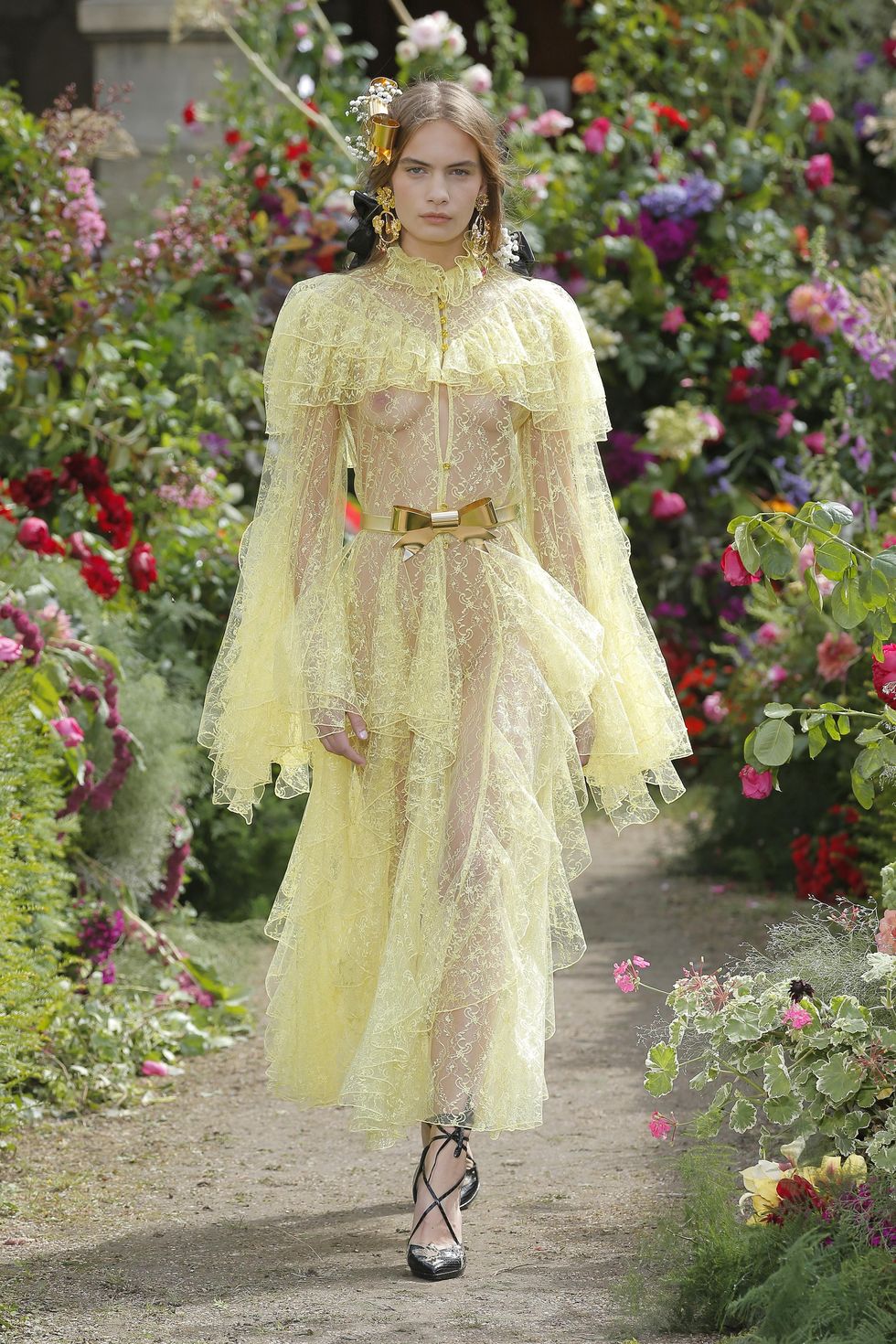
Ever wanted to look like a head-to-toe marshmallow? No? Well, Giambattista Valli is here to quickly change your mind. The designer (and tulle fanatic) showcased several on-point millennial pink gowns, which looked like something straight out of a fairytale. (Getty Images) (Elle)

Kintsugi World

When the last redneck Republican
realises his true enemy
and stirs with his Democrat neighbour
the great melting pot of
red and blue to an unroyal purple

When an eighty-year-old
Israeli and Palestinian
jointly place the last skull in the
Nakba-Holocaust Ossiary Memorial
and agree to share a country

When single use plastic is abhorred
and the use of oil for
virgin plastic rationed
and whole towns comb their beach
for plastic to recycle

When the last billionaire
gives away his last coin
to the last poor person
weeping as he is
buoyed by sheer relief

When global warming is stabilised
and the last bird species
threatened with extinction
breeds the first nest of
the rest of their species

When the last petrol head
learns to love the glint of
sunlight on windmill blades
and drives off in a small electric car
which is no fashion or status symbol

When the last piece of
the fractured world
is fitted into place – fastened
with a seam of shining gold
and balanced once again

When…

© Andrew Wilson, 2025

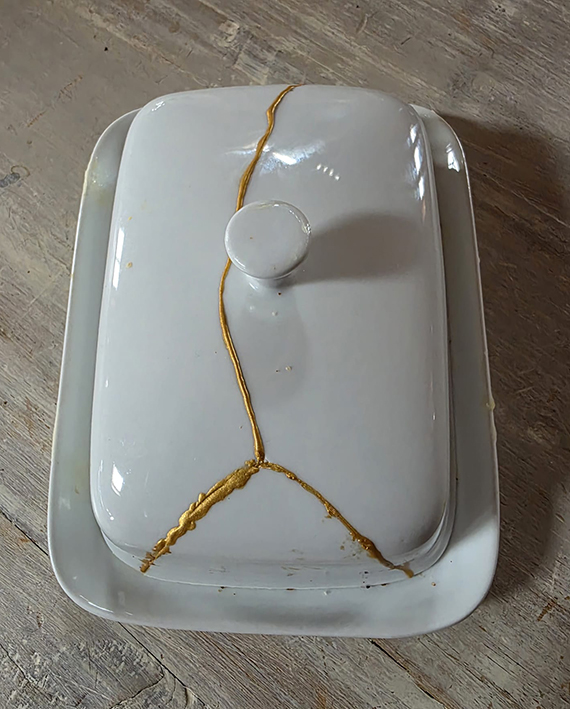
When I dropped a jar of jam on my favourite butter dish, I turned to Kintsugi to fix it…

Over at dVerse Poets Pub,  Mish in Poetics invites us to write about “Building from the Broken” which could be a reference to the Japanese art of Kintsugi, in which a broken piece of porcelain is mended with a glue containing powdered gold resulting in a new and enhanced aesthetic…

A to Z 2025 – Knitting (and Crochet)

I confess I am not a great fan of autobiographies that begin at the beginning and follow a temporal path up to the present day – not that the person might not have some interesting stories, facts and opinions strung on their necklace, but it just doesn’t appeal as a structure. On the other hand, in my last, extra year at school in Oxford, retaking an A-level and adding a couple more, I was allowed out of school on my recognisance and saw a fascinating Exhibition at the Modern Art Gallery. The Artist had laid out and photographed every single possession of a single person – for example, all the cutlery was laid out in one shot, all the shoes in another. This more thematic approach appeals more and although I am not arranging the objects which I have chosen to tell my story in chronological order, I hope that my writing will be sufficiently interesting to keep your interest Dear Reader, and that on the journey from A to Z, you will assemble an impression of my life and who I am…

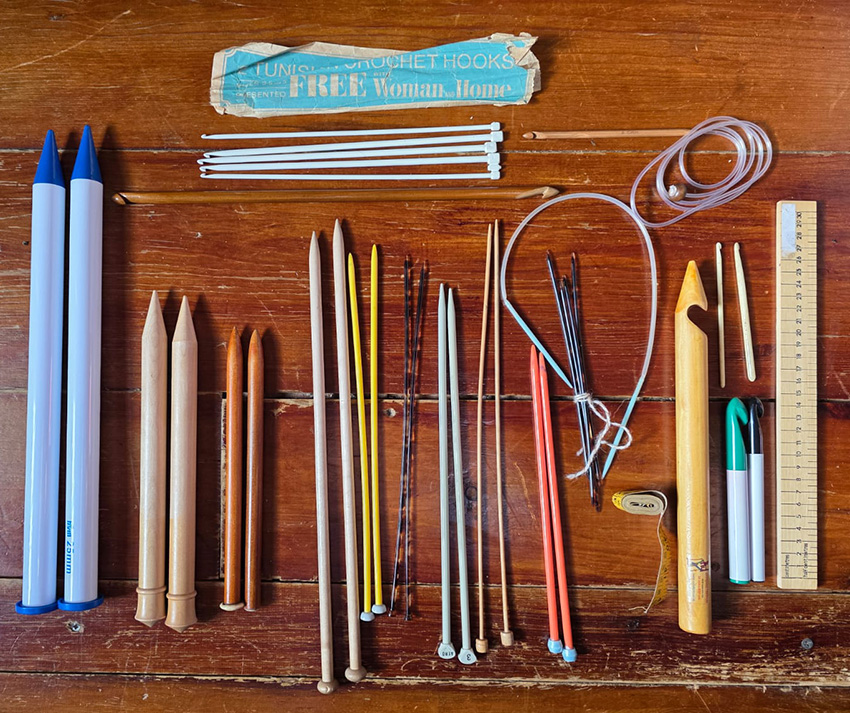
Knitting, Crochet, and Tunisian Crochet Needles. Top – Tunisian needles originally free with Women’s Home magazine, to the right, a Tunisian loop to allow long rows to be made, centre, a double-ended Tunisian needle. Main Row, left to right:- 1″ plastic knitting, 1/2″ wooden knitting, 1/4″ wooden needles, wooden, yellow plastic, plastic tortoiseshell, plastic, bamboo, orange plastic. A loop needle for knitting socks and a set of double-ended needles -the old way to knit socks. On the right side, there is an extreme crochet needle, two ivory and two plastic crochet hooks, a wooden ruler, and a cloth tape measure.
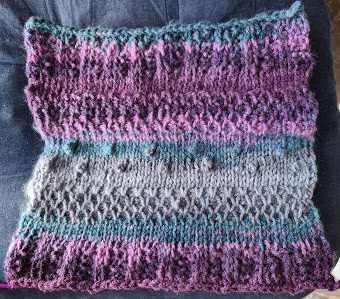
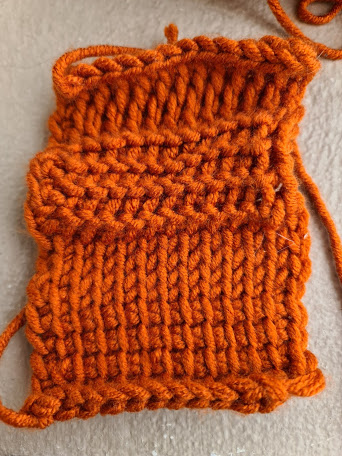
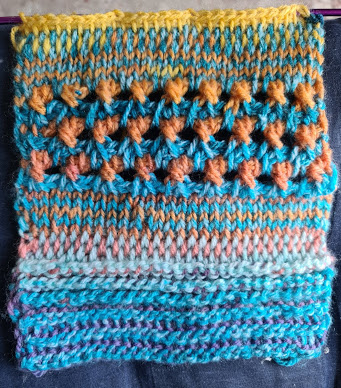
A sampler of Tunisian Crochet stitches done during lockdown – read more here

Knitting and Crochet

Why do I like to knit or crochet? To be sure, since this a kind of memoir, my mother knitted and passed on the bug to my late sister Carol, and I may have been shown how to knit too, but I think the real reason I like to experiment ith stitchcraft is simply the magic – and the perpetual attempt to understand how it works. Knitting offers the same fascination as watching a conjurer, (magic is a concept, not a real thing)and trying to work out how the illusion is carried out – except that knitting is real and produces tangible, useful and beautiful results – if you don’t drop a stitch, that is… I would say that I do understand the process now, especially with Tunisian Crochet and so now, the quest is to finish projects, something I am not always good at doing.

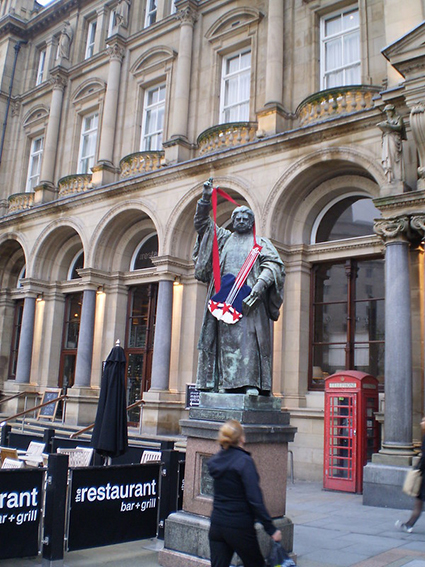
The work of the guerrilla knitting group “Knit a Bear Face” which I joined for a time in Leeds – you can see more of their activity and read my poem referencing them here

Part of understanding how it works relates to my wider skill as a designer – I want to understand how things are made, which in knitting means increasing and decreasing rows in order to shape the panels that will be sewn together to form a garment. I once did an evening class in Dressmaking where I learned to make myself a shirt – a project that covers many of the skills needed in dressmaking, cutting to pattern, gathered joins, pleats, cuffs and collars and buttonholes. I was living near Brixton, London in those days and as the only male and only white person (other than the teacher, a sometime dressmaker to the Queen’s ladies-in-waiting), I was a source of wonder and amusement to the West Indian matriarchs who made up the class. My father’s contribution to the family’s knitted clothes was to operate the Knitting Machine, which my mother found too technical to master. My partner feels uncomfortable seeing me knit whilst we watch TV (her father wouldn’t have been caught dead knitting), but there are many countries where it is considered normal for men to knit, sew and even embroider – let us not forget the great Kaffe Fassett. When I joined the guerrilla knitting group “Knit a Bear Face” who used to meet in the Victoria Arms, Leeds, I found both men and women happily knitting together.

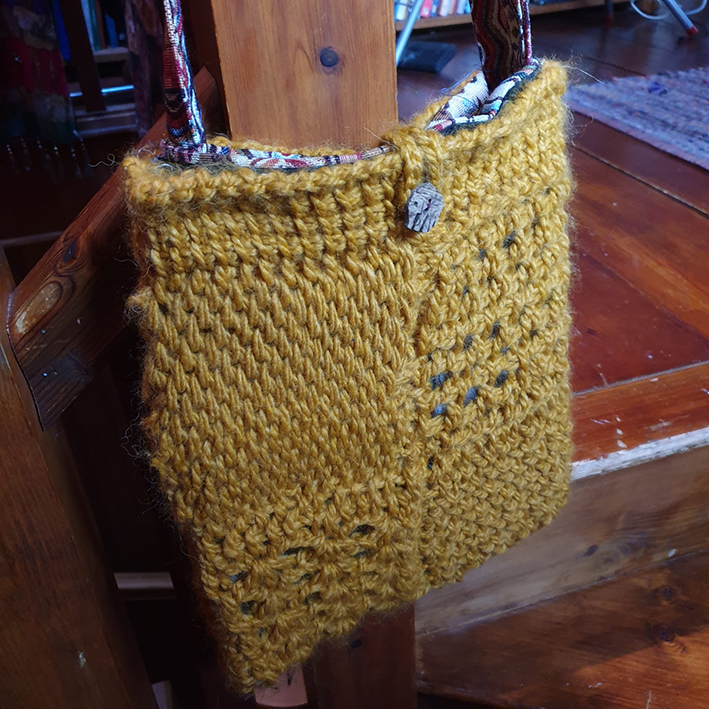
A Tunisian Crochet shoulder bag I made as a present – like all woolen baga it needs a sturdy lining to stop it sagging…

What is Tunisian Crochet, you may ask, and how did I get into it when in truth, I don’t know how to do ordinary crochet. Well when my mother died and both my sisters and myself were sorting out her apartment (a rare conjunction of the three of us), Carol and I were going through her many knitting needles – both Carol and my mother ran knitting groups and although Carol could probably have deployed the lot in her groups, she insisted that I should have some too. After most were divided, there remained a beautiful tortoiseshell pair of teedles (plastic – no tortoises were hurt in the making of them), and a curious long wooden needle with a hook like a crochet hook at one end. Neither Carol nor I knew what it was for – there is no need for a crochet hook to be long since it never holds multiple stitches, so Carol made an executive decision, “I’ll have the tortoiseshell ones and you can have this!” and she thrust the curiosity at me! Sisters! After I was back at home and I did a bit of research and discovered that this was a needle for Tunisian Crochet – sometimes described as a cross between knitting and crochet, and although the results can resemble either, in fact, it is not like either! I am going to have a little rant against the stitchcraft publishing industry – once upon a time, books of stitchcraft would contain both knitting and crochet and even give patterns which combined the two – a jersey with a panel of crochet inset, for example. But the plethora of books and magazines devoted to crafts has led to ever more specialisation – not just crochet, say, but beaded crochet – all in the hope of selling more copies. So Tunisian Crochet became overlooked for a long time, and it is only by the democratising process of YouTube videos that it is now making a comeback.

So why would you want to employ Tunisian Crochet in a project? Well. it produces a much thicker fabric, which is both stiffer and warmer, and so ideal for say, a coat rather than a cardigan. It has many varieties of stitch giving it lots of different looks, and IMHO, it is very easy to learn – go on – give it a go…

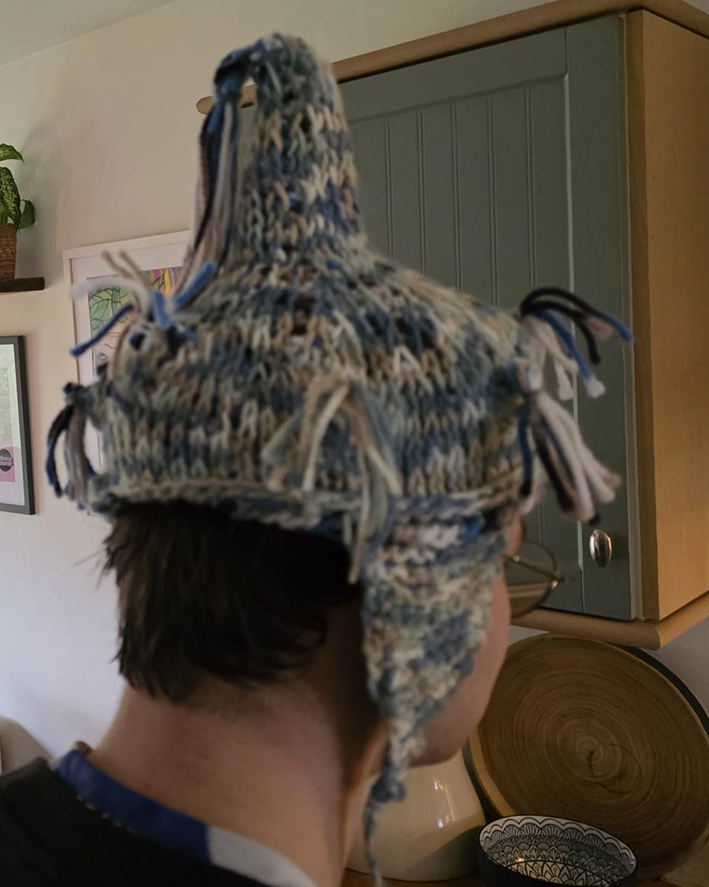
This hat was done as a continuous circle Tunisian crochet and is currently travelling in South America with one of my grandsons – he has promised to send a picture of him wearing it in Machu Picchu…

Other posts on stitchcraft:-

Lockdown Craftiness…

 My partner and I decided to spend the winter escaping the virus in the relative safety of Crete and rented two doors down from her sister in Mavrikiano, Elounda. barbara and Virginia plunged into knitting and eventually the itch to stitch got to much and I purchased a double-ended crochet needle from one of the knitting shops in nearby Agios Nikolaos before the lockdown was clamped down even tighter than in the UK. 

I have only made some samplers to explore new stitches in Tunisian Crochet which is my thing and to stitch with alternating colours on the pairs of rows. I can give more details if anyone is interested…