I thought myself chosen as the moon kept pace with our car speeding home through the night my sister’s squabbling before falling asleep I told no one of how the moon was watching me occasionally, hiding behind clouds but always reappearing the face of the man in the moon communing with me
By teenage years I knew the truth the moon was, well, just a moon a celestial body orbiting the Earth sloshing its waters around to create the tides and allegedly influencing lunatics and mayhem in the general population
If a god had made the world then what a trickster to make the circumference of the Moon, the same as the Sun seen from Earth giving rise to panic-inducing eclipses when peoples as primitive as my younger self felt their personal connection to the god’s of the heavens imperilled
Eventually, I owned a telescope and gazed at the moon afresh as it moved slowly across my field of view, its details craters and “seas” in sharp relief and at the outside of the sphere the crater walls visible as a ragged edge and I saw with newfound clarity that we live on a planet with a companion moon in the vast space between the stars and I was once more in awe…
I would love to have a muse, I think faced with a blank page or a knotty prompt she would be there in a blink with ideas and inspiration chewing the cud, I imagine her gifts to me quite gratis she would require no acknowledgement of our collaboration a relationship too good to be true
Why are muses generally “she” or is it in opposition to the poet’s gender – opposites attract and all that can I pay to go on a course to get my gal is there an Agency for muses that pairs you up like speed dating could AI write me the perfect letter of application – guaranteed to find the perfect match a muse for life – no shallow fling here today abandoned to blank page tomorrow
Instead, if I choose to accept this prompt or if I wake with an itch that only the laying down of poetry can sooth I face each piece of poesie on my own, flying solo never knowing where the words will take me on today’s adventure but within a moment the idea arrives the point of departure then buckle up for the ride here goes blue sky thinking…
If only I had been born Catholic a Saint for every occasion Saint Anthony would have been on speed-dial since I was always losing things I was well known for it—that and forgetting what I was going to the shop for but now I have acquired the habit of carrying a little black notebook sadly not for the phone numbers of paramours but that I might return from the shops with what I went for, amongst other things and when, as a vicarious observer of the sainted folks, I heard of Saint Jude, Patron Saint of Lost Causes I had a sneaking affection for him I bet he would know how to help a serial forgetter of shopping.
At the eleventh hour we stop for tea biscuits – bourbons, custard creams and digestives birthday cakes for birthday boys and girls we see abstemious or decadent their choice lives or dies, pointer to their personality but cake is cake, no judgement do we give anything that elevates the office day is most welcome so we always like to say a merry office band forged in this routine so that whatever friction there has been dissolves in tea, lasting discord seldom seen…
Is poetry a written form or is it meant to be read aloud if only by the voice in your head Concrete poems would convey nothing of their shape by recitation whilst Limericks demand reading aloud their ribald rhymes no hesitation and if as poet you hope for someone else to do the honours consider giving a little guidance in the matter of delivery a comma gives the slightest pause especially midline for line breaks require not the little tadpole or even a period’s emphatic end I like a space hyphen space to indicate a slightly Longer pause or see line three for a positive gap a dramatic pause a pause for effect
In Ulysses James Joyce gives us a manifesto for stream of consciousness but Virginia Woolf in Mrs Dalloway reads so much easier the stream guided with a modicum of punctuation
Unlike composers of music we poets are not tyrants issuing cryptic instructions in superscript for volume and speed forte and piano andante and lente leaving limited room for conductors’ interpretation we poets trust our readers to read and rehearse to infuse the best intonation
The semicolon has no place in poetry or fiction that tadpole crowned with a dot and do all questions require a question mark I’ll let you be the judge
And so to round off poems stories and comments my addiction is to the ellipsis whose merits I have debated with tonight’s muse and I think she is persuaded that it means so much more than duh duh duh for me the ellipsis leaves a little open forgoes finality invites contemplation if not response and so I give you an imaginary ellipsis
I sometimes wonder if the internet was made for people to share their 101’s with others first came porn, stimulating the medium just as it had with home cine film then the cat lovers started sharing cats doing the strangest things long before AI allowed you to craft such behaviours to order
Companies got in on the act and no firm was complete without its website schilling its wares in better or worse fashion after all, you get what you pay for with advertising and websites
Steadily, though, in the background the democracy of individuals shared their passions in ever more sophisticated 101’s. How to make kombucha, kimchi, and sauerkraut How to do Tunisian Crochet and Why You Should 4 Ingredient Low-Carb Bread seedy crackers, cottage-cheese cheesecake recipes from every culinary tradition and country liberally seasoned with adverts As 101’ers try to monetize their craft
But where is Break-up 101: 50 Ways To Tell If Your Relationship Is On the Point of Collapse – is this too negative for jaunty bloggers will it fail to garner followers and accrue comments old-timey newspapers and women’s mags had Agony Aunts who responded to readers’ letters “Dear Joyce how will I know If he loves me so…?” And songs dispense wisdom “There must be 50 ways to leave your lover” “Should I stay or should I go now If I go there will be trouble And if I stay it will be double”
Did the meme of inevitable collapse fail to make the grade on the World Wide Web or am I just stuck in the wrong silos…
Over at dVerse Poets Pub, paeansunplugged in OpenLinkNight, Uncategorized, invites us to submit a poem of our choice… I wrote this in my writing group in the shadow of “My Mother’s Love” by James Allen Hall to the prompt, “Write about a time when collapse was inevitable…”
Something old, something new Something borrowed, something blue And a sixpence in her shoe.
Something blue blue notes? Blue Moon full twice in a month Singing the Blues but not today – getting married in the morning! this morning no more Harvest Moon fear and fumbling stripping off something borrowed – for the hope of fertility Making Whoopee though we know how that ended up will you still love me When I’m Sixty-four? – there may be trouble ahead Stormy Weather Life is an ocean Love is a boat put a sixpence in my shoe here goes nothing…
Early travels were a few streets abroad, playmate in the next street baptismal church next one over holidays added Swanage, Scotland the Lakes, the Scillies but sailing to Australia (flying was too expensive then) added a swathe London – Tilbury Rotterdam and Lisbon, Dakar Cape Town, Durban destination Perth – W. A. Epic train rides Kalgoorlie to Port Pirie on to Adelaide and Melbourne, Sydney driving up to Brisbane, Gladstone back to Melbourne and sailing home Wellington and Rarotonga Tahiti and two weeks empty Pacific – as long as many holidays now Acapulco on Christmas Day then Panama Caracas fuel then Port-of-Spain Southampton and back home again. School trip – Vichy Uni field trips Aix-en-Provence Isle of Arran illicit love to Paris and Malta via France, Italy and Sicily, Tenerife standing above the clouds atop smould’ring Teide holidays to Santorini Naxos and Crete almost living for six months Covid lockdown new home Ireland then relocate to West Yorkshire – songs in Iceland, drive Morocco, the Green Heart of the Netherlands… Now a few streets are become an expedition I vacation still, the very world in my mind’s eye…
Merril D. Smith – a dVerse Poets Pub aficionado and I have made a collaborative project over on Collaborature, run by another dVerse luminary and friend, Melissa Lemay!
Rousseau Exchange #1
by Merril D. Smith and Andrew Wilson
Dear Merril,
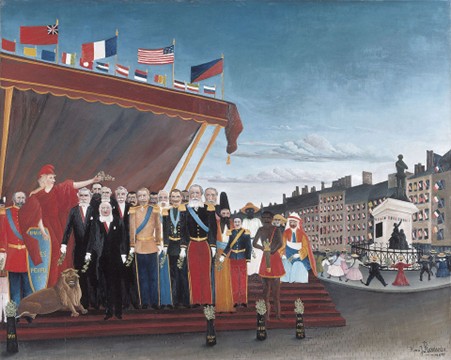
I confess I am quite envious of your recent visit to the Henri Rousseau Exhibition since I have never seen his work in the flesh and I suspect it is even more vibrant than the many reproductions suggest. I wonder if the painting The Representatives of Foreign Powers Coming to Greet the Republic as a Sign of Peace was one of the paintings you saw?
For a celebration symbolic of Peace why are there so many military uniforms in evidence?
Why is the celebration of the Republic by citizens dancing more convincing than Rousseau’s imaginary “photo-op”?
How did the delegates who only merited small flags wave their Olive branches with greater vigour to compensate?
Did the French people, whose fields hosted the First World War appreciate the true irony of this painting…?
Best – Andrew
Dear Andrew,
Thank you for your letter. I send you good wishes on the autumn winds blowing here, but who knows what destruction they will bring.
I did not see The Representatives of the Foreign Powers Coming to Salute the Republic as a Gesture of Peace at the exhibition. Did you know Picasso once owned it? And that he threw a party for the artist, nicknamed “douanier,” the customs officer—though he called Rousseau a joke.
Perhaps, it’s not irony, but innocence, a painting painted before either world wars,
perhaps it’s optimism or hope. Mostly, I wonder about the lion. Rousseau seemed very fond of lions.
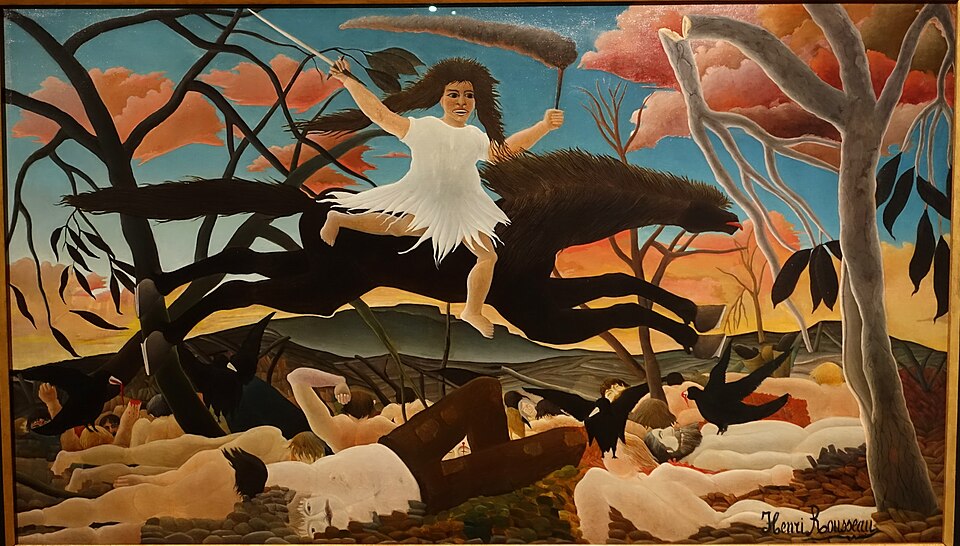
I think about his earlier work, La Guerre painted in 1894, with its avenging-revenging goddess, an otherworldly horse, a nightmare scene of broken bodies and devouring crows, no attempt to make it heroic, this is visceral, brutal–
yet when I look at it again, the white torsos of the fallen men seem almost angelic.
What do you think, Andrew?
Rousseau Exchange #2
by Merril D. Smith and Andrew Wilson
Dear Merril
Thank you for your good wishes, borne on the wind, sooner or later, every breath of America wends Eastward you may have to wait a little longer for mine to reach you West-about…
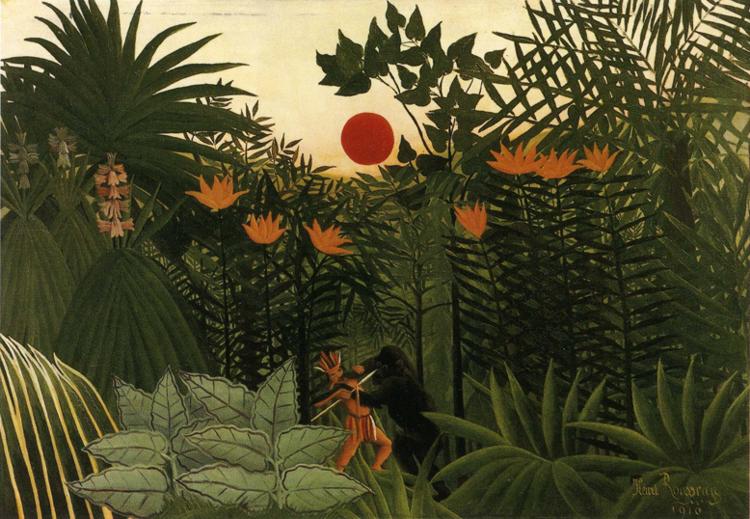
I agree that the lion is fascinating, not just because, it is suggested, it represents French power, and as such, looks remarkably docile; but also, the lion is very strange looking. Rousseau was considered a Naïve or Primitive artist, but that doesn’t mean he can’t draw well but he had never been outside France, his animals are taken from illustrations in children’s books, and tableaux of taxidermy wild animals.
why did Rousseau choose to make the figure of War female why is the French word for war, La Guerre feminine
dressed in blinding, angelic white as she leaps from her jet black horse brandishing a sword and Death’s scythe to alight on the field of the fallen
is it for modesty that the one fallen person on the battlefield whose front we see is fully-dressed – all others naked…
even before the big guns of the First World War cannons could lay waste to trees as well as people
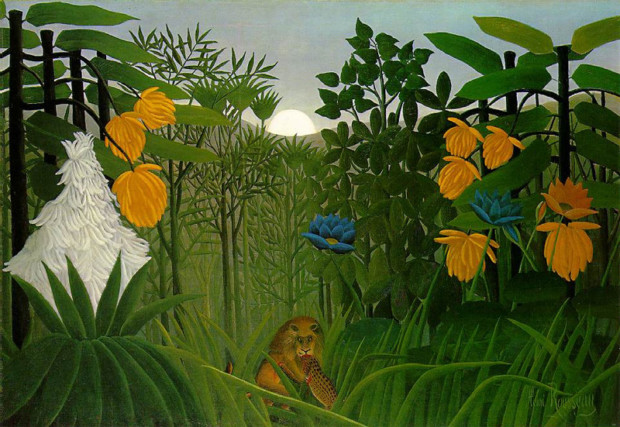
Here is another Rousseau painting of a lion “The repast of the Lion” – this time its head is quite lion-like…
if artists only painted what they had seen with their own eyes and writers wrote only what they had experienced though passed by the sensitivity readers would we survive the dullness of reading or looking…
if the jungle was so plentifully provident of bananas would we have ever left the trees and evolved
did the lion get indigestion from wolfing down the crocodile headfirst and how well hidden are the elephants in Rousseau’s hothouse jungle
What are your thoughts, Merril?
Dear Andrew,
Thank you once again for your letter and good wishes. With climate change, who knows when and where the winds might blow? Or where they might blow us.
As for war and lions—it’s impossible to know what Rousseau was thinking.
Perhaps the lion was symbolic— lying down with peace?
Perhaps it was merely fantasy or exoticism.
War, “la guerre,” must be female, I suppose. But this one is striking, a savage, feral child.
Not that era’s ideal image of childhood or womanhood, for that matter. No sugar and spice there. Only blood.
Nightmarish.
A curator said Rousseau was a story-giver, not a storyteller—the pieces there, for us to weave together.
Perhaps it’s better then, not to wonder what he intended, but simply to see where the images take us.
Did you know his lawyer got him acquitted— in a trial for passing bad checks—
he told the judge Rousseau was too naïve to commit the crime, just look at this painting, he said, where an American Indian wrestles with a gorilla.
Rousseau probably knew what the lawyer was going to say,
maybe even wrapped that persona around himself, wearing It proudly, the naif, the self-taught genius, he was extremely self-confident, it seems.
I can see how his work with its dream-like quality
appealed to the surrealists,
But in fact, I’m still not certain if I like it.
No, I take that back, I like some of it,
I do have a fondness for dreams.
You mentioned the odd-looking lion, but Andrew have you seen the children Rousseau painted?
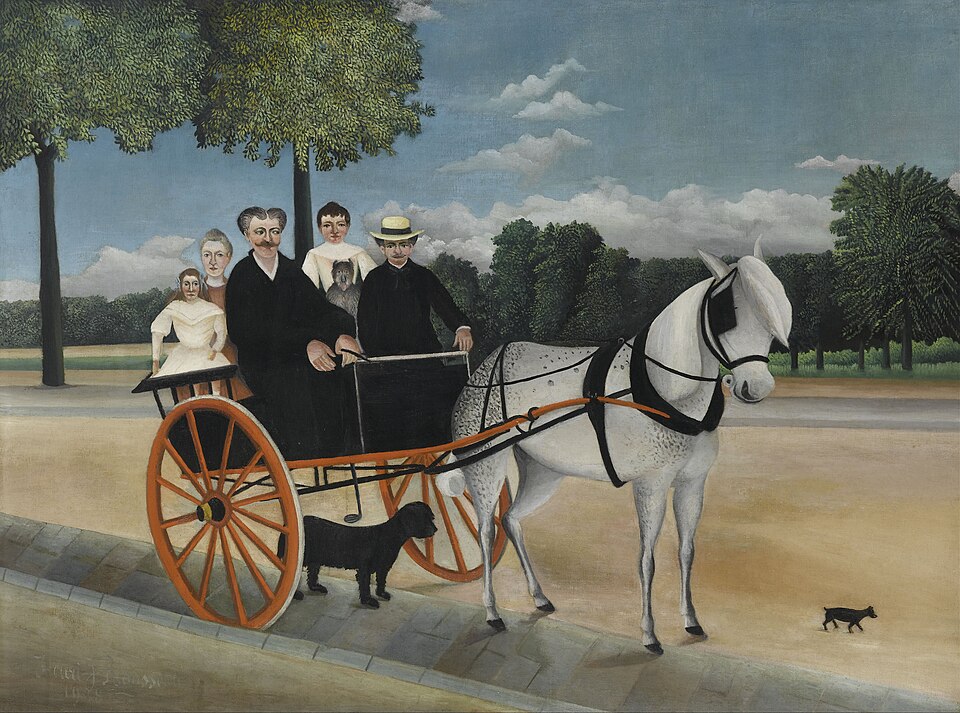
Look at the daughter in the carriage here— how tiny she is! How large the father driving! And the dogs. I think Rousseau must have liked dogs.
There is a third and final post to come and I will append it here when it “drops”!
A rose called Afternoon Delight Recalls love, perhaps a person But the good Baroness Rothschild And her erstwhile husband, Baron With roses, we commemorate Their wealth and rank of State With both hybrid and heritage Bush Rose’s names and image But who was the Beautiful Girl Who FloribundaBetty Cuthbert Perhaps a veryBlushing Knockout Or a Brilliant Pink Iceberg Be we infamous or famous Will a rose one day recall us…
Over at dVerse Poets Pub, merrildsmith in Poetics invites us to celebrate the names of roses, a long list of which you can find here (from which the photos are taken).